Picturing Shakespeare’s characters

My last post was about processions of people dressed as Shakespeare’s characters, especially in relation to David Garrick’s The Jubilee. It’s as if they have a life independent of the plays, so nobody would be surprised to see Falstaff, Juliet or Shylock walking down the street. But artist have also imagined those characters and have also placed them outside the play in which they appear.
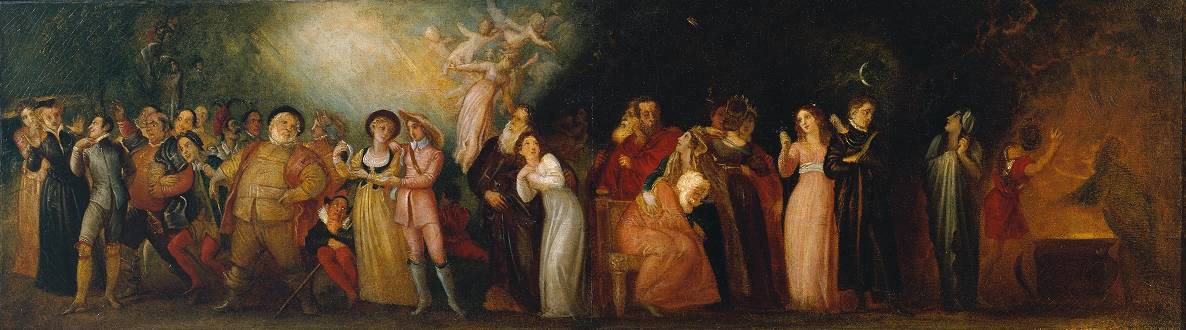
Thomas Stothard, Shakespearean Characters. Tate Gallery

Thomas Stothard, Shakespearean Characters. Tate Gallery

The 1709 edition of Shakespeare’s works, for the first time included illustrations of Shakespeare’s characters, as opposed to portraits of actors in costume. The first major exercise in creating paintings of Shakespeare’s characters was the Boydell Shakespeare Gallery that operated from 1789 to 1805. This major project allowed artists to interpret scenes from Shakespeare’s plays as well as imagining some of the scenes he described. The choice of characters and moments from the plays are often the most popular on stage: the ghost appearing to Hamlet, Falstaff being bundled into the buck basket. But sometimes the artists responded to Shakespeare’s descriptions of events such as the murder of the princes in Richard III and the horseback entrance into London of Richard II and Bolingbroke.

But I’ve come across other representations of Shakespeare’s characters from the late eighteenth and nineteenth centuries that strongly remind me of David Garrick’s onstage procession in The Jubilee. The earliest was by Thomas Stothard, whose painting Shakespearean Characters, shown above, was exhibited in 1813. It’s in the form of a frieze, as is his most famous painting, The Pilgrimage to Canterbury, based on Chaucer’s Canterbury Tales. Stothard, born in 1755, would easily have been old enough to see Garrick’s spectacular piece The Jubilee when it was staged between 1769-1776, and he had already shown his interest in Shakespeare by contributing paintings to the Boydell Gallery.
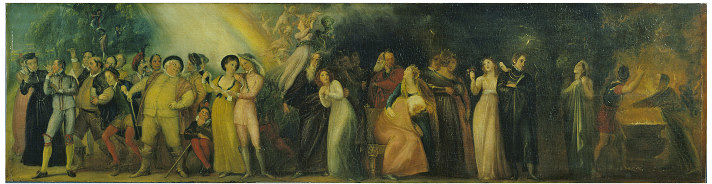
Thomas Stothard, Shakespearean Characters, Victoria and Albert Museum

Thomas Stothard, Shakespearean Characters, Victoria and Albert Museum

This must have been extremely popular as several different versions still exist. The largest is the one at the Tate Gallery, over 2.5 metres long and nearly 1 metre high. The Victoria and Albert Museum has another, 1.4 metres long, and there’s also a watercolour version at the Whitworth Art Gallery, Manchester (no.D.38.1892).

The second painting I came across was Procession of Characters from Shakespeare’s Plays, dating from around 1840. This was formerly attributed to painter Daniel Maclise, who painted one of the most famous pictures of the play Scene from Hamlet. The actual painter is unknown, and the painting is at the Yale Center for British Art.
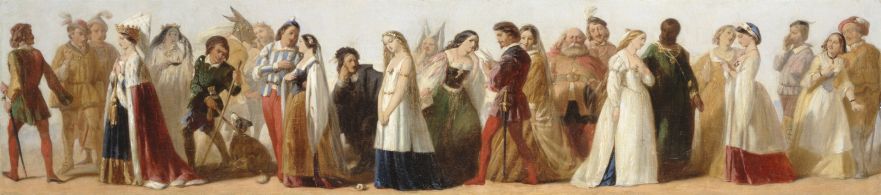
Procession of Characters from Shakespeare's Plays, formerly attributed to Daniel Maclise

Procession of Characters from Shakespeare’s Plays, formerly attributed to Daniel Maclise

Another similar painting that I spotted some time ago (illustrated below), was Sir John Gilbert’s The Plays of William Shakespeare, from 1849. Gilbert too did extensive work on Shakespeare, with his dramatic woodcuts decorating an 1858-1860 edition of Shakespeare’s plays.

The choice of characters indicates the relative popularity of the plays. Stothard, as in the Garrick procession, divides his characters into comedy and tragedy. From the left are characters from Twelfth Night including Olivia and Malvolio, then Falstaff and others from The Merry Wives of Windsor, and Rosalind and Celia from As You Like It, while on the right are Lear and Cordelia, Ophelia and Hamlet, and the Macbeths with the weird sisters. In the centre are Prospero and Miranda from The Tempest, no doubt because Prospero was thought to represent Shakespeare himself. The scenes are very atmospheric, with much use of light and dark.

By contrast the 1840 frieze is rather bland, with no sense of drama, none of the genteel characters doing anything that might upset or offend. On the left is a figure looking like the young Queen Victoria in her coronation robes, followed by characters from a large number of plays: Lady Macbeth, Launce and Crab from The Two Gentlemen of Verona, Bottom from A Midsummer Night’s Dream, figures from Romeo and Juliet, Hamlet, The Taming of the Shrew, The Merry Wives of Windsor, Othello and Twelfth Night.
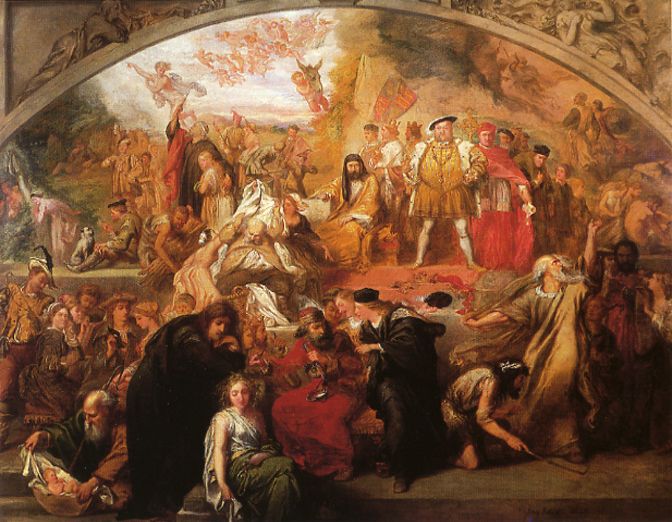
Sir John Gilbert's The Plays of William Shakespeare

Sir John Gilbert’s The Plays of William Shakespeare

Gilbert’s painting is full of dramatic action and a galaxy of characters. In the foreground there’s a sort of cradle to grave progression with the finding of baby Perdita in The Winter’s Tale, Hamlet and Ophelia, Shylock and Portia, and Lear in the storm with Poor Tom. Further back are Henry VIII and Wolsey, Falstaff and the merry wives (with the washing), Prospero, Miranda and Caliban. Launce and Crab appear again, and characters from A Midsummer Night’s Dream are rather strangely tucked away. Some of the characters are in famous poses, such as Henry VIII, straight out of a Holbein painting.

There must be many more images of Shakespeare’s characters, but the one I keep thinking of is George Carter’s The Apotheosis of Garrick. Painted in 1782, after Garrick’s death, it shows him being raised to Mount Olympus to be greeted by Shakespeare and the Muses of Comedy and Tragedy. Bidding him farewell are the actors, in character, known for appearing with him in Shakespeare’s plays, varying from the most popular like Hamlet and As You Like It to the less known Measure for Measure and Cymbeline. I know the painting well because it once hung in the RSC’s Picture Gallery. It’s now in store, but here’s the link to the BBC’s Your Paintings website where it can be seen. Looking at the painting now I wonder if it too refers to The Jubilee, when some of the actors portrayed must have appeared in that spectacular procession of Shakespeare’s characters.

Share
Posted in Legacy, Shakespeare on Stage | Tagged , , , , , , , | Comments Off on Picturing Shakespeare’s characters

Taking to the streets with Shakespeare’s characters

The Procession at the Jubilee at Stratford upon Avon [London, 1769].  From the collections of the Lewis Walpole Library, Yale University

The Procession at the Jubilee at Stratford upon Avon [London, 1769]. From the collections of the Lewis Walpole Library, Yale University

Shakespeare celebrations in Stratford have taken many forms over the past two and a half centuries. I’ve written before about the history of holding feasts, an essential component of any party. But what’s also notable is the tradition of characters from Shakespeare plays processing through the town.

The most famous illustrations of the subject are the two engravings of costumed characters published in 1769 for David Garrick’s Jubilee. This procession was planned to be a striking part of the three-day festival, but it had to be abandoned because of the torrential rain that would have ruined the theatre costumes. Presumably the prints were made in advance, in the hope of selling them as souvenirs, though it’s also possible they were published when The Jubilee was turned into a separate entertainment at DruryLaneTheatre in London a few weeks later. Garrick must have had an inkling that he had a hit on his hands when the competing theatre in London, Covent Garden, got in first and staged a pageant of Shakespeare characters before Garrick’s was ready. This competition seems to have encouraged him to turn the show into the spectacular it became.

In The Jubilee, Garrick gave his great ode, the focus of the Stratford celebrations, choirs sang the song from Stratford, and the procession was the climax of the performance. The little engravings of the planned Stratford procession show only 24 characters, but in the theatre it assumed a much larger scale. Garrick insisted that actors came on appropriately costumed in the roles for which they were well known. Garrick himself came on as Benedick from Much Ado About Nothing.

Continuation of the Procession of Shakespear’s Characters [London, 1769].  From the collections of the Lewis Walpole Library, Yale University.

Continuation of the Procession of Shakespear’s Characters [London, 1769]. From the collections of the Lewis Walpole Library, Yale University.

This may explain one of the oddities of the engravings. Most of the characters are identified by a quote, but the second illustration prominently shows a couple who could be any of Shakespeare’s romantic couples. If the man is Garrick, the most famous actor of the day, as Benedick, he would have needed no explanation.

Vanessa Cunningham, in her book Shakespeare and Garrick, describes the “spectacular all-singing-and-dancing finale” on stage. “He used the processional entrance of the statue of Shakespeare, led by Apollo and supported by the Passions and surrounded by the seven muses with their trophies, to separate the groups of comedies and tragedies” Each play was identified with a banner and the actors held props appropriate to the character. She continues:

The impact of the spectacle must have been terrific. The Tempest featured not only drunken sailors, Ariel, Prospero and Miranda, but also a ship in distress sailing down the stage. Falstaff, Mrs Ford and Mrs Page were on horseback, and after Macbeth and Lady Macbeth came a burning cauldron drawn by four demons, Hecate and three witches following. Oberon and Titania rode in a chariot drawn by butterflies. The Comic and Tragic Muse each had her own chariot, and was appropriately attended: Venus and Cupid, satyrs and lovers for the former; furies, with Fame, Grief, Pity, Despair and Madness for the latter. Including dancers and singers, the script specifies entrances for at least 320 individuals, three horses and one dog (Crab). 

The Jubilee set a record for London productions, being performed 153 times between 1769 and 1776. Those little engravings don’t begin to do the London version justice, but if you’d like to find out more about them, there are two detailed posts on them in Kathryn James’ Remembering Shakespeare blogposts written on 2 and 3 May 2012.

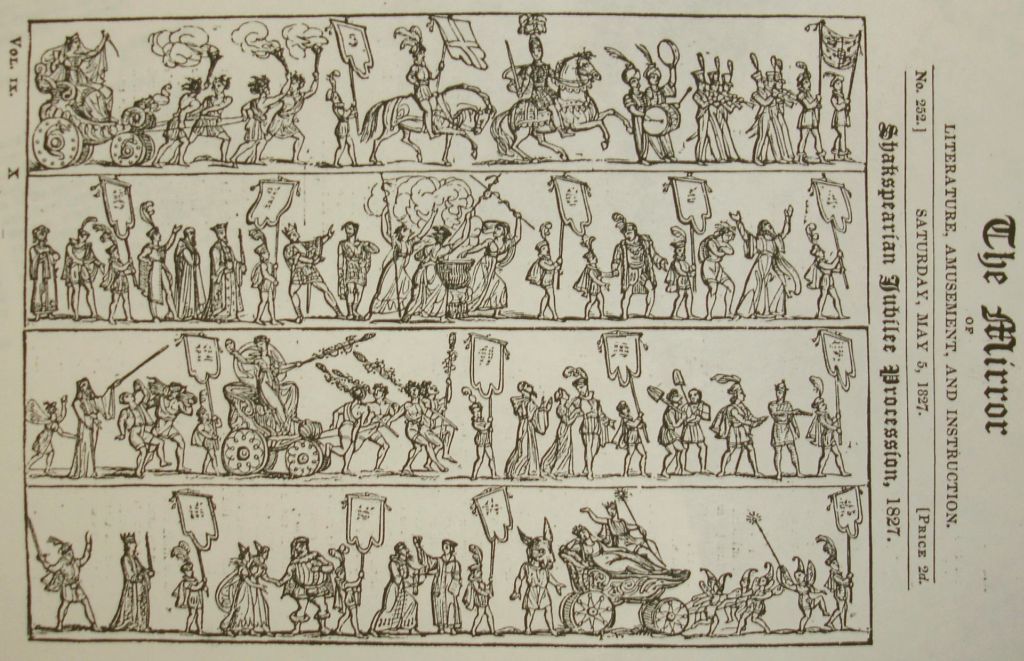
The Mirror, May 1827

The Mirror, May 1827

When, after a gap of over fifty years, locals decided to put on major celebrations of Shakespeare’s Birthday in Stratford, it’s perhaps not surprising that they went back to Garrick’s Jubilee. The first time a procession of costumed characters walked through Stratford was in 1827. The Shakespeare Club had been formed three years before to organise the celebrations, and this was their first big day. Luckily, the procession caused such interest that an engraving was published in The Mirror: literature, amusement and instruction, on 5 May 1827.  This engraving from the Folger Shakespeare Library’s collections can be examined in detail. We can see how it was influenced by Garrick’s Jubilee. Led by banners, first came a band, followed by Henry V and St George on horseback. The Tragic Muse on her chariot introduced among others King Lear, Richard III, Macbeth, and Hamlet, complete with gravediggers. Then the Comic Muse led characters from The Tempest, A Midsummer Night’s Dream (Oberon and Titania in a chariot drawn by fairies rather than butterflies followed by Bottom with his ass’s head), The Merchant of Venice and The Merry Wives of Windsor.

The procession began from the Guild Hall and wound its way all round the town before ending up almost back where it had begun, in Chapel Lane, to lay the foundation stone for the town’s first purpose-built theatre. The costumes had been hired from London, and those taking part included professional actors as well as locals. The Warwick Advertiser reported on 28 April that St George had been “ably represented by Mr William Tasker, junior, of Stratford”. The procession was watched by thousands.

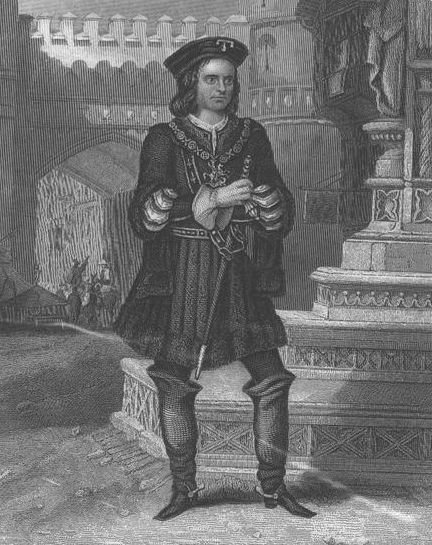
Charles Kean as Richard III

Charles Kean as Richard III

Three years later, in 1830, the procession was staged again. This was even grander than 1827. “Upwards of 75 of the more prominent characters of Shakespeare burst upon the sight at one view, with a vividness and splendour really astonishing.” “Thousands … blocked up the thoroughfare” and between 25,000 and 35,000 people were in Stratford-upon-Avon for “one of the grandest and most pleasant public spectacles ever got up out of the metropolis”. Professional actors and locals again took part. Twenty leading members of the Shakespeare Club rode in the procession on horseback and this time St George was personated by the twenty-year-old Charles Kean who later in the weekend played Richard III in the Chapel Lane Theatre. Kean went on to become one of the most important actors in the Victorian theatre.

These Stratford processions were, as far as I know, the first such outdoor processions featuring a writer’s characters, though I’d love to hear if not. Putting on these magnificent processions must have been a major undertaking for a small town with limited resources. Today processions rarely include Shakespeare’s characters, but the Birthday procession, the most integral part of the celebrations still attracts huge numbers of spectators and still poses a logistical challenge for the organisers.

Share
Posted in Legacy, Shakespeare on Stage, Stratford-upon-Avon | Tagged , , , , , , , , , , | 1 Comment

Erica Whyman and Buzz Goodbody: championing The Other Place

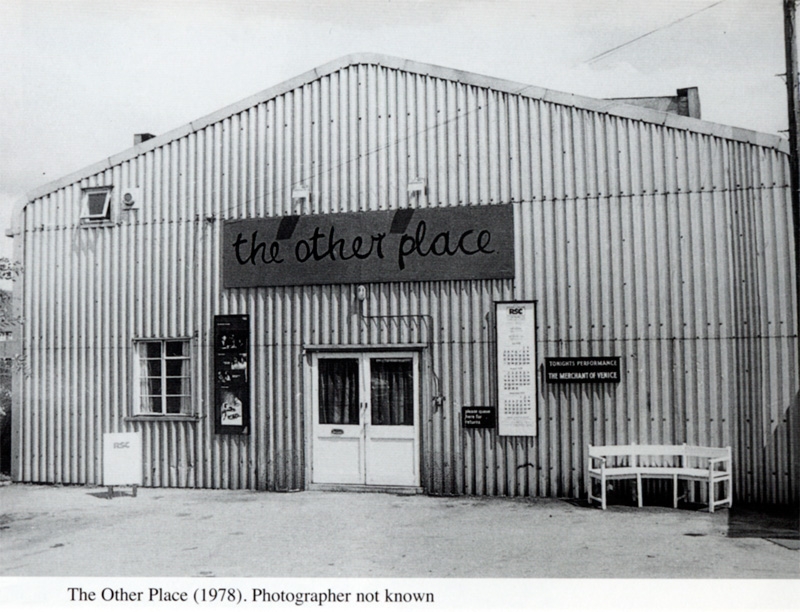
The first Other Place, 1978

The first Other Place, 1978

Back in July 2012 I wondered what the impact of having a young woman, Erica Whyman, as Deputy Artistic Director would be on the RSC.  Earlier this week I got the chance to find out when Erica spoke to the Stratford Shakespeare Club about her role and plans for the future.

She’s been given special responsibility for new work and the redevelopment and re-opening of the RSC’s studio theatre, The Other Place, and I was particularly keen to hear what she had to say about this: like many people whose memories stretch back to the 70s or 80s (and there are quite a lot of us), I have a special place in my heart for The Other Place.

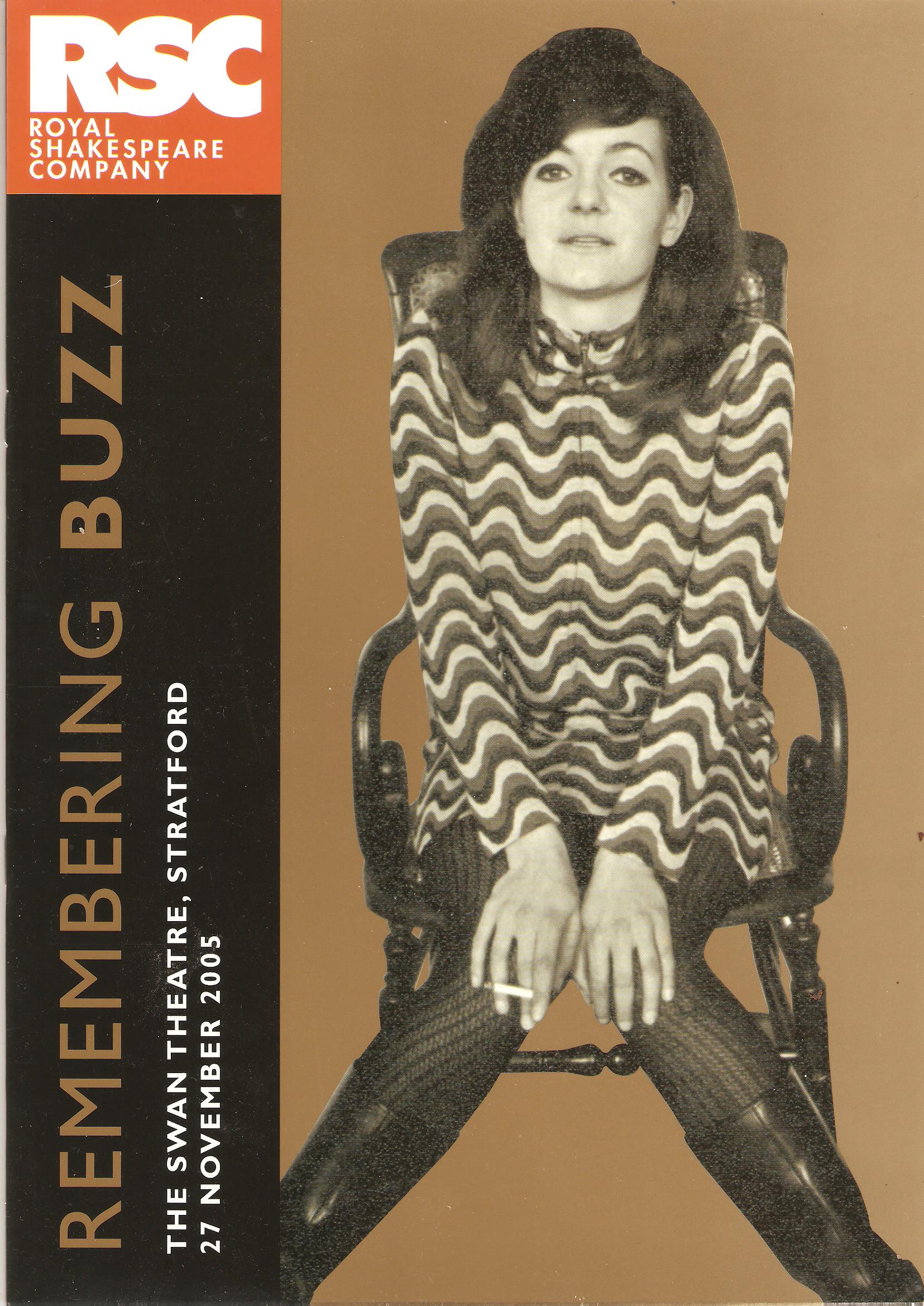
The first Other Place was a corrugated iron building that had first been erected in the 1960s as a rehearsal space. It began to be used for performances in 1973 as the Studio Theatre, but was renamed The Other Place under the leadership of Buzz Goodbody in 1974. Erica referred back to this, and to the manifesto in which Buzz set out her aims for the theatre. She had wanted this space to have a real influence on the RSC, allowing actors and directors the chance to experiment, the company to broaden the scope of their work, and new audiences to be attracted to it.

Remembering Buzz

Remembering Buzz

Buzz Goodbody’s manifesto was in part a political statement based on her socialist and feminist ideals. Forty years on, it’s interesting to see how another young woman defines what she sees at the function of TOP. Erica talked about good theatre: immersive, intimate, challenging, provocative, joyful. All words that could easily be applied to performances at TOP, and to the works of Shakespeare. She quoted the final scene of The Winter’s Tale: “It is required you do awake your faith”. At its most basic, and its most effective, theatre requires simply actors and an audience willing to believe in them. The original TOP had little or no budget, and neither it seems will the new theatre.

Erica Whyman calls her own aim “radical mischief”. Radical because she intends to revive the idea of using the theatre to question current events, and mischief because theatre is meant to be enjoyed, not endured. But like Buzz, she and Gregory Doran want to ask what kind of plays Shakespeare would be writing if he was here now. In the seventies Shakespeare was sometimes seen as part of the mainstream establishment, an enemy to the new.  But Buzz disagreed when she wrote for the RSC Membership magazine:
Shakespeare’s own theatre was a popular art form. Its strength and its richness derived from the social range of its audience as much as from the participants themselves. No one wants to reproduce the conditions of 1599, even if it were possible, but the challenge of closing the gap between the serious theatre and the bulk of society has to be faced.

Erica agreed: Shakespeare was a new writer, writing quickly and sometimes collaboratively. He wrote about the concerns of people of his time, but for political reasons had to disguise references to current events by setting them in the past, or in distant locations.

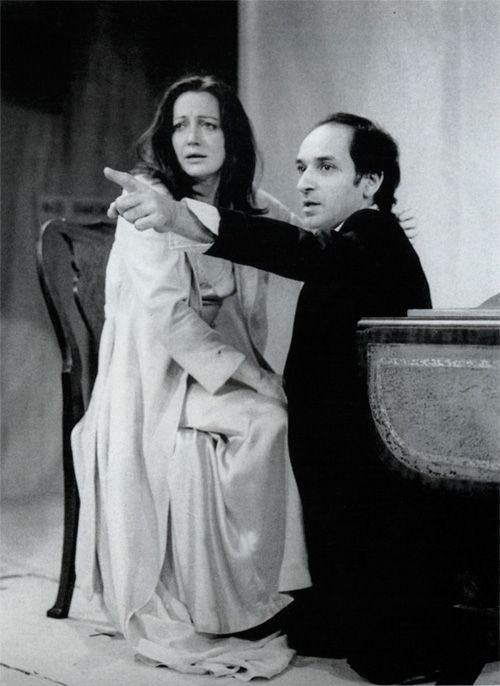
Mikel Lambert as Gertrude, Ben Kingsley as Hamlet, TOP 1975

Mikel Lambert as Gertrude, Ben Kingsley as Hamlet, TOP 1975

Buzz’s death could have dealt The Other Place a major setback, but the Artistic Director, Trevor Nunn, thought TOP’s work so important that he took personal charge. Sadly, it was her suicide that ensured her production of Hamlet got major press attention, as did subsequent work at TOP. The trademark no frills staging of The Other Place came to be often reflected on the  RSC’s main stage, notably in one of the company’s triumphs, The Life and Adventures of Nicholas Nickleby.

The hardships of the first Other Place were part of its charm: the first audiences had to sit on mattresses, later replaced by hard wooden seats and eventually padded benches. Some actors had to make entrances through the gents toilets, and there was no foyer, no refreshments, no reserved seating, and no showers for the actors. The repertoire included everything from Shakespeare and his contemporaries to new plays by Edward Bond, David Rudkin and Pam Gems. In 1989 after more than 15 productive years, the little hut had reached the end of its life, and was rebuilt. The 1991 auditorium was larger and more comfortable, but although still popular it was now competing with the charms of the Swan Theatre and its role seemed less well-defined. In 2006 auditorium of TOP became the foyer to the newly-built Courtyard Theatre.

Now a new Other Place is to be built within part of what is currently The Courtyard Theatre, and the best news is that during the summer of 2014 the space will be used for a short festival, and at the end of the year three plays will be staged marking the centenary of World War 1.

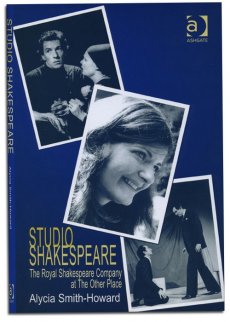
Studio Shakespeare

Studio Shakespeare

Alycia Smith-Howard’s book Studio Shakespeare gives an excellent account of the first TOP, in particular the Shakespeare productions. And in 2013 she wrote an article reassessing the subject for the online Early Modern Studies Journal in which she commented:
Artistic truth, emotional honesty, engaging audiences in acts of direct discovery, unencumbered by the proscenium or superfluous scenic detail – these are the lessons of The Other Place, lessons which are poignant and important for artists today, particularly given our current theatrical preoccupations with kitsch, gimmickry, and well-meaning gestures toward making Shakespeare more accessible. The Royal Shakespeare Company would be wise to cherish and remember the ideals of Buzz Goodbody and the ethos of The Other Place as they move forward into the next era of their history.

As Erica Whyman spoke, it seemed to me that although it’s nearly forty years since her tragic death Buzz Goodbody’s time may be about to come again.


Share
Posted in Legacy, Shakespeare on Stage | Tagged , , , , , , | 1 Comment

Shakespeare’s heroes on stage and screen

Simon Russell Beale in rehearsal for King Lear. Photograph by Mark Douet

Simon Russell Beale in rehearsal for King Lear. Photograph by Mark Douet

Shakespeare is never short of media attention, but just at the moment some of his heroes or at least his leading men, are much in the news.

This week King Lear begins its previews at the National Theatre, featuring probably our most highly-regarded stage actor, Simon Russell Beale, in the lead. Aged only 52, he’s reckoned to be rather young to play the role: it is after all only a few years since he played Hamlet. Lear claims rather confusingly to be “fourscore and upward, not an hour more nor less”, but one thing’s for sure: you need to be fit to get through it. The role includes physical challenges such as the storm scene and, at the end, the need to carry the dead Cordelia onstage while uttering the line “Howl, howl, howl, howl “. It was I believe John Gielgud, who when asked if he had any tips about playing the part, suggested you should cast a small actress as Cordelia. It’s really not a part for an old man.

Paul Scofield as Lear in 1962, RST

Paul Scofield as Lear in 1962, RST

Nor has it always been played by them: Gielgud first played the role aged 36, and Olivier was also in his thirties, though both had cracks at the part when older as well. Michael Gambon was only 42, and Donald Sinden was about the same age as Beale, 53, when they performed the role in Stratford, though more recently Ian McKellen was 68. The most renowned performance in living memory, that made many including academics think differently about the play, was Paul Scofield, aged 40 in 1962. Jonathan Bate has written a nice piece about the part in which he quotes the great critic Kenneth Tynan “Lay him to rest, the royal Lear, with whom generations of star actors have made us reverently familiar, the majestic ancient, wronged and maddened by his vicious daughters.”. Bate comments that “Scofield’s Lear was an irascible father, a difficult old man, as much sinning as sinned against.”

All tickets that have so far been released for Beale’s performance have been sold. I’m including links to a number of articles: a stage history and preview in the Guardian, and a terrific interview with Beale in the Daily Telegraph in which he talks about the role and much besides.

Tom Hiddleston as Coriolanus

Tom Hiddleston as Coriolanus

Meanwhile Shakespeare’s heroes are very much to be seen in the West End at the moment: Tom Hiddleston carries on as Coriolanus at the Donmar Warehouse. Tickets are hard to come by but it’s being screened as part of National Theatre Live on 30 January so it may be possible to catch at your local cinema. And Jude Law continues as Henry V at the Noel Coward Theatre in London until 14 February. Tickets are still available. Both have received excellent reviews.

It was announced a few weeks ago that Benedict Cumberbatch, best known as Sherlock, will be appearing onstage in London this autumn as Hamlet. Details have still not been released but it’s sure to be a very hot ticket. Cumberbatch is no stranger to Shakespeare, or to theatre, and has long dreamt of playing the Danish prince.

The statue of Hamlet, from the Gower Memorial, Stratford-upon-Avon

The statue of Hamlet, from the Gower Memorial, Stratford-upon-Avon

Finally I just wanted to put in a plug for the Shakespeare’s Hamlet: text, performance and culture online course which starts this week courtesy of Futurelearn. It’s planned and delivered by the Shakespeare Institute in Stratford and features many of their expert Shakespearians. I’ve only just got started, but have already enjoyed hearing and seeing the Director of the Institute, Professor Michael Dobson, talking about the various early editions of the play and look forward to much more including discussions of staging issues, with contributions from actors who have recently performed in it. There’s still time to sign up and best of all it’s completely free.


Share
Posted in Shakespeare on Stage | Tagged , , , , , , , , , | Comments Off on Shakespeare’s heroes on stage and screen

Illuminating the seasons difference

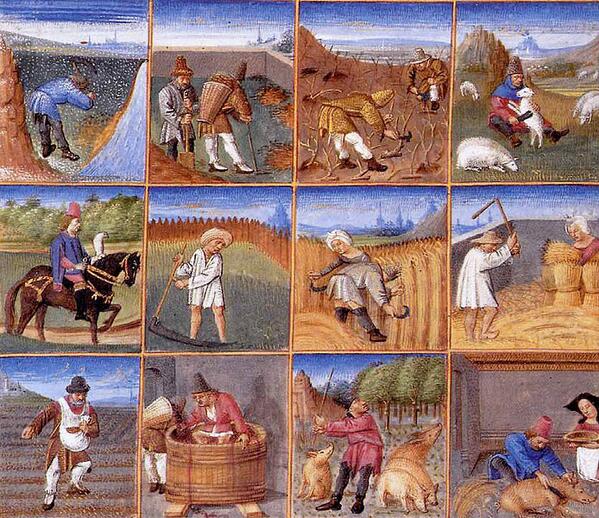
15th century agricultural calendarOn a miserable January afternoon I spent some time looking through some of the beautiful medieval illuminated manuscripts now available online. Just before the new year I had received a tweet including this calendar, each month represented by work done on the land. The only information I had was that it was by Pietro Crescenzi. The picture itself is easy to find: it’s reproduced many times on websites. But none of them explained more about the images, or the copy of the book in which they appear.

The book is Ruralia Commoda, written in Latin toward the end of the author’s life. Pietro Crescenzi was born in Bologna, Italy in the 1230s, and educated at the University there. Following a career as a lawyer and judge he retired to his country estate where he wrote the book, a treatise on agriculture. The book is organised into twelve parts, explaining different kinds of farming and land management, the final chapter being a calendar of tasks appropriate to each month of the year.

It proved extremely popular. Elaborately-illustrated manuscript copies were made, and it was first printed in 1471. By 1500 there were already 13 editions in print, 6 in Latin, 3 in Italian, 2 in French and 2 in German. Many copies still exist in Libraries around the world, and there’s a lot of information about them online: pages from Harvard University and Reading University for instance, and images from the Pierpont Morgan Library copy are posted on Pinterest.

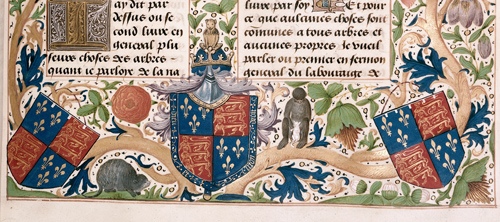
The British Library’s copy has a wonderful history, not quite Shakespearean, but quite close. Their manuscript copy, in French, was decorated for King Edward IV (1442-1483), the elder brother of Richard III. It’s thought to date from towards the end of his reign in the late 1470s.

royal armsOne of the borders contains his royal coat of arms. The book was recorded as being in the Royal collection in Richmond Palace in 1535, remaining in Royal hands until it was given to the British Museum by George II in 1757.

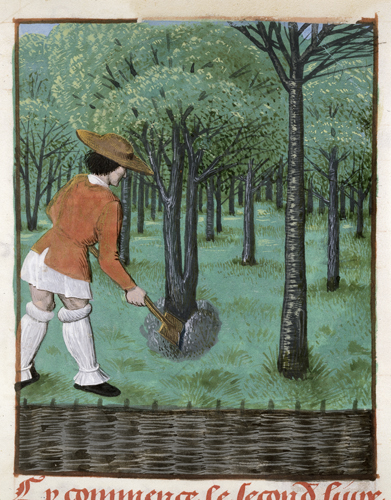
So it’s a book that may have been known by all the Tudor and Stuart monarchs, and by some of the earlier kings that Shakespeare wrote about. Yet the subject of the book was farming, the illustrations, like the one shown here, of peasants going about their daily work.

Man working in orchard Royal 14 E.VI, f.28

Man working in orchard Royal 14 E.VI, f.28

Maybe those monarchs, like the banished Duke in As You Like It, found comfort in

The seasons’ difference; as the icy fang
And churlish chiding of the winter’s wind,
Which when it bites and blows upon my body,
Even till I shrink with cold, I smile and say
‘This is no flattery; these are counsellors
That feelingly persuade me what I am.

And longed for the simple life where they,
            exempt from public haunt,
Finds tongues in trees, books in the running brooks,
Sermons in stones, and good in everything.

Here’s the record for the manuscript with the illustrations following below.

None of these copies, though, seem to be the one containing the glorious images I started with, which seems to have avoided being written about. Here, though, are links to two pinboards, here and here  of images of medieval rural life that I found on Pinterest. Enjoy them!

Share
Posted in Legacy, Shakespeare's World | Tagged , , , | Comments Off on Illuminating the seasons difference

Finding Shakespeare’s “lost play”, Cardenio

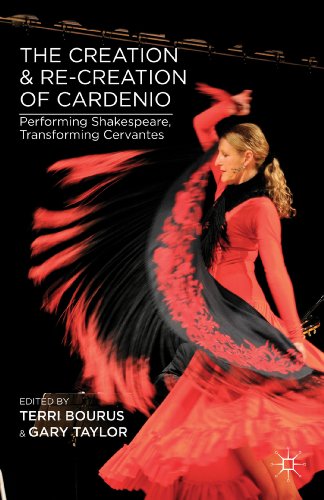
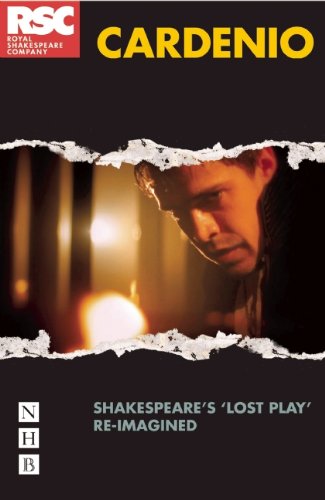
gary taylor cardenioPalgrave Macmillan recently sent me a review copy of their new book The Creation and re-creation of Cardenio: Performing Shakespeare, Transforming Cervantes, edited by Terri Bourus and Gary Taylor. Cardenio is now universally known as “Shakespeare’s lost play” and although I knew something of the history of the play and had seen the RSC’s production in 2011, I’d never read or studied it.

The staging and publication of Double Falsehood, thought to be an adaptation of Cardenio, some 250 years ago didn’t convince critics of its authenticity, and it lay neglected for about 200 years. But in the past decade or so scholarly and theatrical interest in the play has increased, and it’s become the subject of sometimes heated debate. These are the bare facts:

20 May 1613: The Privy Council records show a payment of £20 to John Heminges of the King’s Men for court performances of six plays, including Cardenno.
9 July 1613: John Heminges was paid £6 13s 4d for the King’s Men to perform a play called Cardenna before the visiting ambassador of the Duke of Savoy.
That’s it from Shakespeare’s own lifetime: no mention of Shakespeare or any other author (though there’s nothing unusual about that).

9 September 1653: The Stationers’ Register lists several plays to be published by Humphrey Mosley including The History of Cardenio, by Mr Fletcher and Shakespeare.
This seems not to have been published, nor was the play published in any of the four Shakespeare folios or in Beaumont and Fletcher’s folio.

1727: Lewis Theobald, later to be a famous Shakespeare editor and already in dispute with poet and Shakespeare editor Alexander Pope, prepared for the stage a play entitled Double Falsehood, or the Distressed Lovers.
1728: this play was published, “written originally by W Shakespeare; and now revised and adapted to the stage by Mr Theobald” who included a preface explaining the origins of the play.

Theobald claimed to have based his edition on three manuscript copies of the play, one of which “is …in the handwriting of Mr Downes, the famous Old Prompter; and, as I am credibly inform’d, was early in the possession of the celebrated Mr Betterton”. Theobald never referred to it as Cardenio, and changed all the names (as was often done in post-Restoration adaptations), but it was known to be based on a story in Cervantes’ Don Quixote. In his preface to Double Falsehood Theobald promised to publish his own edition of Shakespeare’s plays which “may furnish occasion for speaking more at large concerning the present play”. But when this opportunity arose with his own carefully-edited version of Shakespeare’s plays in 1733, this play wasn’t included. Had he lost confidence in the play’s authenticity?

While most accept that there was a play called Cardenio in which Shakespeare had a hand, questions remain: did Theobald invent the whole thing? If he did use manuscripts, were they authentic (they have never been found)?  How much did he adapt the manuscripts? How much was there of Shakespeare, and how much Fletcher? And is Shakespeare’s hand to be found in any part of Double Falsehood?

cardenioModern editors, scholars and directors have had to grapple with these questions. The play has exerted a strong hold on a number of people including Brean Hammond, the editor of Double Falsehood for the Arden Shakespeare, Gregory Doran who recreated the play for the RSC, and Gary Taylor, the co-editor of the book which I mentioned at the start. This is actually the second book Professor Taylor has co-edited on the subject of Cardenio, and the book includes his “unadaptation” of the play. Most of the book, though, consists of scupulously researched essays by many contributors explaining the origins of the play, the role of Cervantes’ Don Quixote, the process of staging Taylor’s version, and the possibility that the play was deliberately “disappeared” because of its controversial treatment of ethnicity. The plot thickens.

The air of intrigue is increased by play’s story, rich in romance, disguise, betrayal, madness, forced marriage and seduction, set in the exotic location of Andalucia.

For me, though, the interesting thing about these books is the variety of texts now in existence. The Arden Shakespeare edition of Double Falsehood came first, making it accessible for the first time in 250 years. The play appears again in Bate and Rasmussen’s edition of William Shakespeare and Others: Collaborative Plays. And there are two versions of Cardenio, each of which has been staged. I’m used to editions of a Shakespeare play containing differences, but here we have the opportunity to see a number of reworkings of the same, unsatisfactory text.

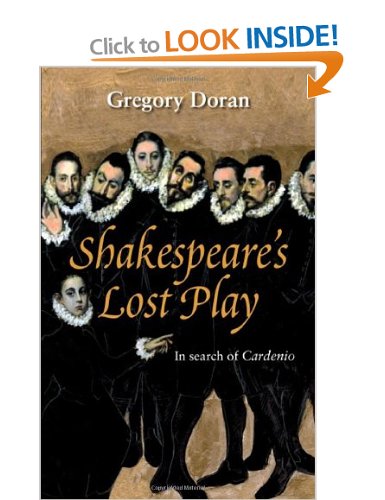
the quest for cardenioGregory Doran’s “re-imagination”, performed by the RSC in 2011, is basically Theobald’s text with additions. As a theatre director with huge experience of staging Shakespeare and his contemporaries Doran perceived that Double Falsehood would not work onstage, and used the translation of Don Quixote used by Shakespeare and Fletcher to construct missing scenes. Taylor’s version is a “thought experiment”, an “unadaptation”. He asks “What would The History of Cardenio have looked like, before Theobald turned it into Double Falsehood?” In order to strip the layers back Taylor has imitated Shakespeare and Fletcher, using meticulous scholarship and his considerable experience of editing Shakespeare. His version has evolved from 1992 to 2012 and he sees it as a work in progress, calling for feedback and criticism from “the great variety of readers”. So if you want to know which you should read, the answer is both.

Shakespeare's Lost PlayWhat though are the disagreements which I mentioned at the beginning?  The absence in Taylor’s book of almost any discussion of the RSC’s high-profile version of Cardenio
suggests a certain defensiveness, and Taylor’s review of the Bate and Rasmussen volume containing Double Falsehood is dismissive. Professor Tiffany Stern has struck a sceptical note about the whole issue: “It’s very unclear that there ever was a Shakespeare play called Cardenio“, she says, and there’s a recording of her discussion on the subject with Gregory Doran on the SBT’s Blogging Shakespeare.

Maybe one of those elusive manuscripts still survives somewhere, and will answer some of the questions. From 2010-2013 at least seven books, listed below, have tried to solve its mystery. There will surely be much more to say about Shakespeare’s “lost play”.

Chartier, Roger. Cardenio between Cervantes and Shakespeare: The Story of a Lost Play (Cambridge: Polity Press, 2013).

The Creation and re-creation of Cardenio: Performing Shakespeare, Transforming Cervantes, ed Terri Bourus and Gary Taylor. (New  York: Palgrave Macmillan, 2013).

Doran, Gregory. Shakespeare’s Lost Play: In Search of Cardenio (London: Nick Hern Books, 2012)

Doran, Gregory, and Alamo, Antonio. Cardenio. Shakespeare’s “Lost Play” Re-imagined  (London: Nick Hern Books, 2011).

Double Falsehood, ed. Brean Hammond (London: Arden Shakespeare, 2010)

The Quest for Cardenio: Shakespeare, Fletcher, Cervantes and the Lost Play. ed. David Carnegie and Gary Taylor (Oxford: Oxford University Press, 2012).

William Shakespeare and Others: Collaborative Plays (RSC Shakespeare), ed. Jonathan Bate and Eric Rasmussen  (Basingstone: Palgrave Macmillan, 2013).

If you’re unable to get any of these, you might like to read Greg Doran’s blog that he wrote while directing his version of the play.

Share
Posted in Legacy, Plays and Poems | Tagged , , , , , , , | Comments Off on Finding Shakespeare’s “lost play”, Cardenio

In with the new: welcoming the Sam Wanamaker Playhouse

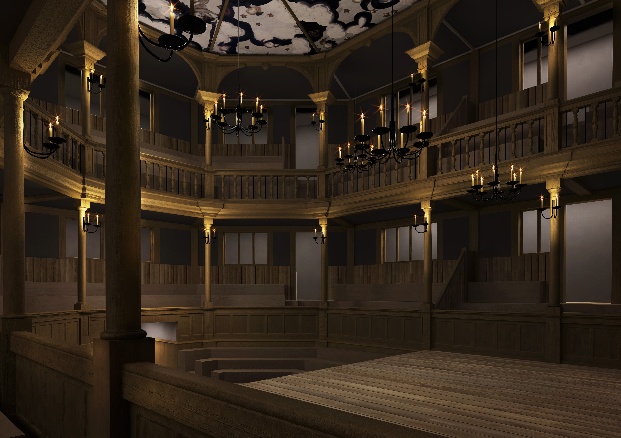
CGI model of the Sam Wanamaker Playhouse

CGI model of the Sam Wanamaker Playhouse

On 9 January 2014 the great Jacobean tragedy The Duchess of Malfi will be the first play to be performed at the Sam Wanamaker Playhouse, the second performance space in the Shakespeare’s Globe complex on the south bank of the Thames. It’s been a long time coming:  Wanamaker died just over twenty years ago, and the reconstructed Globe was officially opened back in 1997. The new playhouse is an indoor theatre, and as well as giving the Globe the opportunity for year-round performances it will allow them to investigate the repertoire of plays that were written with indoor performance in mind. The playhouse will seat only 340, so it’s going to be an intimate experience quite different from the open air Globe. The layout has been based on a sketch found in a book in Worcester College Oxford in the 1960s that seems to be a design for an indoor playhouse. The sketch was originally thought to be by Inigo Jones, but it now thought to be by his protege John Webb. With no plans or images of Shakespeare’s Blackfriars Playhouse, his indoor theatre, it’s the best evidence there is.

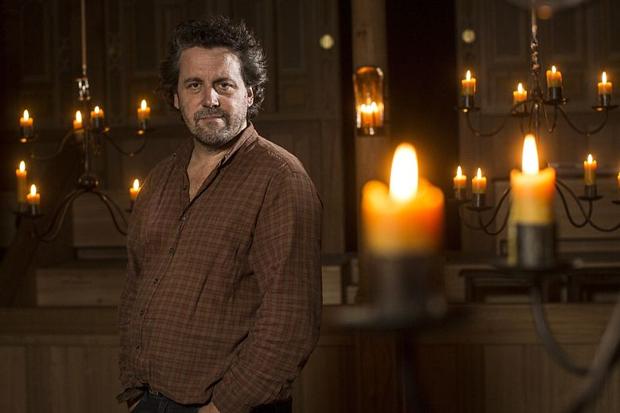
Dominic Dromgoole, Artistic Director of Shakespeare's Globe, in the Sam Wanamaker Playhouse

Dominic Dromgoole, Artistic Director of Shakespeare’s Globe, in the Sam Wanamaker Playhouse

What will set the new space apart, though, is not the shape of the auditorium but the fact it is to be candlelit. The beeswax candles for each performance will cost up to £500 and will take several hours to set up. During the play the candles will be trimmed or replaced just as they would have been originally. The five-act structure which we all think of as Shakespearian was introduced in order to allow this to take place. Music was played while the candles were being sorted out and these necessary breaks would have been written into plays that were to be performed there. I’ve never seen a play lit solely by candlelight, but I have experienced several productions in intimate theatres in which electric lighting was used very subtly, such as the 1989 production of The Duchess of Malfi at the Swan Theatre, Arden of Faversham in 1982 at the original Other Place, and, most memorably A Woman Killed With Kindness, performed in 1991 at the second Other Place. In this production the lighting was so low I remember longing for them to turn it up. I’m a great admirer of the ability of modern theatrical lighting to enhance productions without drawing attention to itself, and I’m looking forward to seeing how modern audiences respond to plays lit by candles alone.

This post was written a year or so by Professor Andrew Gurr about the Blackfriars and the idea of the new theatre.  Among the press interest there has been a page about the theatre on the BBC’s website, and Andrew Dickson has written a piece for the Guardian. Earlier this week the BBC broadcast a half-hour radio documentary to coincide with the new theatre’s opening: Staging a Revenge: The New Jacobean Theatre.  It will be available to listen to again for a few days.

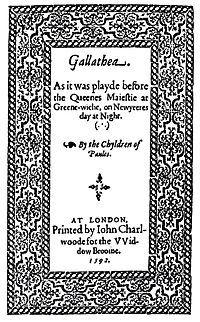
Title page of John Lyly's Galatea

Title page of John Lyly’s Galatea

In a couple of month’s time Edward’s Boys, the schoolboy troupe from Shakespeare’s own school in Stratford-upon-Avon will be staging John Lyly’s play Galatea. After first performances at Lady Margaret Hall, Oxford and the Levi Fox Hall in Stratford-upon-Avon they will be taking the play to the Sam Wanamaker Theatre on 27 April, to coincide with a study day at the Globe on its author. John Lyly’s play was first performed at court in 1588, and published in 1592. The title page states that it had been performed by the Children of Paul’s, the most important of the boys playing companies. It was also performed at Blackfriars, so its performance by a group of boys at the new playhouse is keenly anticipated.

The Duchess of Malfi is, not surprisingly, sold out as people clamour to see what the new theatre is like.  It’s also one of the finest  of Jacobean plays, and very much worth seeing in its own right.  It’s been a smart move not to schedule any Shakespeare in the first season of plays in the Sam Wanamaker Playhouse, but for most people it will be seeing his familiar plays in a very different setting that will bring the theatre to life.

Share
Posted in Legacy, Shakespeare on Stage, Shakespeare's World | Tagged , , , , , , , , , | Comments Off on In with the new: welcoming the Sam Wanamaker Playhouse

Celebrating Shakespeare in Stratford-upon-Avon

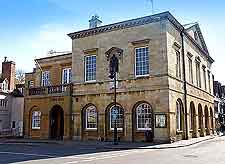
Stratford Town Hall, venue for the Birthday dinners

Stratford Town Hall, venue for the Birthday dinners

2014 is quite rightly going to be dominated by the centenary of the outbreak of the first World War, but it’s also an important year for Shakespeare-lovers celebrating his 450th birthday. My ex-colleague Dr Susan Brock and I are currently co-writing a chapter on Celebrating Shakespeare in Stratford-upon-Avon for a book on Shakespeare celebrations worldwide.

We’ve been going back to contemporary reporting of the celebrations from the early 1800s. The organisation of the Birthday celebrations was one of the aims of the The Shakespearean Club when it was founded in 1824, in fact it’s often stated that the Club began them. It’s not quite as clear-cut as that: there were quite elaborate celebrations in 1816, the bicentenary of Shakespeare’s death. A commemorative medal was struck and on the day the town’s bells rang, cannon fired, there was a public breakfast, a dinner and ball and fireworks. It was regretted that they could not achieve a dramatic presentation, and promised something better.

The 1829 advertisements for rival celebrations

The 1829 advertisements for rival celebrations

Much of the evidence that remains for the early years of the Club consists of printed materials and what was reported in the press: advertisements, accounts of  dinners with lists of toasts, speeches and poems, and songs sung. It’s easy to get the impression that members had little real interest in Shakespeare. This is made worse by the well-documented rivalry between the original club and a second Shakespearean Club that appeared a couple of years later. Did this show admiration for Shakespeare, or for having fun? The advertisement for 1829 shows how intense the competition was, with almost identical offerings in the shape of dinners being provided by the landlords of public houses.

In 1830 local historian Captain James Saunders had had enough. He wrote “Cautionary Lines … to the belligerent Shakespeare Clubs engaged in preparing for the Celebration” and Mr Bisset urged “their glory should be to unite and be free to spread the Shakespearean flame”. The rivalry between the Clubs to outdo each other provided a focus to the detriment of the celebrations themselves.

Both clubs carried on, but by 1832 the original club was dominant again with 200 attending the dinner representing “nearly every respectable inhabitant of the town and neighbourhood”, and aimed to institute a library “bequeathing a permanent …collection of well-chosen books, to the inhabitants”. In 1833 the Warwickshire Advertiser devoted only 12 lines to the rivals who “enjoyed in the true spirit of hilarity”.

There are also hints that the Shakespeare Club was developing bigger ambitions. People from as far as London attended, and a more serious note is heard: “The worthy Mayor, Thomas Mills, Esq., [is] one who remembers the sacrilegious down-cutting and up-rooting of Shakespeare’s mulberry tree …and his younger fellow townsmen will need no exhortation from us to support him”. The mulberry tree had been cut down 77 years earlier, and the Club saw itself as a group of local people rightfully protecting their fellow townsman.

At the dinner in 1834 a Mr Serle, a visitor, exhorted members of the Club: “let all the memorials of Shakespeare contained in your church be repaired and preserved”. It was a fine aim in itself, but  “Thus too would the Shakespearean Club acquire a still higher title to esteem, by exhibiting a religious care of the remains of him who. born in their town, and brought up among their forefathers, became the wonder of the world”.

Dr Connolly’s impassioned speech on the same day went further:
The ruin of Shakespeare’s house, that house in which he lived and died, the sacreligous destruction of his Mulberry tree, the loss of almost every personal relic of him; the defacement of his tomb, at the investigation of a selfish and conceited commentator;  are all melancholy proofs that for a long time after his death there was either an indifference to his immortal memory, or the want of a Shakespearean Club to concentrate individual regard and give it an honourable utility. You cannot raise his mansion from the dust,  nor restore the original colours of his monument, you cannot make the mulberry tree put forth its green leaves and crimson fruit once more, but his works, his unrivalled works remain… they flourish with a perpetual spring,  and of their precious fruits men will gather to the end of time. 

Stung into action, by 1835 the Shakespearean Monumental Committee had been set up to raise funds, led by Dr Connolly of the Club who suggested:
In case of a sufficient amount being subscribed the Committee would gladly extend their care to the preservation of the house in which Shakespeare’s father resided, in Henley Street, the presumed birthplace of Shakespeare, and to the house remaining at Shottery… and even to the purchase of the site of New Place… a spot which, being yet unencroached upon, they are most desirous of guarding from new erections and consecrating to the memory of him whose name has rendered it in the estimation, holy ground. 

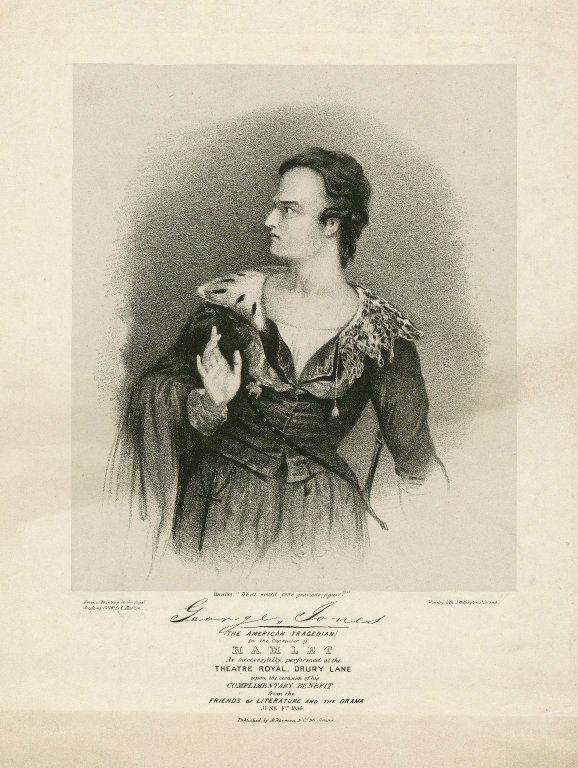
George Jones as Hamlet. Engraving based on 1836 painting by J Martin. Folger Shakespeare Library

George Jones as Hamlet. Engraving based on 1836 painting by J Martin. Folger Shakespeare Library

The first international contribution that I have yet found, was the First Annual Jubilee Oration, delivered in 1836 at the Chapel Lane Theatre by the American Tragedian, George Jones. During his two-hour oration he declared “Warwickshire in the 19th century has been rescued from the charge of an unnatural indifference”. He donated an American flag to the Club to be flown alongside the British flag at the birthday celebrations.

In 1837 the restored chancel in the church reopened on the Birthday. There was further talk about the need to preserve the Birthplace: “as long as it remains private property, we have no security against its total demolition”.  The Stratford Club liked to see itself as the centre of both international and national interest,  as in 1840 other clubs “cannot but feel that all these are the offspring of the Parent Club”. But even as it tried to broaden its influence it was in decline. There was a shift to London: towards the end of the decade the Birthplace was purchased for the nation with the assistance of committees fundraising in both Stratford and London. The creation of the Shakespeare Birthplace Trust in 1847 signalled the end of the Club’s status as the natural protector of the Shakespeare relics in the town. But it was the first such organisation, which inspired the creation of those that now dominate the town’s Shakespeare heritage.

The Shakespeare Club still exists with monthly lecture meetings being held at 7.45 at the Shakespeare Institute. These are the next few meetings:

14 January: Erica Whyman: Future plans for the RSC

11 February: Dr Erin Sullivan: Beyond Melancholy: Sadness and Selfhood in Renaissance England

11 March: Professor Jonothan Neelands: Learning Shakespeare by Heart not Off by Heart

8 April: Dr Nick Walton and Amanda Jenkins: Muse of Fire: A Shakespeare Entertainment


Share
Posted in Legacy, Stratford-upon-Avon | Tagged , , | Comments Off on Celebrating Shakespeare in Stratford-upon-Avon

Staging the caskets: The Merchant of Venice

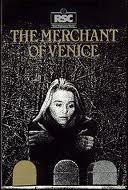
The programme from The Merchant of Venice, 1984

The programme from The Merchant of Venice, 1981


As a man of the theatre, Shakespeare must always have written his scenes with an idea of how they would be performed, though given the limited technical scope of theatres at the time he does sometimes seem to have made it puzzlingly difficult. How did he expect Antony to be lifted up to Cleopatra’s monument in Antony and Cleopatra, and how was the storm to be staged in The Tempest? Other moments seem simpler, but may still present a challenge. One such is the staging of the three casket scenes in The Merchant of Venice, set in Portia’s home in Belmont, where  suitors have to choose between metal caskets of gold, silver or lead in order to win Portia in marriage. The three scenes are not consecutive, but are separated by short scenes set in Venice. So the staging has to be simple to allow for the play to continue swiftly.

In the nineteenth century, where elaborate, realistic sets were required, set changes took so long that all these scenes were conflated and run together as a sequence.  But once the fashion for realistic scenery wore off, the original order of scenes was restored and they looked for solutions to allow quick scene-changes between the two locations. Miriam Gilbert’s excellent survey of RSC productions of the play in the Shakespeare at Stratford series comments on no fewer than thirteen stagings between 1947 and 1997. The simplest idea was probably John Barton’s in two productions at TOP in 1977 and RST in 1981 where three small boxes were simply placed on a wicker coffee table. This solution didn’t interfere with the action of the play, and the starkness of the caskets suited the idea that in Belmont the past has an unhealthy hold on the future. The black programme cover for this “comedy” in 1981, (reproduced above), featured Portia (Sinead Cusack) staring wanly out from behind the caskets.

Portrait of Peggy Ashcroft, 1953

Portrait of Peggy Ashcroft, 1953

The 1953 Shakespeare Memorial Theatre season opened with The Merchant of Venice, directed by Denis Carey. Belmont was a light, elegant world contrasting with a darker Venice occupied by Shylock (Michael Redgrave). The mood carried through into the way the caskets were staged, each one held by a boy page who sat on a central oval bench. I recently received some photographs from my brother-in-law James Morris who lives in New South Wales, Australia, and who, aged twelve, was one of the casket boys. The pictures included a copy of the photograph Peggy Ashcroft, playing Portia, gave him, signed “To Jimmy – with every good wish from his Portia”, and a letter thanking him for the flowers he gave her on the press night of Antony and Cleopatra “I look forward to seeing you in Belmont tonight – a happier place than Egypt”.

Over Christmas we talked on the phone about his memories. Jim had held the lead casket – the one which contained Portia’s likeness. He remembered coming on upstage and walking down to the bench where they retrieved the caskets from a shelf out of view of the audience. The boys remained seated as the suitors approached, handing the caskets over. I had always assumed, because Jim was head chorister at Holy Trinity Church, that the boys sang “Tell me, where is fancy bred”, but Jim corrected me: their job was only to hold the caskets. He also mentioned that the boys had a fight onstage, a bit of business he obviously enjoyed.

The Merchant of Venice, 1953. Includes John Bushelle as the Prince of Morocco, Anthony Adams, Robert Scroggins and James Morris as the pages, Peggy Ashrcoft as Portia, Marigold Charlesworth as Nerissa. Photographer Angus McBean

The Merchant of Venice, 1953. Includes John Bushelle as the Prince of Morocco, Anthony Adams, Robert Scroggins and James Morris as the pages, Peggy Ashrcoft as Portia, Marigold Charlesworth as Nerissa. Photographer Angus McBean

I headed for the Shakespeare Centre Library and Archive, where the RSC archives are kept, to examine the prompt book, reviews, photos and production records to see if I could find out more. What I found confirmed his recollections. The prompt book contains diagrams of the stage showing the three boys, and the production records include descriptions of their costumes, pale blue sleeveless jackets and trousers, shirts with lace-edged collars and grey shoes It’s clear that the boys helped to set the tone for the three scenes. At the start of the first, with the Prince of Morocco, they came on as part of a formal procession. Then in the second scene, with the Prince of Arragon, often played for comedy, they ran on, fighting, pushing each other off the central bench (described as the Snuff Box) until Nerissa brought them to order by clapping her hands. The fighting resumed at the end of the scene. At the end of the third scene, after Bassanio had successfully won Portia’s hand, the boys exited playfully “creeping in time with music”. Several critics commented on these scenes. The Guardian praised their handling and the Coventry Evening Telegraph said “the casket affairs go very well”, not surprising since they were thoughtfully integrated into the action. Only the Birmingham Mail found the pages, “young-eyed cherubims”, “merely a distraction”, and thought it was an example of “that striving for something different to the neglect of essentials”.

What, I wonder, would the Birmingham Mail critic have made of the ill-fated 1984 production. I doubt if anyone who saw it will have forgotten the way in which the caskets were staged. You could see it had been a great idea: the solution to the problem of getting the life-size caskets on and off the stage was to suspend them way above the stage throughout, lowered smoothly and elegantly onto the stage when required, and just as swiftly removed. But the brackets each one stood on were reminiscent of anglepoise lamps, and as the caskets were raised and lowered they wobbled violently. Whenever they moved they became the focus of the audience’s attention, provoking unwanted giggles. It was a great lesson in the advantages of keeping things simple: they must have longed for a neat little table or those three boys who some thirty years earlier had seemed a bit of a distraction.

There’s lots of information about the stage history of the play on the RSC’s website, including photographs of the casket scenes in many productions.

Share
Posted in Plays and Poems, Shakespeare on Stage, Stratford-upon-Avon | Tagged , , , , , , | 6 Comments

In memory of Reg Foakes


Arden 3 edition of King Lear, edited by R A Foakes

Arden 3 edition of King Lear, edited by R A Foakes

I’m sitting here with my Arden Edition of King Lear, probably the most authoritative edition of the play ever published. Its editor, Reg Foakes (R A Foakes on the title page) died over Christmas at his home in Stratford-upon-Avon aged 90.

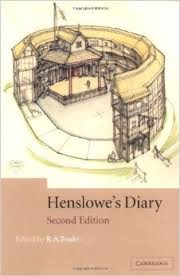
Over the next few weeks many of Reg’s professional academic colleagues will be sure to write about his huge contribution to Shakespeare studies. Just one of his lasting scholarly achievements is his edition of Henslowe’s Diary, first published in 1961, reprinted in 2002 and still the standard work on the subject, helping to uncover much about theatre in Shakespeare’s time including the controversial topic, collaborative writing. He was a member of the Advisory Board for the ongoing Henslowe-Alleyn Digitisation Project and contributed several essays to the website, listed here.

I knew Reg for many years, and although we often discussed Shakespeare, that isn’t what makes me so sad to hear of his death. He was a man of great modesty: it doesn’t surprise me that his Wikepedia entry is brief and out of date, nor that Google fails to find a single picture of him.

The second edition of Henslowe's Diary, edited by R A Foakes

The second edition of Henslowe’s Diary, edited by R A Foakes

We met while I was working at the Shakespeare Centre Library in Stratford. Although he was a highly-respected academic his unassuming personality and willingness to discuss his work made him popular as a reader. I remember discussing the size and orientation of the restored Globe (Reg’s opinion was that it was too big). While he was working on his book Hamlet versus Lear we discussed the relative merits of the two plays (King Lear, in Reg’s opinion, is by far the better play). But most of my memories relate to the Arden edition of King Lear which he prepared over several years. He researched part of the text and sourced many of the production photographs for its introduction using the Library’s performance collections. One of the difficulties with the play is that the two editions, the 1608 Quarto and the 1623 Folio, are very different from each other. Reg wanted to signify this by using different typefaces for each text so it would be immediately obvious to the reader which was which. Perhaps inevitably he lost this argument, and in the Arden edition the texts are signified by a subtle Q or F that does not detract from the elegance of the page.

Reg’s edition of King Lear came out in 1997, the year after his second wife, Mary, died. When I joined the staff at the Shakespeare Centre Library in 1979 she had already been working there for six years. She became my dearest friend. We shared an office and the day to day running of the Library for the next fourteen years, until she married Reg and joined him in California. Mary had a Shakespeare quote for every occasion so their collaboration on a book of Shakespeare quotations, categorised by subject, was a happy one after they married.

Mary was the sweetest-natured person I’ve ever known, so it seemed particularly cruel that some years before she married Reg she developed a mental illness. It was only after Mary’s death that he realised the severity of her illness, which she had managed to conceal from him. It must have been terrible for him to have to continue thinking about his edition of King Lear after her death.  He dedicated the book “For my beloved Mary” and quoted Lear’s words after the death of Cordelia:
Thou’lt come no more,
Never, never, never, never, never.  

His first wife, Barbara, had also died in tragic circumstances and in the last years of his life he wrote several books of poetry and a memoir, Imagined Places, in which he talked frankly about the loss of both women, and about the importance to him of his four children and their families. The final sentence of the memoir deliberately echoes the end of King Lear: ” Now I see that achievement, the goal of youth, is not what matters most in life, but rather love, generosity, acceptance, and the ability to endure with patience suffering that can not be avoided.”

And his last collection, Just Watch Your Step contains this sensitive poem, Loving.
It must be your presence enriching the path,
Moving beside me as in a vital dream,
Speaking in your unforgettable voice
So many ways of loving. Time bends
Around us in the ever-changing light,
And we always keep our fingers intertwined
As long as I can remember, ever since first
We followed the unmapped trail that brought us
Through grateful years to unexpected places,
Crowded city streets, woods coming into leaf,
Quiet paths of autumn, at the sea’s verge,
Dodging the surf on exhilarating beaches,
Or at home, wherever it was we found ourselves,
Over and over while the days held us together,
Always as if for the first time and for ever;
So though your ashes are buried you remain,
My shadowy partner until I reach the end,
Unafraid of whatever lies in wait, having
Your image to grace all possible exits.

Share
Posted in Legacy, Plays and Poems | Tagged , , , , , , | 5 Comments