Paul Robeson, Othello and Mixed Britannia

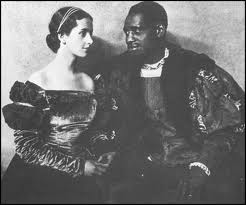
Peggy Ashcroft as Desdemona, Paul Robeson as Othello

The BBC has just begun a mixed race season, examining how over the past 100 years Britain has come to be a country in which inter-racial partnerships are commonplace. The first documentary in the series Mixed Britannia looked at the period 1910 to 1939, before the well-documented postwar wave of immigration.

During this period a white girl could be ostracised for dancing with a black man, and those who forged relationships with them could be branded little better than prostitutes. Some of the details were shocking: the children of mixed race couples were treated as mentally and physically inferior and the British Eugenics Society theorised that interbreeding would result in a weakening of the population. The programme was a tribute to the open-minded women who put up with this intolerance, sometimes giving up their own nationality while striving to bring up their children as the product of two sometimes conflicting cultures.

The programme included the example of Paul Robeson’s 1930 London performance as Othello. The amount of public interest in watching a black man embracing a white woman, even if just on stage, made Robson nervous: “That girl couldn’t get near to me,” he said later. “I was backin’ away from her all the time. I was like a plantation hand in the parlour, that clumsy.” The problem wasn’t Peggy Ashcroft: what the press and the audiences didn’t know until many years later was that their offstage relationship also blossomed. Although both were already married, Peggy Ashcroft delicately explained “what happened between Paul and myself” was “possibly inevitable”.

Shakespeare wrote the part of Othello for the star actor of the King’s Men, Richard Burbage. It would never have occurred to anyone at the time that a Moor should play the role. All the women’s parts, after all, were also taken by men and continued to be so for several decades.

Ira Aldridge as Othello

The earliest black man to play Othello in England was another American, Ira Aldridge, who being unable to pursue an acting career at home came to London to make his name. He first appeared as Othello in 1825, adopting the title “The African Roscius”. Convention prevented him from performing in the top London theatres but he was not seen as a threat to white men as Robeson was a century later. He played on his race’s reputation for violence, encouraging the rumour that he had actually killed some of his Desdemonas. Madge Robertson in her memoirs described how he used to drag her round the stage by her hair before smothering her. Aldridge was not just a novelty act, but an actor of quality. One reviewer wrote:

No sooner did the Moor make his appearance, than I felt myself … instantly subjugated, not by the terrible and menacing look of the hero, but by the naturalness, calm dignity, and by the stamp of power and force that he manifested.

His greatest success was Othello but in his long European career he also performed the conventionally white roles of Macbeth and King Lear, for which he rather bizarrely had to “white up”.

Paul Robeson also continued to be associated with Othello for most of his life. Embracing Socialism during the years of the Depression he worked in Russia, visited fighters in the Spanish Civil War and made British films. The 1939 film The Proud Valley questioned prejudice in a Welsh mining valley: “Aren’t we all black down the pit?”  In 1939 he returned to the USA and a few years later played Othello again. He committed himself to the war effort and Civil Rights but in 1945 was ordered to be kept under surveillance, and after a tour of Britain in 1949 his passport was revoked. His right to travel outside the USA was only reinstated in 1958. By the time he appeared as the first black Othello to perform in Stratford in 1959 he was a figure of enormous political significance. The son of a slave, a fighter for human rights, he, like Othello, was a powerful outsider in a white-dominated world.

The story of mixed race Britannia is, like the play itself, as much about love as hate and jealousy. Othello was after all “One that loved not wisely, but too well”. After Robeson, it was said that no white man would ever be able to play the part again. This wasn’t quite the case but it’s now possible for black actors in the UK to play Shakespeare’s English kings and Hamlet as well as the Moor of Venice.

Share
Posted in Legacy, Plays and Poems, Shakespeare on Stage, Stratford-upon-Avon | Tagged , , , , | Comments Off on Paul Robeson, Othello and Mixed Britannia

Shakespeare and National Poetry Day

Thursday 6 October is National Poetry Day in the UK. With so much economic gloom in the news, and to mark the day, here are a couple of pieces of Shakespeare’s most beautiful poetry.

 The first one comes from near the end of The Merchant of Venice and conjures a peaceful, harmonious scene where Lorenzo and Jessica sit outside at night listening to music playing. Looking up at the sky, Lorenzo describes the music of the spheres, by which the planets were thought to sing as they move through the heavens. 

How sweet the moonlight sleeps upon this bank!
Here will we sit and let the sounds of music
Creep in our ears. Soft stillness and the night
Become the touches of sweet harmony.
Sit, Jessica. Look how the floor of heaven
Is thick inlaid with patens of bright gold.
There’s not the smallest orb which thou behold’st
But in his motion like an angel sings,
Still choiring to the young-eyed cherubins.
Such harmony is in immortal souls,
But whilst this muddy vesture of decay
Doth grossly close it in, we cannot hear it.

 And in A Midsummer Night’s Dream, Oberon describes the power of the imagination to drive the lunatic and the lover to madness, while it inspires the creativity of the poet:

 The lunatic, the lover and the poet
Are of imagination all compact:
One sees more devils than vast hell can hold,
That is, the madman: the lover, all as frantic,
Sees Helen’s beauty in a brow of Egypt:
The poet’s eye, in a fine frenzy rolling,
Doth glance from heaven to earth, from earth to heaven;
And as imagination bodies forth
The forms of things unknown, the poet’s pen
Turns them to shapes and gives to airy nothing
A local habitation and a name.

 Enjoy the day!

Share
Posted in Legacy, Plays and Poems | Tagged , , , , | 2 Comments

Seeing the spider

Autumn’s coming round, and that means we are all seeing more spiders in homes, gardens and in the countryside. Spiders have always got a bad press. In folklore they’re associated with evil, malevolence, and rumoured to be venomous.

 Spiders don’t do themselves any favours. Weaving webs which people walk into, or hiding in our houses where we spot them out of the corner of our eyes running across the floor or hanging from the ceiling, spiders are a nuisance. But looked at from another point of view spiders are our friends. Tiny money spiders are said to be lucky. Spiders catch flies which spread disease, they are industrious, and they construct the most beautiful webs.

 Shakespeare’s aware of their positive qualities. In A Midsummer Night’s Dream one of the fairies is called Cobweb and Bottom comments on the fact that these webs can be used to bind wounds. “If I cut my finger, I shall make bold with you”.

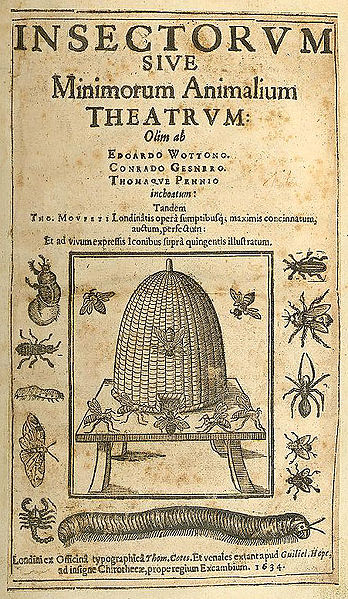
Thomas Muffet (or Moffet) was an Elizabethan physician fascinated by insects and spiders and their uses. He is reputed to be the father of “Little Miss Muffet” who is frightened by the spider in the nursery rhyme, though there’s no evidence. A copy of his posthumously published book Insectorum Sive Minimorum Animalium Theatrum is kept at the Shakespeare Centre Library and Archive. Spiders themselves could be used for treating illness: a live spider encased in butter or honey and swallowed was thought to be therapeutic (at this period the remedy was often almost more unpleasant than the disease).

 Most of Shakespeare’s references to spiders though fit the stereotype. Richard III is likened to many unpleasant animals, but the scuttling, malevolent spider is the most abiding. Richard sets a trap like a spider’s web into which his enemies fall one by one. One character warns another:

         why strew’st thou sugar on that bottled  spider
Whose deadly web ensnareth thee about?


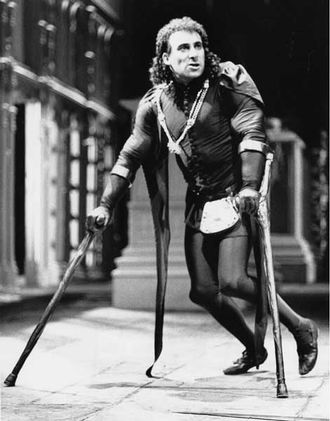
Antony Sher as Richard III, RSC 1984

When Antony Sher played the role in 1984 for the Royal Shakespeare Company he wore a tight-fitting black costume and wielded a pair of crutches to help him move across the stage at lightning speed. He was the malevolent spider personified.

 Shakespeare also used the spider motif when writing about the Duke of York, Richard’s father, in Henry VI Part 2. He too is a plotter:

 My brain, more busy than the labouring spider,
Weaves tedious snares to trap mine enemies

 In Henry VIII two nobles jealously observe the ambitious but low-born Cardinal Wolsey who

                               spider-like
Out of his self-drawing web, ‘a gives us note
The force of his own merit makes his way.

 One of my favourite speeches in Shakespeare involves a spider.  In The Winter’s Tale  Leontes uses what seems an unlikely image, of a spider concealed in a drink, to explain the agony of jealousy. For Leontes it’s the suspicion of his wife’s infidelity that causes pain, not the infidelity itself. Another jealous husband, Othello, expresses the same sentiment, and there too the audience knows the jealousy is unfounded.

 In both cases the men are blind to all arguments, and the speech gives a glimpse into the frightening world of the obsessive. Shakespeare brilliantly chooses this image with its strong emotional associations of fear, suspicion and evil. The cause may be imaginary but the pain to the sufferer is no less real:

                         There may be in the cup
A spider steep’d, and one may drink; depart
And yet partake no venom (for his knowledge
Is not infected), but if one present
Th’abhorr’d ingredient to his eye, make known
How he hath drunk, he cracks his gorge, his sides
With violent hefts.  I have drunk, and seen the spider.

Share
Posted in Plays and Poems, Shakespeare's World | Tagged , , , , , , | 2 Comments

Shakespearian stars 3: John Gielgud as Hamlet

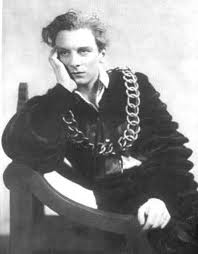
A young John Gielgud in his first Hamlet

If asked to name the greatest Hamlet of the mid-twentieth century most people would suggest Laurence Olivier. It was, though John Gielgud who received more critical acclaim and who, for people alive at the time, was most closely associated with the part. 

 John Gielgud was born on 14 April 1904. Coming from a famous theatrical family, his acting career started early and he had already become a leading man inLondon’s West End by the mid-1920s. His first major success in Shakespeare came during the 1929-30 season at the Old Vic, when at 25 he become the youngest to play Hamlet in living memory. The famous critic James Agate judged his performance to the “the high water mark of English Shakespearian acting in our time” and the production transferred to the Queen’s Theatre in London.

 In 1934, John Gielgud took a gamble, directing and performing Hamlet at what was then the New Theatre (renamed the Albery in 1973). Shakespeare was rarely seen in the West End at the time. W A Darlington, the Daily Telegraph critic, said “In every syllable that he speaks, there is evidence of an understanding mind at work so that the lines come fresh to the minds of the audience as if the part had never been acted before”. For those used to seeing Gielgud as an elderly man, it may be a surprise to read W Jesse Collings statement that “He rather gave me the impression of a moody modern youth who needed spanking”.  This production, running for 155 performances, defined Gielgud as the Hamlet of his generation.

 One of the reasons for his success was that he was able to bridge the gap between the world of the theatre and academia, regularly taking advice from Harley Granville Barker and scholar George Rylands and predicting the post-war rise of academic interest in Shakespeare onstage.

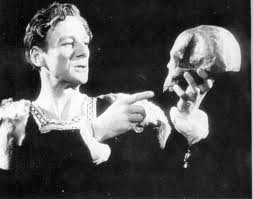
Hamlet in a 1940s production

Two years later Gielgud was directed by Guthrie McClintic at another revival at the Empire Theatre, New York. McClintic aimed to produce a less noble Hamlet in a swift fast-moving production. Rosamund Gilder was editor of Theater Arts magazine and wrote a book documenting the production. She concluded “He combines the power to convey subtle movements of the spirit, delicate shades of thought, the inner workings of mind and hear, with an ability…to tear off a “passionate speech” with the best of them…In his hands Hamlet seems born again every night.” The production played for a record 132 nights in New York, easily breaking the great John Barrymore’s record. Gielgud greatly admired Barrymore and receiving a telegram from him congratulating Gielgud on his “brilliant success” was one of the most wonderful events of his life.

 In 1939 he appeared in another production at the castle in Elsinore, then in 1944, searching for a new approach, he invited the academic George Rylands to direct him at the Theatre Royal, Haymarket. Many felt this to be his most successful production. His last performances were in an ENSA tour to the Middle and Far East in 1945-6.

 Later in life he recollected “I was amazingly lucky with Hamlet. By the time I had finished with it I did not want to read or write about it any more. I had played it many hundreds of times over fifteen years, in six different productions.”

 The reason why Olivier’s performance has overtaken Gielgud’s is of course the 1948 film which cut the play to half its normal length. Olivier had previously played the role in 1937 and by the time of the film was a distinguished stage and film actor. The film won four Oscars including Best Actor and Best Film.

 Few recordings remain to give the flavour of Gielgud’s performance. Elliot Norton, in the Boston Post, wrote “His greatest asset is his voice… It is like a musical instrument on which he plays at will, lightly and expertly”. Another critic wrote “Never has English sounded more beautiful from the human mouth”, and Donald Sinden, then a young serviceman who attended one of Gielgud’s last performances wrote “He turns to Horatio and Marcellus and says “Nay, come, let’s go together”. I wish I could describe how many facets Gielgud gave to that simple line”.
http://www.youtube.com/watch?v=BCyjXJ9oogg
 This rare recording of three speeches from the play was made several years after Gielgud stopped playing the part. His performance was always intellectual, often romantic, and it’s a pity the trembliness in his voice, which became more pronounced as he got older, is so obvious.

James Agate followed Gielgud’s career from its beginnings and in 1944 wrote “I hold that this is, and is likely to remain, the best Hamlet of our time”.

Share
Posted in Plays and Poems, Shakespeare on Stage | Tagged , , , , | 1 Comment

Shakespeare and Doctor Who


Doctor Who is a quintessentially English, science fiction TV programme which was first screened in 1963. To date eleven actors have played the part of the eccentric time-traveller.  A few weeks ago there was a jokey suggestion in the press that the current Doctor Who, Matt Smith, and his companion Amy, Karen Gillan, might play the Macbeths in Shakespeare’s play. Neither have a track record of performing Shakespeare.

Doctor Who has a long history of Shakespeare associations, and I’ve been taking a look at some of them. The first Doctor, William Hartnell, was an actor whose greatest ambition was to be a comic like his hero Charlie Chaplin. He came to the role late in life, following success in British films. He is said to have got his first professional job with Frank Benson’s Shakespeare Company aged only 16. Sadly I’ve not been able to verify this as his name doesn’t appear in any of the programmes for the Shakespeare Festivals inStratford-upon-Avon (not unusual since so many actors use stage names). I’ve not found any evidence that he ever played in comedy.

The second Doctor was Patrick Troughton, father of Shakespeare actor David Troughton and grandfather of the RSC’s most recent Romeo, Sam Troughton. Patrick Troughton’s Shakespeare credits include playing the Player King in Laurence Olivier’s 1948 film of Hamlet.

I’ve drawn a blank with Jon Pertwee, but the fourth Doctor, Tom Baker, played in a number of Shakespeare productions for the National Theatre and Bristol Old Vic among others from 1966, including playing Macbeth. Tom Baker’s probably the actor whose career has been most strongly influenced by the role but after leaving the series in 1981 he managed to shake it off, and returned to the theatre playing Frank in the RSC’s production of Educating Rita.

Peter Davison and Colin Baker don’t seem to have any Shakespeare credentials, but many years later Peter Davison’s daughter Georgia Moffett appeared in one of the episodes with David Tennant. Romance blossomed because they are now engaged and have a baby daughter.

The next Doctor, Sylvester McCoy, played the Fool to Ian McKellen’s King Lear for the RSC in 2007, and other Shakespeare roles have included Puck in A Midsummer Night’s Dream and Feste in Twelfth Night.

Paul McGann was the last Doctor before the programme was put on ice during the 1990s. He’s played at Shakespeare’s Globe, but not in Shakespeare, and has appeared in a number of Shakespeare recitals.

Christopher Eccleston

When the programme was revived in 2005 Christopher Eccleston took the role, a serious actor with a strong track record in TV drama. In 2002 he had played Hamlet at the West Yorkshire Playhouse, and he notably played Ben Jago, the Iago character in a modern version of Othello for TV.

Eccleston did only one series of Doctor Who, but achieved a remarkable level of success, establishing the series which had become known for its cheap sets and camp humour as a serious piece of TV drama.

David Tennant, another established actor, took over the role and played it for several years. He’d been a member of the RSC and the National Theatre whose Shakespeare credentials included Romeo, Antipholus of Syracusse and Touchstone. While playing Doctor Who he took time out to perform the leading role in Hamlet and Berowne in Love’s Labour’s Lost in Stratford and London, and filmed Hamlet for TV.

As well as Doctor Who’s playing Shakespeare, Shakespeare himself has featured in a number of episodes of the programme. I’ve only recently come across this one from 1965 in which the first Doctor and his assistants get a peep at the court of Queen Elizabeth through the time-space visualiser. You’ll find the link to the video on this page.

 Both the 4th and the 6th Doctors apparently claimed to have met Shakespeare.

But the best is the episode called The Shakespeare Code, featuring David Tennant as the Doctor, and Dean Lennox Kelly as Shakespeare. Screened in 2007 it was the most expensive episode ever made at the time because of the amount of location work ti required in Warwick, Coventry and Shakespeare’s Globe. The programme featured three witches straight out of Macbeth and speculated about how Shakespeare’s play Love’s Labour’s Won came to be lost. Shakespeare takes a fancy to the Doctor’s assistant Martha who he calls his Dark Lady, and on several occasions the Doctor supplies Shakespeare with some of his own lines. The whole thing’s on YouTube, broken up into scenes if you’d like to see it.

At the crisis point Doctor Who calls on Shakespeare to foil the witches plot by shouting some of his own poetry. The power of words reverses the spell and saves the world. It’s a scene that the writer must have very much enjoyed writing.


Share
Posted in Legacy | Tagged , , , , | 7 Comments

Ralph Fiennes and Coriolanus on film

In the UK we’re in party conference season, where the political parties have their annual meetings: there’s much jostling for position while leaders try to reaffirm their dominance. And in the USA, although there’s over a year to go until the next presidential election, a number of candidates have already formally announced they’ll be running. In both systems standing for election puts politicians under close scrutiny and any slip can be catastrophic to their chances.

 Coriolanus is Shakespeare’s most political play, and asks many questions about power and the political process. It’s not an easy play to watch: there’s no sub-plot, no comic relief. Coriolanus himself is the centre of attention in almost every scene, and Shakespeare makes sure that the audience never quite know what to think of him. He’s a supreme soldier and leader of troops in time of war, but has none of the skills to make him effective in peacetime politics. Do we admire him for his honesty, even if we find his opinions distasteful, or condemn him for his violence and unwillingness to compromise?

 In order to be voted consul, Coriolanus has to win popular approval, tricky when in the first lines of the play he’s described as “chief enemy to the people”. His only hope is to be able to disguise his true feelings, in effect to learn the skills of the actor. His mother encourages him to “perform a part thou hast not done before”. He knows it’s “a part which never I shall discharge to th’life”.  He finds the whole idea distasteful:

                                      Must I
With my base tongue give to my noble heart
A lie that it must bear?

 He knows he will have to dissemble as much as the harlot, the knave and the beggar.

 Away, my disposition, and possess me
Some harlot’s spirit! My throat of war be turned,
Which choired with my drum, into a pipe
Small as an eunuch or the virgin voice
That babies lulls asleep! The smiles of knaves
Tent in my cheeks, and schoolboys’ tears take up
The glasses of my sight! A beggar’s tongue
Make motion through my lips, and my armed knees,
Who bowed but in my stirrup, bend like his
That hath received an alms!

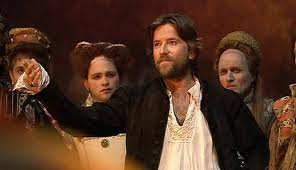
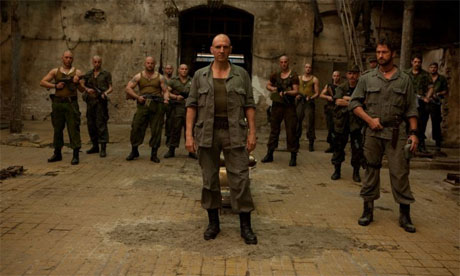
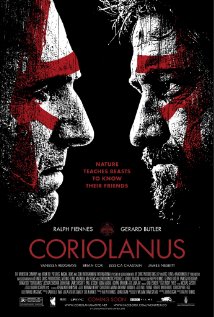
 A new film of Coriolanus, directed by and starring Ralph Fiennes, will be released in the next few months. The film’s well-timed to be in cinemas in the USA in December, January in the UK. Fiennes has given some interviews about the film.

The trailer’s action-packed, and I’ve read reviews suggesting it’ll be popular with fans of war films, while also a triumph for Fiennes. The poster suggests it’s principally about the rivalry between Coriolanus and his rival Aufidius.

Let’s hope it also gives weight to the compelling discussions about politics and the nature of power which sit at the heart of Shakespeare’s play. Who rules, and how accountable should our rulers be? How much of a role should the common people have? Should people show more loyalty to their families or their country?

 Shakespeare’s earlier plays about civil war centred on the chaos that resulted when warring families all claimed the right to rule, not how the country should be governed. Coriolanus looks towards the future: not many years after Shakespeare’s lifetime Englandwas once again at war with itself, in revolt against a monarchy that liked to think it ruled by divine right. The questions about how we are ruled, as well as by whom, make the play as relevant now as it was then.

Share
Posted in Legacy, Plays and Poems | Tagged , , , | 8 Comments

The Parnassus Plays: our fellow Shakespeare

I’ve referred a couple of times in my blogs to the Parnassus plays. This trilogy of student dramas are usually relegated to the footnotes in Shakespeare biographies so I decided to do look at them in a bit more detail.

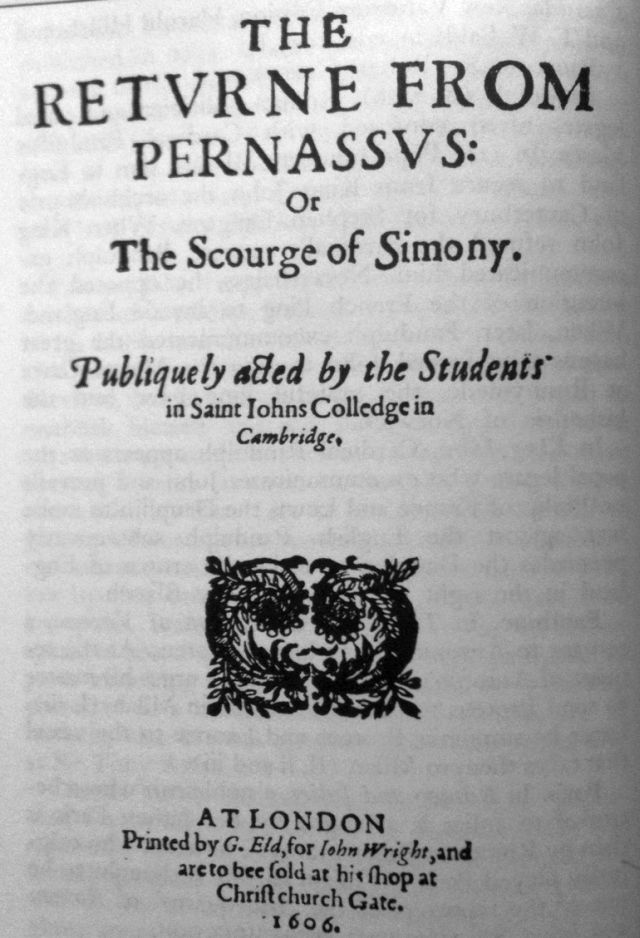
 There are three so-called Parnassus Plays, the first entitled The Pilgrimage to Parnassus, the second two sharing the name The Return from Parnassus. All date back to 1598-1602 when they were written and performed anonymously at Christmas by students from St John’s College Cambridge. As you might expect they’re full of in-jokes, tales of student life, and the virtues of alcohol. This is particularly true of the first one, in which Philomusus and Studioso, arrive to begin their studies at the University, or Parnassus. Another student, Stupido, who’s later described as a “pulinge Puritaine”, counsels them: “Studie not these vaine arts of Rhetorique, Poetrie and Philosophie; there is no sounde edifying knoweledg in them. Why they are more vaine than a paire of organs or a morrice daunce!”.

 Poetry, though, is the subject celebrated by the plays, and to be a professional poet is to have reached the height of achievement. By the second play, Philomusus and Studioso are disillusioned, and resolve to leave Parnassus so the plays’ main subject becomes the students’ attempts to find work. One student tries unsuccessfully to get a patron. Students also consider other jobs: music, or, in one of the scenes which is always quoted because of its relevance to Shakespeare, acting.


William Kemp

The students are auditioned by Richard Burbage and William Kempe from Shakespeare’s company. It’s suggested one of them could play Richard III and he quotes the first lines of Shakespeare’s play. But the students want to write poetry, not to speak someone else’s lines:

Must we be practis’d to those leaden sports
That nought doe vent but what they do receive? 

The student Ingenioso comments: “I see wit is but a phastasme and idea, a quareling shadowe that will seldom dwell in the same roome with a full purse”, and even though their ambitions become modest, to

                                     Wander in the worlde,
And reape our fortunes whesoer’re they growe.
Some thacked cottage or some cuntrie hall,
Some porche, some belfry, or some scrivener’s stall

 it’s still more difficult than they think. Paula Glatzer, in her book, describes the trilogy as “the story of their attempts… to earn a living in an unappreciative world”.

 The references to Shakespeare are too complicated to explain in full, and can be read in many biographies and on this webpage. Some indication of the regard Shakespeare was held in can be seen in the discussions of the relative merit of poets. Spenser, the writer of the accomplished and courtly poem The Faerie Queene, is regarded as the finest. So Gullio’s preference for “Sweet Mr Shakespeare” confirms his lack of sophistication.

Let this duncified worlde esteeme of Spencer and Chaucer, I’le worship sweet Mr Shakespeare, and to honour him will lay his Venus and Adonis under my pillowe.

 Another student mentions both of Shakespeare’s erotic poems:

 Who loves not Adons love, or Lucrece rape?
His sweeter verse contaynes hart throbbing line,
Could but a graver subject him content,
Without love’s foolish lazy languishment.

 In private many students probably enjoyed Shakespeare’s love poems more than Spenser’s rather genteel lines. Probably the most famous reference to Shakespeare comes in the discussion between Kempe and Burbage already quoted. The two actors are dismissive of the talents of playwrights from the universities. “Why heres our fellow Shakespeare puts them all downe”. Again this shouldn’t necessarily be taken as a compliment to Shakespeare as Kempe, and by inference the professional actors, show their ignorance of the classics, but it does locate Shakespeare firmly as part of the acting company.

 The other connection between Shakespeare and the University is that Hamlet was played there. The title page of the so-called Bad Quarto of the play published in 1603 reads “As it hath beene diverse times acted …in the two Universities of Cambridge and Oxford, and else-where”.


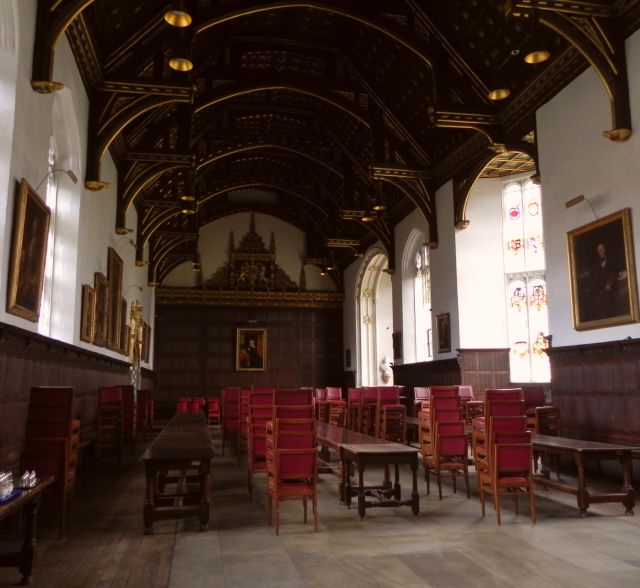
The Hall of St John's College Cambridge

When I visited the city recently I took a look around St John’s College where the Parnassus Plays were originally performed. The venue isn’t stated, but it seems likely they would have used the Hall which dates back to 1511-20. This magnificent room has a hammerbeam roof and linenfold panelling and is still used as a dining hall, although it’s been enlarged. Some of the windows contain 15th century glass. Could this Hall also have been the venue for the performances of Hamlet, with the College’s many connections with drama and poetry?

I was surprised to find that apart from a rehearsed reading of the third play at the Globe Theatre in 2009, the Parnassus plays have remained unperformed for centuries. The only book about them seems to be Paula Glatzer’s The Complaint of the Poet: the Parnassus Plays, dating from 1977, and there’s no more modern edition than Leishman’s dating from 1949. I’d love to be wrong about this so if you know of productions please let me know!

Paula Glatzer reminds us that the Parnassus Plays are some of the earliest records to explain how writers or would-be writers felt they were perceived by others. The story they tell about Shakespeare isn’t straightforward but the plays do also tell us about the life, beliefs and preoccupations of students in Shakespeare’s time, which turn out to be remarkably similar to those today.

Share
Posted in Legacy, Shakespeare's World | Tagged , , , , | Comments Off on The Parnassus Plays: our fellow Shakespeare

Shakespeare’s plays in his lifetime: the Cambridge Conference

William Kemp

One of the sessions in the recent Cambridge Shakespeare Conference was on Shakespeare’s Plays in his Lifetime. Frustratingly little is known about the performance of Shakespeare’s plays and how they were originally received so I looked forward to hearing from people who are carrying out active research.

 Each of the three papers took a different aspect of the subject: one about how Shakespeare reflected contemporary political events, another about the complicated relationships between plays and writers, and the third about the activities of provincial acting companies.

 Alisa Manninen, from the University of Tampere, reminded us that Macbeth can be perceived not just as a compliment to the new Scottish King, James 1, containing references to his known interest in witchcraft and his own lineage, but also as a political play optimistically suggesting that the union of the two countries will produce a period of freedom from rebellion. The contrasting views of England (stable and peaceful) and Scotland (divided and dangerous) in the play certainly did not represent the reality of the situation.

 Steve Roth ventured into the murky waters of the so-called War of the Theatres. He illustrated his paper with quotations showing how much Shakespeare’s Hamlet built on the already-popular genre of revenge drama, containing deliberate echoes of earlier plays. He quoted a speech from the play The True Tragedie of Richard III, published anonymously in 1591-2. This is part of Richard’s speech before his death:

 The screeking Raven sits croking for revenge.
Whole heads of beasts come bellowing for revenge.
And all, yea all the world I thinke,
Cries for revenge, and nothing but revenge.

 In Shakespeare’s play, Hamlet calls for the murderer in the play within the play to begin:

Come; the croaking raven doth bellow for revenge

 It’s recorded that Jonson was paid to make new additions to “a book called Richard Crookback”, which might have been this same play, as well as to The Spanish Tragedy and others.  Did Shakespeare deliberately mock Jonson’s work when he came to write his own revenge tragedy? Was the play of Hamlet itself the “purge” which according to one of the Parnassus Plays, Shakespeare gave to Jonson?

 None of the plays for which Jonson wrote revisions were acknowledged in his Folio, published in 1616, making a clear distinction between his bread and butter rewriting work and the creative writing of which he was so proud.

 While it’s interesting to speculate, Roth reminded us that this period of theatre history is complex, and it’s impossible to prove the extent of Shakespeare’s involvement.

 Siobhan Keenan from De Montfort University gave a paper looking in detail at a reference to two of Shakespeare’s plays performed in Yorkshire in 1609-10. The plays are mentioned incidentally: in 1611 the Simpson Players found themselves caught up in a Star Chamber case against Sir John Yorke of Nidderdale, owner one of the houses which they visited. One of their plays was perceived as “popish”, and in their defence an actor listed other plays they had performed including: “Perocles, prince of Tire, And […] king Lere”. These “so plaid were vsuall playes And such as were acted in Comon and publick places and staiges”.

 The company in question consisted of nine working men, mostly related to Christopher Simpson, a cordwainer. Records show that a few years after the case the troupe performed at nine different houses in the area over the first two weeks of January, the end of the Christmas holidays. Comparisons with the “hard-handed men that work in Athens” who perform for Duke Theseus on his wedding day in A Midsummer Night’s Dream are irresistible.

 The choice of plays is interesting. Both Pericles and King Lear had recently been published, so the texts would be available for other companies to perform. Provincial audiences seem to have been keen to see the same plays that were popular in the capital, even though they might be thought too ambitious for a small itinerant group to try. Can we assume that Shakespeare’s reputation was such that his plays were in particular demand?

 It seems likely that provincial acting companies actively sought out printed plays, using them as the basis for prompt books for their own performances. Although it wasn’t mentioned as part of the paper, the fact that these published plays were performed confirms that the London acting companies who owned the scripts, were justified in not supporting their publication. As soon as they had been published they could easily be taken and performed by other companies. Unlike the poems Venus and Adonis and The Rape of Lucrece there’s very little evidence that the plays were intended to be printed.

It’s to be hoped that more evidence of Shakespeare’s plays being performed across the country will emerge, especially as the University of Toronto’s Records of Early English Drama project continues.   

Many thanks to the three participants for contributing to this interesting session and to Duncan Salkeld for convening it.

Share
Posted in Plays and Poems, Shakespeare's World | Tagged , , , , , , | Comments Off on Shakespeare’s plays in his lifetime: the Cambridge Conference

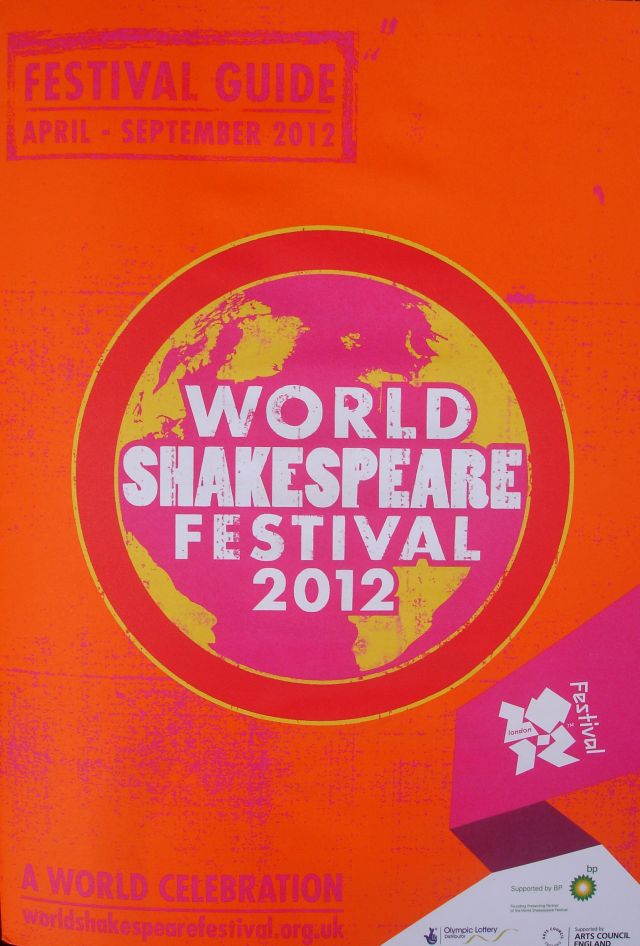
World Shakespeare Festival: is all the world a stage?

The plans for the biggest Shakespeare Festival ever to be staged have just been released. The World Shakespeare Festival will run from 23 April until September 2012, bringing artists from all over the world together in a UK-wide festival in venues including Stratford-upon-Avon, London, Newcastle, Birmingham, Bridgend, Brighton and Edinburgh. The Festival Guide lists hundreds of events that’ll be taking place including the Open Stages strand in which 263 amateur productions will be staged.

 The RSC, which is organising the Festival, is no stranger to managing big events. In 2006-7 it successfully organised the Complete Works Festival in which all Shakespeare’s plays and poems were performed over a complete year, by a mix of companies from around the world.

 Some of the events sound fascinating: Shakespeare’s Globe has set itself the challenge of welcoming guest companies performing 37 plays in 37 languages from Armenian to Yoruba over a period of six weeks, showcasing Shakespeare’s global appeal. Elsewhere, some of our most distinguished actors will be taking part: Jonathan Pryce will play King Lear at the Almeida and Simon Russell Beale will appear as Timon of Athens for the National Theatre. The RSC itself promises some fascinating productions: a Julius Caesar set in Africa, a Brazilian take on the Wars of the Roses, Two Roses for Richard III, and The House of Fairy Tales trail through the life of Shakespeare and his plays.

 So why do I feel a bit disappointed? The Shakespeare Festival is the culmination of the Cultural Olympiad which runs alongside the Olympic Games. Like many other people I was unable to get tickets but I know I’ll be able to get a brilliant view of events, free of charge, by watching the Olympics on TV.  I may not get the thrill of being actually there, but I know that when I watch the final of the men’s 100 metres I’ll be one of hundreds of millions holding my breath, willing Usain Bolt to smash the world record of 9.58 seconds.

 But where are the big, must-see, participatory events in the World Shakespeare Festival, the ones that will bring people together with a real sense of celebration?

 Michael Boyd has said about Shakespeare “People of all races, creeds and continents have chosen to gather around his work to share stories of what it is like to be human. To fall in love or fall from grace. To be subject to the abuse of power or to live with the dreams of angels in the shadow of our own mortality”.

These are fine sentiments, but by concentrating on theatre productions of Shakespeare surely the Festival is preaching to the converted, to people who are already theatre audiences or Shakespeare fans? The events aren’t cheap: many productions start at £12. The British Museum exhibition will cost £14, and the three day education conference, Worlds Together, at Tate Modern, will cost an eye-watering £395. What of the people who can’t afford these prices, who’ve never set foot in a theatre, or who live in the back of beyond?  If I lived in Cardiff, Manchester, or Inverness, let alone Johannesburg or Tokyo, I’m not sure I’d feel very involved.

We’ve all experienced great events like the Last Night of the Proms, shared not just by people at the Royal Albert Hall, but people attending a parallel concert in the park, those watching on live relays around the country and viewers on TV all over the world. I recently attended the National Theatre Live performance of One Man, Two Guvnors, a joyous evening made even more enjoyable by knowing that it was being simultaneously broadcast to cinema audiences worldwide. How much would it mean to people in India, China or Brazil to see performers from their own country performing Shakespeare in England?

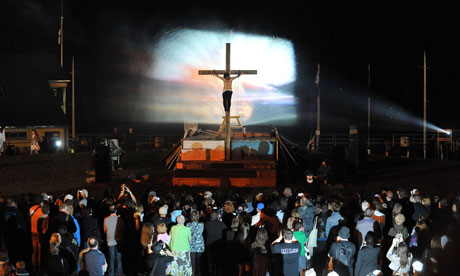
Earlier this year, over the Easter weekend, the Port Talbot performance of The Passion, over 72 hours, was seen to be “changing the shape of participatory performance”. It used a whole range of methods including YouTube and Twitter to involve what Lyn Gardner in her fascinating report for the Guardian called “a hyper-connected 21st-century audience, particularly those who seldom go anywhere near a theatre building”.

Shakespeare’s special gift is to bring people from around the world together regardless of culture, age or income. Surely there should be something in the World Shakespeare Festival that will confirm, especially for the less privileged, that Shakespeare deserves to be “the favourite playwright and artist of the whole world”?

Share
Posted in Legacy, Shakespeare on Stage | Tagged , , , , , , , | 8 Comments

Treasures of St John’s, Cambridge


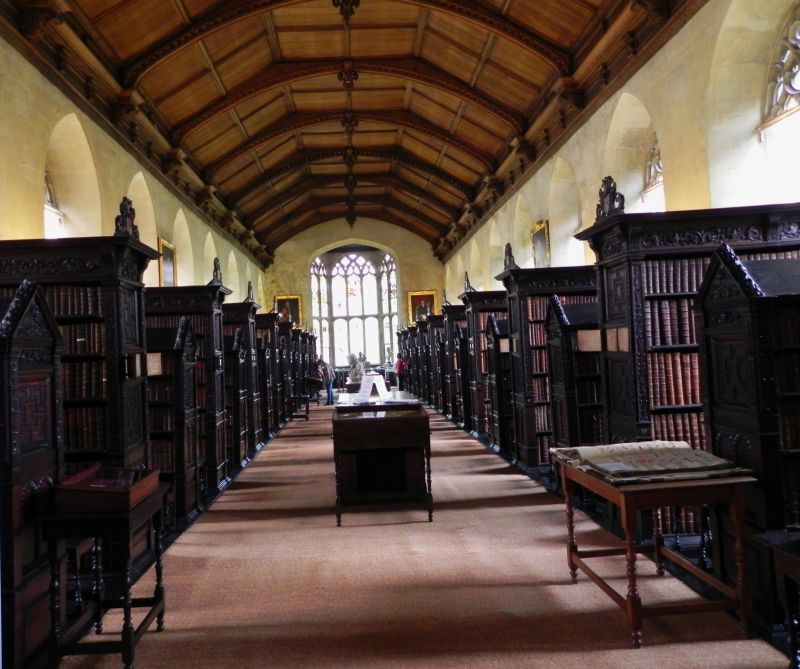
The Old Library, St John's College

From 9-11 September Heritage Open Days all over the country celebrated the history, architecture, art and gardens of the UK.  The City of Cambridge opened up many of its historic sites, and while staying in the city I visited the display of Treasures at the Old Library in St John’s College. 

 In 2011 St John’s College is celebrating five hundred years since its foundation by Lady Margaret Beaufort, the mother of Henry VII. One of the items on display was owned by her, a woman who had an extraordinary life. She was married four times, outliving all her husbands. She gave birth to her first son at the age of only 13 and lived to see both her son and grandson crowned kings of England.


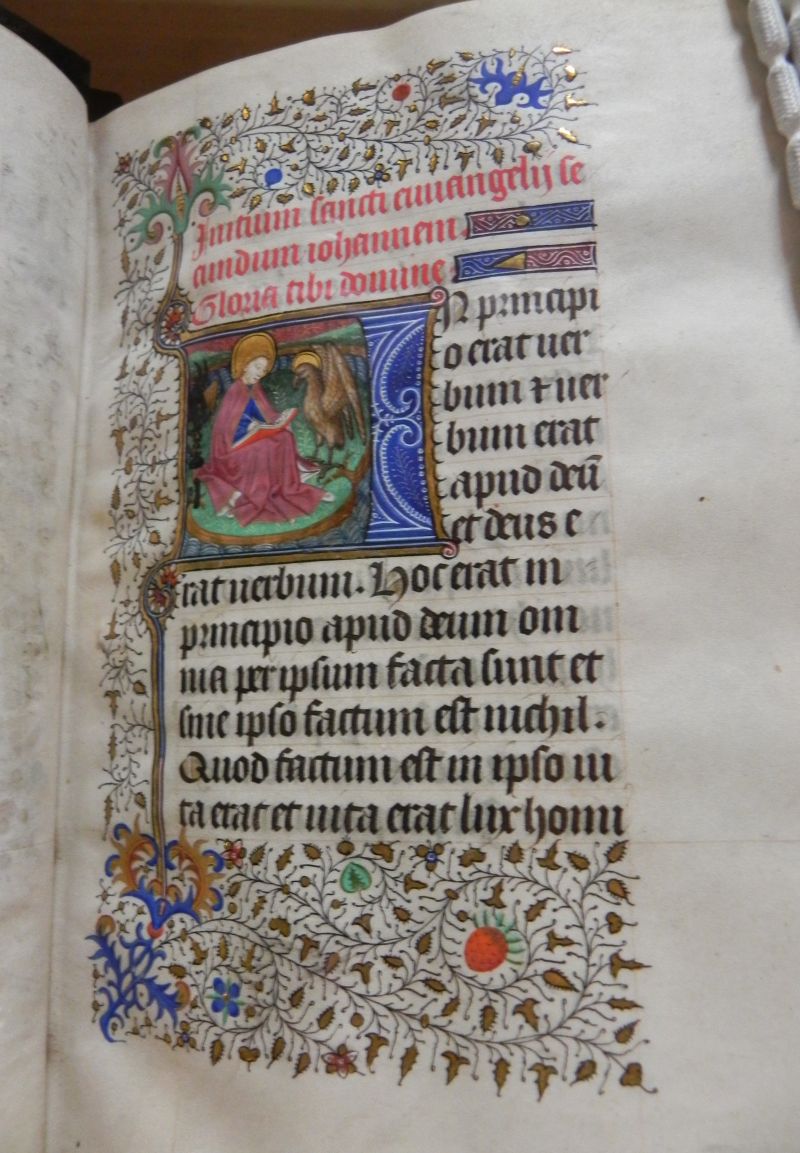
Lady Margaret Beaufort's Book of Hours

Her illuminated book of hours contains prayers and readings in Latin as well as exquisite illustrations. It’s thought to have been created in France around 1440 and used by her towards the end of her life. The illustration shows St John the Evangelist with his emblem, also that of the college, the eagle.

 St John’s is one of Cambridge’s oldest and most distinguished colleges. Three plays known as the “Parnassus” plays were written and performed by students of St John’s around 1600. These mention Shakespeare, but I hadn’t realised how many people with Shakespeare connections were students at the college. These include Roger Ascham, William Cecil, John Dee, Thomas Nashe, Robert Greene and most importantly Henry Wriothesley, 3rd Earl of Southampton. Wriothesley was Shakespeare’s patron to whom he dedicated Venus and Adonis and The Rape of Lucrece, both specifically mentioned in the Parnassus plays.

 He was a royal ward under the care of William Cecil, Lord Burghley, who had also studied at St John’s, and graduated aged only 16 in 1589. He’s also indirectly responsible for the building of the Old Library. Later in his life he encouraged William Crashaw, a noted poet and bibliophile, also a graduate of St John’s, to pass his books on to his old college.  Crashaw had “gathered up out of many nations, one of the most complete libraryes in Europe” and in 1615 he offered the College his 500 manuscripts and up to 3000 printed books. He credited Wriothesley with the idea.

The Irish psalter

Crashaw suggested a better room was needed to house the collection, prompting the building of the library, and passed all the books over to Wriothesley until it was completed. The building was finished in 1624, the same year Wriothesley died.  It’s a beautiful example of Jacobean architecture, and still contains the original carved oak bookcases. Among the Treasures on display was the late 10th Century Irish Psalter, the oldest complete book in the College’s collections, one of the manuscripts from Crashaw’s collection which came to the College via Wriothesley. The image is of a stylised representation of the crucifixion of Christ.


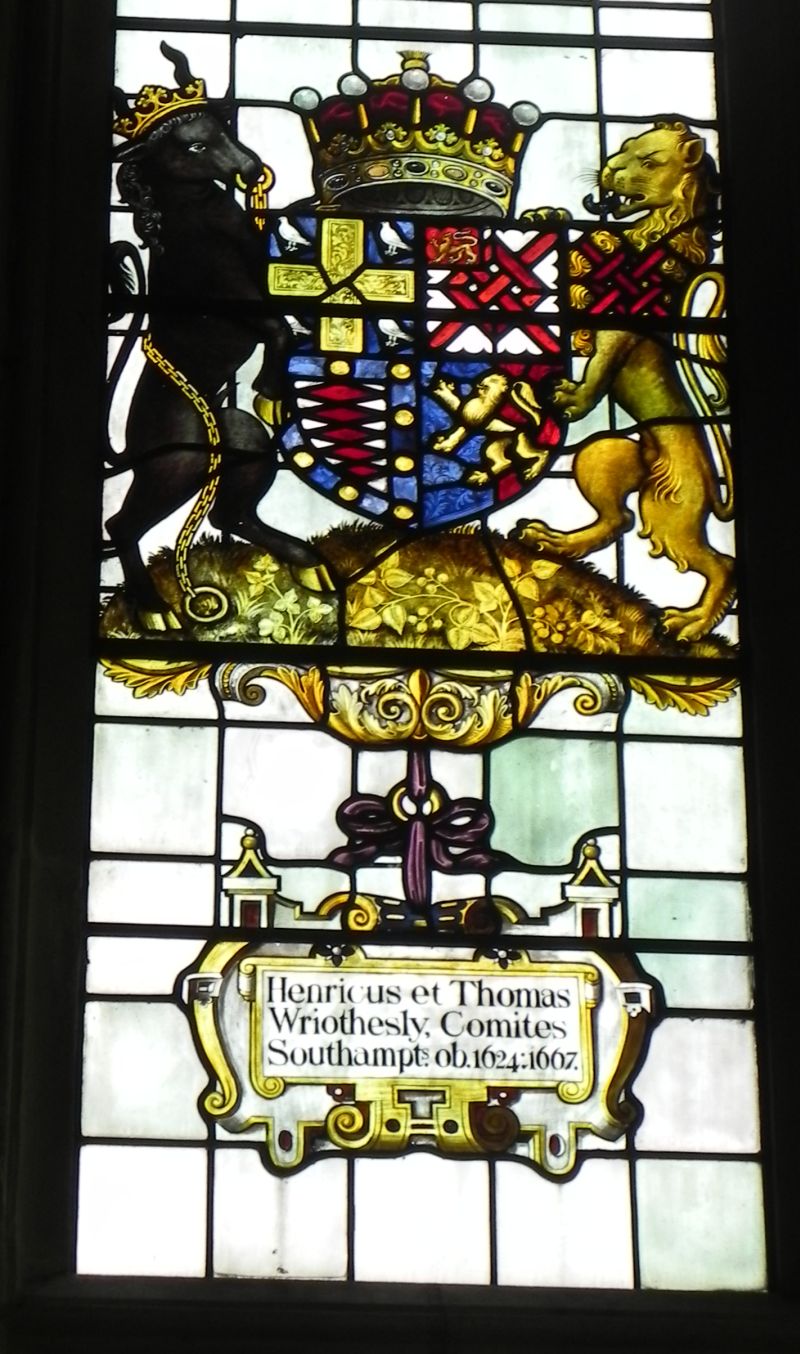
The Wriothesley coat of arms

The window that overlooks the River Cam contains a stained glass panel commemorating Wriothesley’s contribution to the College’s library and its collections.

Share
Posted in Legacy, Shakespeare's World | Tagged , , , , , , | Comments Off on Treasures of St John’s, Cambridge