Michael Rosen and Shakespeare for children

Michael Rosen

I recently spent a day at the Cambridge Shakespeare Conference, its theme Shakespeare: sources and adaptations.  It opened with a thought-provoking lecture by Michael Rosen, Children’s Laureate 2007-2009 and Shakespeare enthusiast. To an audience who needed no convincing of the importance of Shakespeare or poetry he asked two big questions “How do you familiarise young people with Shakespeare?” and “How do you transmit ideas about poetry?

He suggested that childrens’ authors “talk to the child we were”, but how many of us really remember what turned us on to Shakespeare or poetry? And seeing how much the world has changed since any of us were children, how can we help today’s children to get as much as we all do from Shakespeare?

 As Children’s Laureate his job was “to rush about being enthusiastic” and he treated us to a description of some of the methods he’s used in the past to enthuse children about Shakespeare as well as making some suggestions for things people might try.

 His most compelling anecdote, and the one which I think we all sympathised with, was the story of the school he visited expecting to run a session with 15-16 year olds, only to find that the children were only 11. He had selected a scene that he thought teenagers would respond to, the scene in Romeo and Juliet where Juliet is rejected by her parents because she refuses to marry the man they choose for her. With no opportunity to rethink, he carried on regardless, getting the children to break up into groups to interpret part of the scene. He was astonished by the strength of the emotional response of the children. The moral, I think, is that we should not patronise younger children by assuming that they can’t get anything from Shakespeare just because they don’t understand every word.

Among his other suggestions was one which has become very popular: looking at the play from the point of view of one of the characters in it, as Tom Stoppard’s wonderful play Rosencrantz and Guildenstern are Dead does. An example of this was seen during the conference when Tim Crouch’s one man play I Caliban was performed by Jimmy Whiteaker. Tim Crouch has made a bit of a career of these plays which “involve the audience in a direct way and focus on telling the story of each play through the eyes of a character who watches the main action from the sidelines”. He’s also written and performed I Banquo, I Peaseblossom and I Malvolio, the last of which is currently touring. Also part of the conference was a rehearsed reading of a new play by Rory Stallibrass, Mamillius, based on the character in The Winter’s Tale.

Active participation is the thread that runs through much of the educational work currently being done on Shakespeare, like the RSC’s Stand Up for Shakespeare campaign.

Alternative approaches that particularly appeal to younger people came in for discussion in the Shakespeare in Unconventional Media session, not part of the formal education strand. Why not try to involve young people using communication methods they already use, like Facebook and Twitter?  Alicia Williams’ paper tackled these ideas, and she kindly gave me a copy of her paper which I hope she doesn’t mind me referring to.
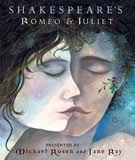
 Her paper looked at two projects based, again, on Shakespeare’s Romeo and Juliet. One, called Live Music, encouraged people to contribute via Facebook to an animated film. Those taking part could download storyboards and designs, and all the shots submitted were visible for voting and review before being incorporated into the final 6-minute film.

 The second example was the RSC’s Such Tweet Sorrow which depended on six actors adopting online personas from the play, sending tweets based on daily guidance documents supplied to them. Each of the personas received and acted on tweets from their followers. Juliet, not surprisingly the most popular of the personas, built up over four and a half thousand followers in the course of the project. It’ll be interesting to see how projects using social media continue to develop over the next few years, involving more and more participants in imaginative ways.

 For my own full engagement with Shakespeare I have to thank my English teacher, Miss Jones, who set my first A level essay question, “What expectations does the first scene of Hamlet raise in the audience?” This question made me look really hard at the words on the page and use my own imagination to create a performance based on what Shakespeare wrote.  It was a great gift and one I’m still grateful for. A few years later I was lucky enough to see some brilliant productions of Shakespeare that lived up to the performances I’d imagined in my “mind’s eye”, performed by actors who spoke Shakespeare’s words superlatively.

 I know I’ve been fortunate, and I’d be delighted to hear from anyone who would like to share their special Shakespeare moments.

Share
Posted in Plays and Poems, Shakespeare on Stage | Tagged , , , , , , , | 7 Comments

Shakespeare’s magical island in The Tempest

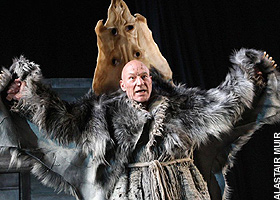
Patrick Stewart as Prospero in Rupert Goold's RSC production. Photograph by Alastair Muir

Where is the unnamed isle in The Tempest? The literal-minded will say that it’s obviously in the Mediterranean, where a ship headed from Tunis to Italy might have foundered.  Those who know Shakespeare’s written sources will mention Strachey’s 1610 letter and other documents that describe a shipwreck which took place on the coast of Bermuda.

 Shakespeare seems to have adopted a pick’n mix attitude to the various written sources which he used, including that letter, an essay by Montaigne, Ovid’s Metamorphoses and many others. He’s deliberately contradictory and evasive when describing the magical island, and theatre companies have always grasped the imaginative possibilities it presents.

 A new production of the play, starring Ralph Fiennes as Prospero, directed by Trevor Nunn, has recently opened in the West End of London. From the photographs and reviews, Nunn seems to have adopted a traditional approach to the design, the recently-shipwrecked Italians dressed in Elizabethan/Jacobean costumes while Prospero and Miranda wear plainer clothes of an indeterminate period. The question of location has, it seems, been left open.

 In 2006 Rupert Goold took the bold decision to set his RSC production in the frozen north. This seemed to be an eccentric choice. Isn’t the island supposed to be hospitable? Or are we conditioned to think it’s some kind of paradise, like that conjured up by the theme music for the Radio 4 series Desert Island Discs, which beguilingly suggests palm trees, blue seas, and golden sands?

 Even the characters on the island see it differently depending on their personalities. Of the shipwrecked Italians, Gonzalo and Adrian are positive about their surroundings, while Antonio and Sebastian can see only bad.

Adrian:            … the air breathes upon us here most sweetly
Sebastian:        As if it had lungs, and rotten ones.
Gonzalo:         Here is everything advantageous to life.
Antonio:          True; save means to live.
Gonzalo:         How lush and lusty the grass looks! How green!
Antonio:          The ground, indeed, is tawny!
Sebastian:        With an eye of green in’t.

While Goold’s production was admired for incorporating Inuit culture into his “totally coherent vision of the play” Dominic Cavendish wrote that:

Goold is undoubtedly a creative force to be reckoned with but he’s gone overboard here…: the feast magically presented to the oppressed travellers …becomes a dragged-on dead whale, yielding bloody, raw meat, and the nuptial masque for Ferdinand and Miranda… is now a faintly ludicrous tribal ceremony involving the couple being blindfolded and assailed by much incomprehensible chanting.

The audience was left puzzled rather than uneasy, the island unfamiliar and threatening, so Adrian’s comment that the island is “uninhabitable, and almost inaccessible”, certainly fitted with the Arctic setting.

The shore of Jan Mayen island showing driftwood from the forests of Siberia

Among the sources for the imaginary island, though not documented, must be stories of voyages to far-off places which would have been brought back to England by travellers. Not all voyages were to the south, east or west. English explorers were also travelling north.

 The islands of Jan Mayen, off Greenland, and Spitsbergen, far north of Norway, were discovered during Shakespeare’s lifetime and both were visited by English explorers around 1607. Jan Mayen is a desolate place, dominated by a huge active volcano, the land black as a result of the latest eruption with glaciers stretching down to the sea shore. Spitsbergen is a land of snow and huge jagged mountains, so far north that in the summer the sun never sets, followed by months of perpetual night in winter.


Part of Spitsbergen

It took several years to organise after those early exploratory journeys, but the first English whaling expedition to Spitsbergen took place in 1611, employing a number of experienced Basque whalehunters to accompany the English crews. Those early sailors might well have agreed with Gonzalo:

 All torment, trouble, wonder and amazement
Inhabits here; some heavenly power guide us
Out of this fearful country!

 Is it fanciful to think that Shakespeare heard about these islands, and incorporated stories about them into his imaginary isle of The Tempest?

 I recently spent a wonderful day researching the early history of whaling at the Scott Polar Institute Library in Cambridge and in a further post I’ll be writing more about the adventures of English sailors in the far north.

Share
Posted in Plays and Poems, Shakespeare's World | Tagged , , , , , , , , | 6 Comments

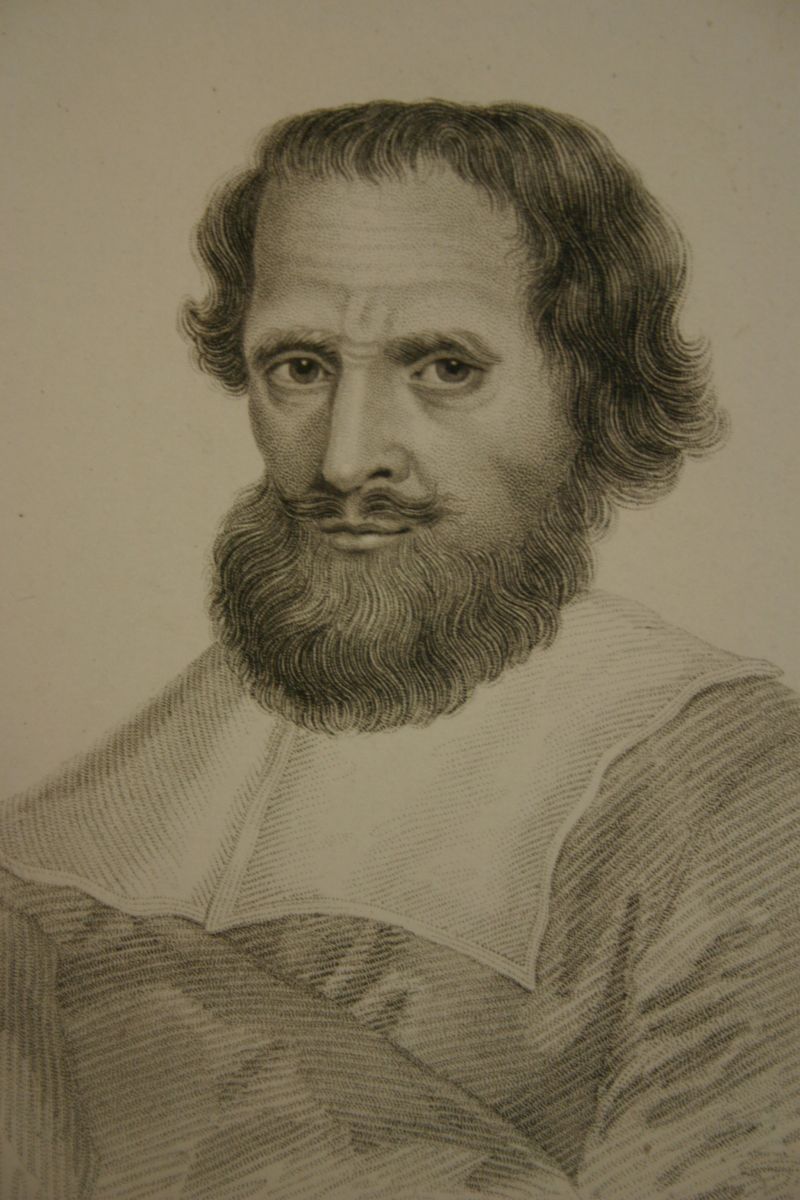
Simon Forman, Shakespeare and the stage

Simon Forman

12 September 2011 is the 400th anniversary of the death of the colourful astrologer-cum-physician Simon Forman – or perhaps it was 11 September, or even 5 September, accounts vary.  Whichever is correct, Forman was a well-known, even notorious figure in Shakespeare’s London, said to be the inspiration for Ben Jonson’s play The Alchemist, and a great example of the vibrancy of English life.

 Simon Forman was born in 1552 in a hamlet outside Salisbury. Following a grammar school education he attempted to study at Oxford but was forced to cut short his formal education due to lack of money. He did most of his studying while working as a teacher. He was found with magical books and imprisoned, but despite his lack of training in 1592 he still managed to set himself up as an astrologer and physician in London. His casebooks, now at the Bodleian Library in Oxford, give details of 10,000 consultations. They show that he dealt with a wide range of matters, and began each consultation with an astrological reading. One common question was whether a man or his wife would die first. There’s a transcript of Forman’s formula for working this out here

Here’s an example using a fictional couple:

 Mary & Jhone being man & wife which shall die first. Mary the number of her letters are 4 & the number of the letters of Jhone are 5 & Jhone is the elder & she was a mayd & he a bacheler & neyther of them was contracted to any other before, & the number of boath of the names being added togeather make 9 then because Jhone is the elder I begin with Jhone & say Jhone mary Jhone mary 9 times & the number doth end on Jhone. Therfore dico quod Jhoanna prius morietur.

 The Casebook Project is currently under way to digitise and transcribe Forman’s casebooks as well as those of his follower Richard Napier, aiming to  make available a huge amount of information about the preoccupations and beliefs of the people who consulted these men. Here’s a link to an article by expert Lauren Kassell about Forman and the project. 

The Royal College of Physicians fined Forman for practising medicine without a licence, and in 1601 they complained that he was the worst of the “unlearned and unlawful practitioners, lurking in many corners of the City”. We’d find the methods of most of the scientists of this period hard to take seriously today. Queen Elizabeth’s astrologer, John Dee, was a famous, learned and highly regarded mathematician, but was better known for practising alchemy and being associated with the occult. Even the highly-regarded physician John Hall, Shakespeare’s son in law, prescribed alarming-sounding remedies to his patients.


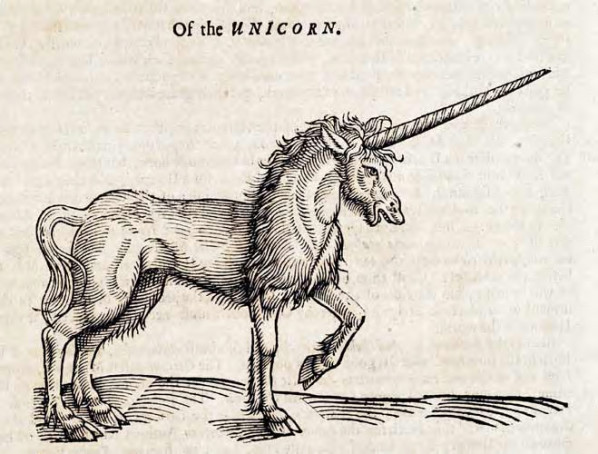
The unicorn from Topsell

It wasn’t just the workings of the human body that fascinated the Elizabethans and Jacobeans. They strove to document and explain the world around them, but were defeated by the complexity of the world that was opening up to them. Myth and fact sat side by side: Topsell’s 1607 History of Four-Footed Beasts contains information about domesticated animals like horses and goats as well as the mythical unicorn.

 Forman was a compulsive record keeper, describing performances he attended at the theatre. He went to see Macbeth, and was impressed by the medical and magical elements of the play, especially the presence of a doctor making notes of Lady Macbeth’s words as she sleep-walked. You can find the full description here , but this is an extract:

 In Macbeth at the Globe, 1610, the 20 of April, Saturday, there was to be observed, first, how Macbeth and Banquo, two noble men of Scotland, riding through a wood, there stood before them three women fairies or nymphs, and saluted Macbeth, saying three times unto him, “Hail, Macbeth, King of Codon; for thou shall be a King, but shall beget no kings,” etc. Then said Banquo, “what all to Macbeth, and nothing to me?” “Yes”, said the nymphs, “hail to thee, Banquo, thou shall beget kings, yet be no king”; and so they departed …

And Macbeth…through the persuasion of his wife did that night murder the King in his own castle, being his guest; and there were many prodigies seen that night and the day before. …

Then was Macbeth crowned kings; and then he…contrived the death of Banquo…. The next night…the ghost of Banquo came and sat down in his chair behind him. And he…saw the ghost of Banquo, which fronted him so, that he fell into a great passion of fear and fury, uttering many words about his murder, by which, when they heard that Banquo was murdered, they suspected Macbeth. …

Observe also how Macbeth’s queen did rise in the night in her sleep, and walked and talked and confessed all, and the doctor noted her words.

 Forman is supposed to have predicted the date of his own death, and it’s somehow appropriate that the exact date and circumstances aren’t clear. The Casebook Project should throw light on many areas of life in Shakespeare’s London.

Share
Posted in Plays and Poems, Shakespeare's World | Tagged , , , , , , , , , | Comments Off on Simon Forman, Shakespeare and the stage

Shakespeare and the Internet series

I’ve recently contributed a post to a new series of blogs published by James Harriman-Smith at Open Shakespeare, part of the Open Knowledge Foundation. The subject of the series is Shakespeare and the internet and my post, called Finding Needles in Haystacks, will be the first one to appear on Monday 12 September. It sounds like it’s going to be a great series, and I’m looking forward to seeing what the other contributors have to say.  This is now live here!

Share
Posted in Legacy | Tagged , , | Comments Off on Shakespeare and the Internet series

Shakespeare’s mothers and sons


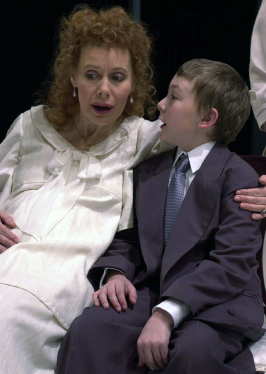
Hermione (Barbara Robertson) and Mamillius (Zach Gray), Photo by Michael Brosilow, Chicago Shakespeare Theatre, 2003.

Towards the end of Shakespeare’s life, early September must have been a sad time, not just because it signalled the end of summer. Both parents died at this time of year: his father was buried on 8 September 1601, and seven years later, on 9 September 1608, his mother Mary. We know little about Shakespeare’s parents. John came from the little village of Snitterfield where his father rented a farm owned by Mary’s father Robert. He was an ambitious young man, moving into Stratford-upon-Avon, learning to be a skilled glover, and getting himself onto the newly-established local  council. Mary’s family lived in the village of Wilmcote, part of the “ancient and worthy family”, the Ardens. Mary was the youngest of eight sisters, and must have been a capable young woman as she was named as one of the executors of her father’s will as well as being a major beneficiary. John was lucky to catch a woman with an inheritance. The date and place of their marriage is unknown but probably took place during 1557, the year following Mary’s father’s death. There’s no evidence that either was educated, but their country background doesn’t mean they were completely illiterate.

Scientific studies are now proving that the first few years of a child’s life are crucial to their development. In Shakespeare’s time women were responsible for the rearing of young children, and his mother’s influence would have been very important. As John and Mary’s first surviving child, following two sisters who died young, William must have been dearly cherished.

 Shakespeare writes several scenes showing young boys and their mothers in a close and affectionate relationship.  In The Winter’s Tale Mamillius begins to tell his mother a story before the cosy scene is broken apart by Hermione’s arrest on suspicion of infidelity.

 Hermione        Come sir, …; ‘pray you, sit by us,
                          And tell’s a tale.
Mamillius        Merry, or sad, shall’t be?
Hermione                                    As merry as you will.
Mamillius        A sad tale’s best for winter: I have one
                        Of sprites and goblins.
Hermione                                            Let’s have that, good sir.
                        Come on, sit down, come on, and do your best
                        To fright me with your sprites: you’re powerful at it.
Mamillius        There was a man –
Hermione                                            Nay, come sit down: then on.
Mamillius        Dwelt by a churchyard; I will tell it softly,
                        Yond crickets shall not hear it.
Hermione                                            Come on then,
                        And giv’t me in mine ear.


Engraving of Constance and Arthur in King John

Many of the children in Shakespeare’s plays are parted from their mothers by death or politics, the separation made more poignant by the distress of their mothers. In King John, Constance’s son Prince Arthur has been taken away from her:

 Grief fills the room up of my absent child.
Lies in his bed, walks up and down with me,
Puts on his pretty looks, repeats his words,
Remembers me of all his gracious parts,
Stuffs out his vacant garments with his form;
Then have I reason to be fond of grief? …
O Lord! My boy, my Arthur, my fair son!
My life, my joy, my food, my all the world!

Richard III’s greatest crime is the killing of the little princes in the Tower of London. This event is the catalyst that unites three women, not natural allies, in cursing the man responsible for many deaths. A series of ritual incantations express their rawness of emotion, and can be one of the most powerful moments in the play.

 Shakespeare knew what it felt like to lose a child, both from observing his own mother when as a 15-year old boy his 7-year old sister Ann, died, and from his own experience of losing his son Hamnet in 1596, aged only 11.


Share
Posted in Plays and Poems, Shakespeare's World, Stratford-upon-Avon | Tagged , , , , , , , | 4 Comments

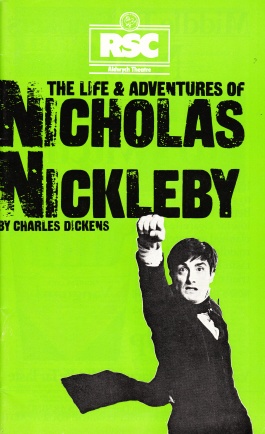
The Nicholas Nickleby phenomenon: a Royal Shakespeare Company triumph remembered

The Life and Adventures of Nicholas Nickleby, one of the most successful productions in the RSC’s history, has rightly been marked with an event in the RSC’s programme celebrating 50 years of outstanding theatremaking.

 The adaptation of Charles Dickens’ comic novel opened in June 1980 at the Aldwych Theatre, initially for an eight-week run. The eight and a half hour two-part production became a sellout, playing for two more seasons at the Aldwych, then being filmed at the Old Vic before transferring to Broadway from September 1981-January 1982. The filmed version was shown as the first major drama broadcast on Channel 4. In 1985-6 the RSC revived the production with a new cast, performing it in Stratford-upon-Avon, Manchester, Newcastle-upon-Tyne, Los Angeles and Broadway and since then a shortened version has also been performed at Chichester. Information can be found on John Caird’s website.

I’d always loved Dickens as well as Shakespeare and found the combination irresistible. I went to the very first all-day performance, and saw each version at least twice, attending all three of the last nights at the Aldwych. On Sunday several of the original members of cast got together again: Christopher Benjamin, Suzanne Bertish, Janet Dale, Patrick Godfrey, Julie Peasgood, Edward Petherbridge, Emily Richard, Timothy Spall and David Threlfall, as well as co-director John Caird, adapter David Edgar and designer John Napier. A group of five musicians performed some of Stephen Oliver’s original music and the actors performed some scenes from the production interspersed with film clips and reminiscences.

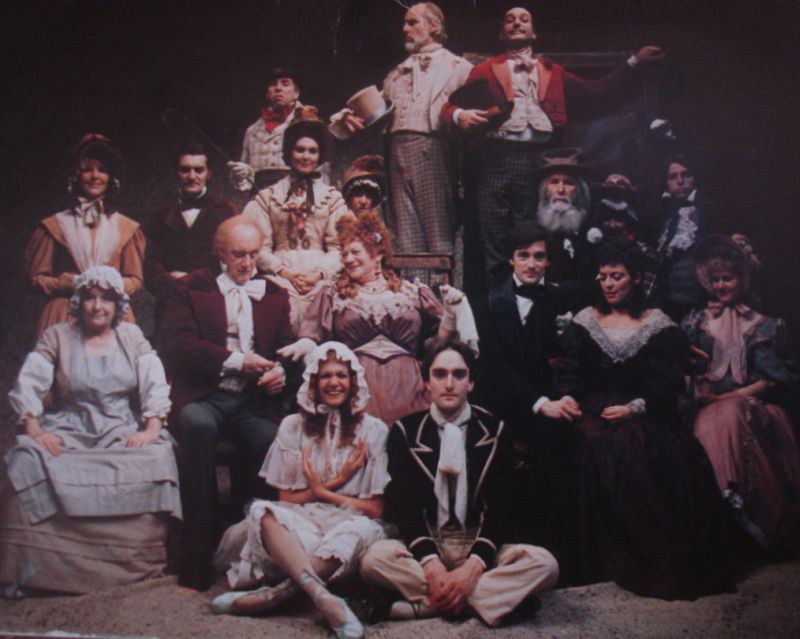
 This triumph was born out of near-disaster. John Caird explained how the RSC was faced with a drastic cut in Arts Council funding at the end of 1979. Instead of putting on two or three new productions inLondonin 1980 Trevor Nunn decided to put all the company’s available resources into one spectacular production. They may have been short of money, but they weren’t short of talented actors who were already used to working together and other creative people happy to improvise. The rehearsal period began in November in Stratford with a five-week workshop period. Each actor précised a chapter of the book, and researched an aspect of Victorian life. Only at the end of this period were parts allocated.

 David Edgar had been commissioned to adapt the novel. He was impressed early on by the way that all the complex interweaving plots of the novel echoed each other, stories of dysfunctional families all driven by money. He was able to add some interweaving of his own: rehearsals for the Crummles theatrical company’s production of Romeo and Juliet were cross-cut with real dramas. Juliet’s distress at being cast off by her parents when she refused to marry their choice of suitor was alternated with scenes showing Kate Nickleby’s helplessness at being pursued by the sinister Sir Mulberry Hawk (played memorably by the late Bob Peck). Smike, cast as the Apothecary in Romeo and Juliet, heartbreakingly repeated his line “Who calls so loud”, when dying in Nicholas’s arms.


The Crummles Company. Photograph by John Napier

Dickens was a writer with a real social conscience, but no real political views. His opinion has often been quoted as “if men would behave decently the world would be decent”. The production’s success relied in great measure on the choice of Roger Rees to play Nicholas, a bit of a prig in Dickens’ book. James Fenton wrote “I can think of few actors who are better at conveying, through facial expressions alone, a frank acquaintance with grief. It was a good move to cast such an engaging actor in the part of young Nickleby…because a striking character was required to add savour to the original”

 The play generated a fantastic hoax. Using forged headed notepaper a press release was sent out and letters were written to the company explaining that as a result of the success of Nicholas Nickleby the Royal Shakespeare Company was to be renamed the Royal Dickens Company. Several people were taken in by the scam, discovered to be the work of director Ken Campell.

Some of the initial reviews were disappointingly luke-warm. Michael Billington’s Guardian review was read out, followed by two letters written in response, one of which was my own. Word of mouth ensured the play’s success, helped by Bernard Levin’s review several weeks later which left no-one in any doubt that he thought the show

So richly joyous, so immoderately rife with pleasure, drama, and entertainment, so life-enhancing, yea-saying and fecund…  – so Dickensian.

 The evening ended with the “Farewell” song. In a lovely spontaneous touch David Threlfall, (Smike), invited Julie Peasgood, (The Infant Phenomenon) to dance, followed by the rest of the people on stage, treating the audience to the unexpected sight of David Edgar waltzing with Timothy Spall.

 A number of clips are on YouTube. This one is from a documentary with, about 3 minutes in, a live recording of the scene where Fanny Squeers invites Nicholas to tea.

 This clip is the same scene as filmed without a live audience, including the wonderful game of cards.

Share
Posted in Legacy, Shakespeare on Stage | Tagged , , , , , , , , | 8 Comments

The curse of Macbeth strikes again

Poor Jonathan Slinger, the RSC’s current Macbeth, seems to be the latest casualty of the so-called “curse of Macbeth”. He didn’t acquire his broken arm during any of his dangerous onstage moves but, rather prosaically, by being knocked off his bike in the street.

 Macbeth has been thought to be unlucky for centuries, perhaps ever since it was written. The spell cast by the weird sisters around their cauldron, conjuring ghostly apparitions and prophecies of Macbeth’s doomed future, is said to be genuine, and would have terrified superstitious members of Shakespeare’s audience.

 Eye of newt and toe of frog,
Wool of bat and tongue of dog…
Double, double, toil and trouble;
Fire burn, and cauldron bubble…
Finger of birth-strangled babe
Ditch-deliver’d by a drab,
Make the gruel thick and slab…
Cool it with a baboon’s blood,
Then the charm is firm and good.

 Ironically this part of the scene is omitted from the current production, the weird sisters being played by three children.

 The play has frightened actors as well as audiences. When Sarah Siddons first read the play in preparation for playing Lady Macbeth she recorded her impressions in her diary:

 I went on with tolerable composure in the silence of the night ‘til I came to the assassination scene. The horrors of the scene rose to such a degree that made it impossible to get further. I snatched up a candle and hurried out the room in a paroxysm of terror. My dress was of silk and the rustling of it, as I ascended the stairs to go to bed, seemed to my panic-stricken fancy like the movements of a spectres pursuing me. I capt my candlestick and threw myself on my bed where I lay without daring even to take my clothes off.

 The play turned out to be lucky for Sarah Siddons. She held audiences spellbound in the role of Lady Macbeth, playing it for over 25 years right up to her farewell to the stage in 1812.

 Some of the many mishaps blamed on the play are documented in Richard Huggett’s book The Curse of Macbeth. The Astor Place riot in New York in 1849 was said to be sparked off by the rivalry between Edwin Forrest, the leading American tragedian and English actor William Charles Macready, who were appearing in competing productions of Macbeth. A crowd 20,000 strong assembled, said to be organised by Forrest, and soldiers called in to control the riot mistakenly fired into the crowd killing 31 people.

 There have been accidents during rehearsals. Laurence Olivier was preparing for the opening night at the Old Vic in 1937 when he lost his voice and was nearly killed by a heavy weight falling in the wings. Then Lillian Baylis, the theatre’s manager, died of a heart attack two days before the first performance.  In 1967 Peter Hall was directing Paul Scofield in the play when Hall collapsed with a severe attack of shingles. It was feared that he would lose his sight.

 Many accidents have happened onstage, but is Macbeth really more prone to these than other plays? The stage is always a health and safety nightmare, though precautions are in place to make it as safe as possible. In the 1997 Hamlet, Susannah York fell off the stage late in rehearsals breaking a bone in her heel. Diana Quick replaced her at short notice and played the part for six weeks. Darrell D’Silva, the RSC’s most recent Antony in Antony and Cleopatra, had an accident which damaged his hand while handling a firearm in rehearsals.

 It seems unlikely that any of these are attributable to a mention of Macbeth, but Jonathan Slinger’s accident isn’t going to dispel the longstanding reputation of “The Scottish Play”.

Share
Posted in Plays and Poems, Shakespeare on Stage | Tagged , , , , , , , | 3 Comments

One-man shows and Shakespeare’s theatre

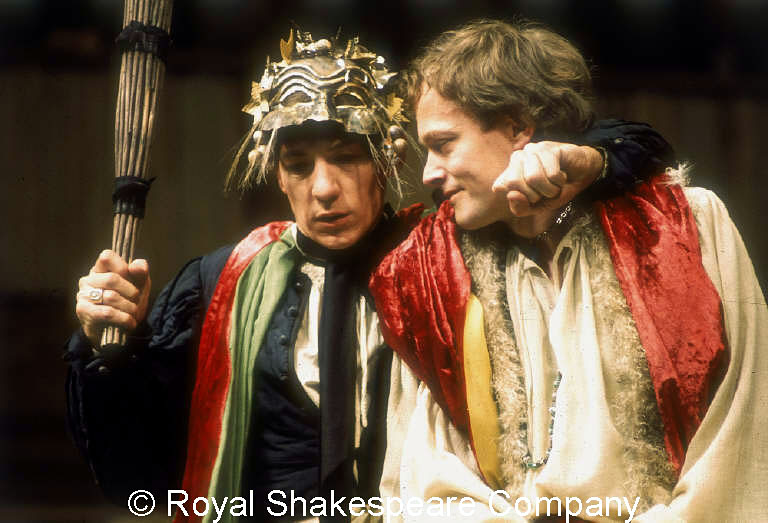
Ian McKellen as Romeo and Michael Pennington as Mercutio

Last week I saw Eduardo de Filippo’s play The Syndicate, currently touring UK towns and cities. It stars two great Shakespearean actors, Ian McKellen and Michael Pennington. Watching them in this subtle play it occurred to me that the last time I’d seen them together onstage was in 1977 in Romeo and Juliet at the Aldwych, where they’d played Romeo and Mercutio respectively. It was a heady time for the RSC. What I loved was the sense of company: Romeo and Juliet set in Renaissance Italy one night, a musical version of The Comedy of Errors in a Greek tourist resort the next, many of the same actors in both, performing with terrific panache.


Simon Callow in Being Shakespeare

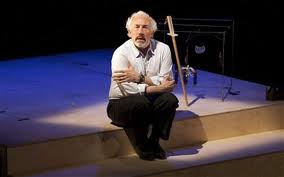
Both men have since had outstanding careers in Shakespeare and other drama. They’ve both also performed one-man shows about Shakespeare, Acting Shakespeare by McKellen and Sweet William by Pennington. This year I’ve also seen Simon Callow in his show Being Shakespeare and Roger Rees in What you Will. Incidentally Roger Rees played Benvolio in that same production of Romeo and Juliet.

John Gielgud performing Ages of Man

One-man shows about Shakespeare have a long history. John Gielgud, one of the greatest actors of the twentieth century, performed his Shakespeare recital Ages of Man from 1957-1979.  The recital was based on an anthology by the influential Oxford professor George Rylands, and Gielgud won a Tony Award, an Emmy and a Grammy for it. This interview with Gielgud includes, towards the end, a clip from the film of Ages of Man;
http://www.youtube.com/watch?v=65seXyvD7H4 

Ellen Terry as Queen Katherine in Henry VIII

The idea for Gielgud to put on his own Shakespeare performance came from his great-aunt, Ellen Terry, easily the most famous actress of the late nineteenth century. When she became too old to play them onstage, she performed extracts from her famous roles in Shakespeare’s Heroines.

 Just recently Judi Dench was interviewed on BBC Radio 4’s arts programme Front Row. One of Mark Lawson’s questions was about solo shows, and her answer was very revealing about her approach to working onstage.

 I wouldn’t do a one-woman show. It would be death for me. I would not know who to get ready for. I suppose it’s the support, and what appeals to me is the fact there’s a group of people…so there’s author, director, cast, audience and it’s something to do with that process of telling that story that I love… but I don’t want to do it on my own.

 I suspect that love of collaborative working in the theatre is something that Shakespeare would recognise. He wrote for a group of people he knew, and he would have imagined as he wrote how they would speak the lines, how they might move. He’d have heard stories of seafaring, gossip and odd turns of phrase in alehouses and in the streets. The film Shakespeare in Love shows Shakespeare writing in private, while picking up snippets (and even play titles) from all kinds of sources, and bouncing ideas around with friends and colleagues.  

 There’s a lovely section near the beginning of Romeo and Juliet where Romeo, who has been desperately in love with the unattainable Rosaline, meets his friends for an exchange of high-spirited laddish banter. His friend Mercutio says:

 Why, is not this better now than groaning for love? Now art thou sociable, now art thou Romeo; now art thou what thou art, by art as well as nature.

One-man plays are hugely enjoyable, giving actors the chance to show off their virtuosity, but it’s the interaction of theatre that really gives it appeal for audiences as well as professionals.

Share
Posted in Plays and Poems, Shakespeare on Stage, Shakespeare's World | Tagged , , , , , , , , , , , , , , , , | 5 Comments

Henry V, star of England

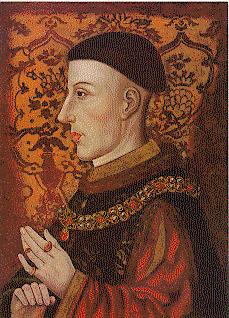
31 August is the anniversary of the death of that “star of England”, King Henry V. He died in France, where he had been on a military campaign to capture more of the country, in 1422 aged only 35.

 If you haven’t seen Henry VI Part 1 you might not be aware that this play begins with the funeral of Henry V in Westminster Abbey.  The Dukes of Bedford and Gloucester seem to be trying to outdo each other in their praise:

 Bedford
Hung be the heavens with black, yield day to night!
Comets, importing change of times and states,
Brandish your crystal tresses in the sky,
And with them scourge the bad revolting stars
That have consented unto Henry’s death…
Gloucester
England ne’er had a king until his time:
Virtue he had, deserving to command;
His brandish’d sword did blind men with his beams;
His arms spread wider than a dragon’s wings;
His sparkling eyes, replete with wrathful fire,
More dazzled and drove back his enemies
Than midday sun fierce bent against their faces.

This rare clip is from the English Shakespeare Company’s production, to my taste rather underplayed.
http://www.youtube.com/watch?v=6qTK0UsdQw4
 

Laurence Olivier

Shakespeare came to write Henry V some years after Henry VI , when he was on top form. Taking as his subject the greatest of English kings, he rose to the occasion with writing that is both superbly powerful and subtle. It’s a play that divides opinion. Richard Dutton, in his essay The Second Tetralogy, asks “Is it a celebration of national glory, with Henry a truly heroic warrior prince? Or is it a dark satire on warfare and the abuses of power, a prelude to the tragedies soon to follow?”


Kenneth Branagh

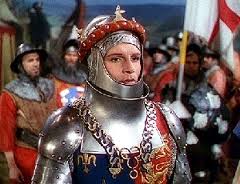
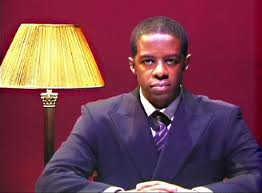
These questions weren’t raised in the Olivier film of the play, released during the dark days of the Second World War and quite deliberate propoganda. Modern productions though nearly always tackle them, and no matter how persuasive the great heroic speeches, today’s audiences are left in no doubt that the play is not as straightforward as it looks. In 1984 Kenneth Branagh’s stage performance for the RSC was dubbed the first post-Falklands Henry and Adrian Lester’s 2003 National Theatre performance was plainly a response to the war in Iraq.


Adrian Lester

Henry’s early death was seen as a national tragedy, the more so in retrospect since his son’s disastrous reign was overtaken by civil conflict and his father’s gains in France were lost. For Raphael Holinshed, writing his history of the country, Henry V was “a king, of life without spot, a prince whome all men loved, and of none disdained, a capteine against whome fortune never frowned, nor mischance once spurned…A majestie was he that both lived and died a paterne in princehood, a lode-starre in honour, and mirror of magnificence”.

Share
Posted in Plays and Poems, Shakespeare on Stage, Sources | Tagged , , , , , , | 4 Comments

Your actions are my dreams: Shakespeare and conspiracy

A week on Sunday it will be exactly ten years since the awful events of 9/11 in which thousands of people died and which sparked the wars in Iraq and Afghanistan.

 On Monday it was revealed that a poll undertaken in the US and UK suggested that 1 in 7 people believe the US government was involved in staging the attacks.

A documentary on this subject was screened in the UK on the same evening.  Further programmes will take a more sober look at the events, but even this one raised difficult questions. Why, with so much evidence to show it was a terrorist attack, are  so many people willing to believe that the government launched it on their own citizens? The lives of people who died that day have been devalued because conspiracy theorists deny one of the crashes, adding to the distress of their families and the people who dealt with the aftermath.

 Jonathan Kay is a journalist who has taken an active interest in conspiracy theories, and he’s concerned that these theories are growing in popularity, whether they are about the moon landings, JFK, the killing of Osama Bin Laden, or, of course, the authorship of Shakespeare’s plays. Although this last one seems trivial in comparison with the others, it displays many of the same characteristics. 

Kay claims never to have won an argument with a conspiracy theorist, because no sooner is one point countered than, rather than changing their view, they move to the next disputed point. Any small slip by anyone giving evidence is jumped on. Another journalist, Guy Smith elaborates:

The deeper you dig in the dark world of conspiracies, the more you realise that different theories share much in common. The conspiracy theorist seizes on any apparent inconsistency and from that germ of truth the story is built up.

The books that have been written about Shakespeare over the past two hundred years or so offer material a-plenty for conspiracy theorists. In that time thousands of books have been written and hundreds of different stories reported, many of them with little foundation, so there is no shortage of inconsistencies on which to build.

 In recent years orthodox scholars have grasped the nettle and challenged the conspiracies. The chapter in Jonathan Bate’s book The Genius of Shakespeare begins:

there is a mystery about the identity of William Shakespeare. The mystery is this: why should anyone doubt that he was William Shakespeare, the actor from Stratford-upon-Avon?

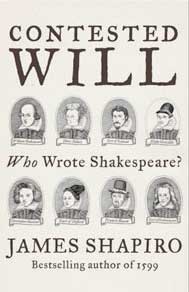
In only 35 pages Bate sets out the arguments, while James Shapiro’s Contested Will and Irving Leigh Matus’s Shakespeare in Fact are excellent fuller studies.

 These theories remind me of Leontes in The Winter’s Tale, who is so convinced in his own mind of his wife’s infidelity that he refuses to believe her or anyone else. He changes his mind only when a source which he trusts, the oracle, confirms her innocence. It’s been suggested that a belief in conspiracy theories is to do with anxiety. In an age of uncertainty, where religion is in decline, and where there’s no trust in government to do the right thing, these theories at least suggests that someone is in control. The alternative is to believe that 19 young men, armed with nothing more than plastic knives, could swiftly destroy some of the most powerful symbols of the American way of life.

 Why should this anxiety transfer itself to belief in Shakespeare’s authorship, something that can make no real difference to anyone’s life four centuries on? Do doubters see themselves as champions wanting to give the right candidate the admiration to which he’s entitled? Or is it about knocking the orthodox candidate off his pedestal?

 During his lifetime and for centuries after it nobody doubted that Shakespeare, the man from Stratford-upon-Avon, wrote the plays and poems attributed to him. None of  the alternative candidates ever made any sort of claim, nor did their families or descendants. Shakespeare wrote and acted in some of the most popular plays of the time, that appealed to ordinary people as well as the court. He worked with the best actors of the day, knew the best writers, and collaborated with some of them.

 It’s not a glamorous story, but I’m happy to trust Ben Jonson, Francis Beaumont, William Camden and many others, who knew Shakespeare and didn’t need to make it up.

If you’d like to join in the debate, see my last post for information about the Shakespeare Birthplace Trust’s campaign about the authorship question.


Share
Posted in Legacy, Shakespeare's World | Tagged , , , , , , , , , | Comments Off on Your actions are my dreams: Shakespeare and conspiracy