Shakespeare’s First Folio: “read him, … and again and again”

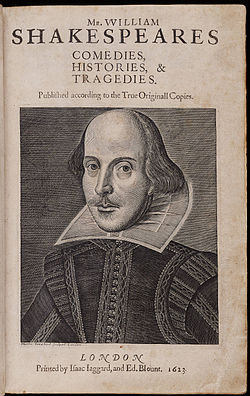
The title page of William Shakespeare's First Folio, published in 1623

Shakespeare’s First Folio has been in the news again recently due to two new exhibitions featuring this most famous of books.

 The Folger Shakespeare Library’s summer exhibition in Washington, DC, will be Fame, Fortune and Theft, looking at the book’s cultural significance as well as examining how it has been studied and collected over the centuries before becoming the highly-prized object it is today. It will also cover the story of the theft of the University of Durham’s copy and its recovery in 2008, in which the Folger took a crucial part. This story was the subject of a TV documentary in 2010, Stealing Shakespeare.

 Co-curating this exhibition is Anthony James West, who has examined all the existing copies of the First Folio in existence and published an authoritative census of these copies. Called as an Expert Witness for the Crown Prosecution Service in the Durham Folio trial, he was also responsible for the identification of the First Folio held by the Craven Museum in Skipton, Yorkshire. In March 2010 he was at the opening of the Craven Museum’s exhibit of the Folio, the only one on display in the north of England.

 Fewer than 50 copies of this book remain in England from the 700 or so that were originally published in London in 1623.  Three copies are in Stratford-upon-Avon in the care of the Shakespeare Birthplace Trust, one of which is on permanent display and seen by all visitors to Shakespeare’s Birthplace as part of the Life, Love and Legacy presentation. In all 232 copies still exist, this high proportion illustrating the value the books have always had for their owners. Eleven copies will be displayed in the Folger’s exhibition.

 The Folio’s importance for Shakespeare’s reputation as an author is that it published for the first time around half of his plays including Macbeth, Twelfth Night and The Tempest, which would otherwise probably have been lost. Several digital facsimiles are available to view on the internet, including this one from the Folger Shakespeare Library.

 It’s also important as a testament to the regard in which Shakespeare was held by his contemporaries. The book was put together by two of Shakespeare’s fellow-actors, John Heminges and Henry Condell. They explain that they have done this work “only to keep the memory of so worthy a friend and fellow alive as was our SHAKESPEARE”.  Writing of the plays, they write “Do not envy his friends the office of their care and pain to have collected and published them…as he conceived them”. They urge us to “Read him, therefore, and again, and again”.

The prefatory material contains many phrases about Shakespeare which have become famous in their own right. Ben Jonson wrote “He was not of an age, but for all time” and coined the phrase “Sweet swan of Avon”.

 The idea that Shakespeare’s real monument is the book is repeated in several of the contributions. Leonard Digges celebrates the power of the printed word:

                          when that stone is rent,
And Time dissolves thy Stratford monument,
Here we alive shall view thee still.

 There’s no better argument for standing up for the libraries which care for and make available our written cultural heritage.


Share
Posted in Legacy, Plays and Poems, Shakespeare's World | Tagged , , , , , , , , , | 3 Comments

A rose by any other word

The scent of roses is in the air already this year. With whole gardens devoted to its many varieties, no flower has a closer association with summertime in England. As national flower, it also has a special link with the history of the country.

 The Wars of the Roses were civil wars which raged from 1455-1485, and their continuing fame owes much to Shakespeare’s plays. Shakespeare imagined the famous scene in the Temple Garden in London, Act 2 Scene 4 of Henry VI Part 1, in which a group of arguing young noblemen pluck either red or white roses according to whether they support the house of Lancaster or York. In a theatre offering little in the way of visual resources, this scene was a brilliant stroke, together with the idea of making the supporters of each side continue to wear their roses, making it easier to follow the complicated twists and turns of the story.

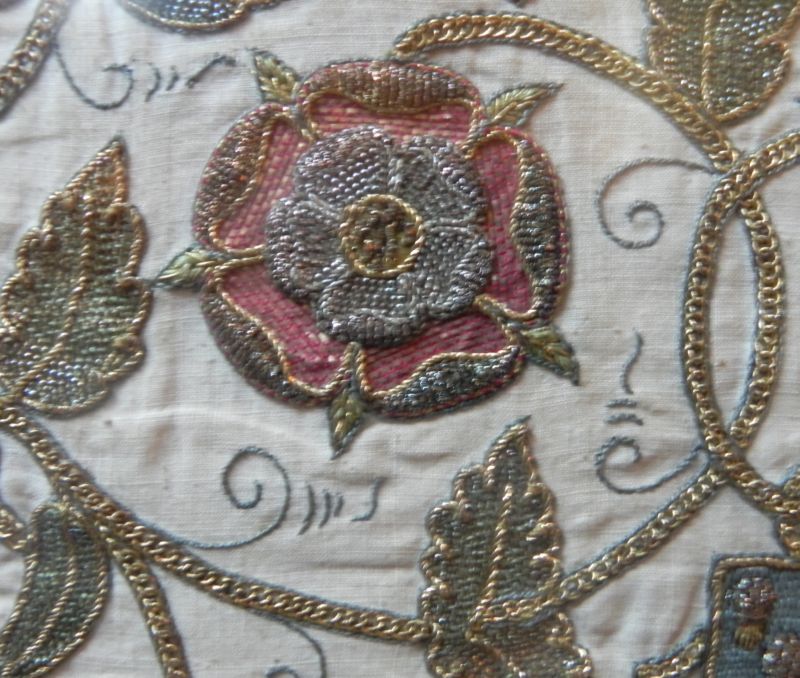
An embroidered Tudor rose on display at Petworth House, Sussex

The conflict ended with accession of Henry VII and his marriage, and the double rose combining the red rose of Lancaster and the white rose of York came to symbolise not just the house of Tudor which he founded but the unity of England as a whole.

The Tudor rose, symbolising unity, appeared as a decorative emblem in many different places. The two examples here show it as a carving on the front of Harvard House, Stratford, and a piece of embroidery associated with Queen Elizabeth’s favourite, Robert Dudley, Earl of Leicester.

Roses have many symbolic meanings. For Shakespeare and for poets before and since, they have both positive associations with love, youth, beauty and sweetness and negative ones with blood, changeability and time. The combination of the rose’s beauty and its thorns symbolise the pleasures and pains of romantic and sexual love.

One of Shakespeare’s most famous lines contains a reference to a rose, spoken by his most romantic heroine, Juliet:

                   What’s in a name?
A rose by any other word would smell as sweet.

In A Midsummer Night’s Dream Theseus tries to persuade a young girl, Hermia that marriage (the rose distill’d)  is preferable to living as a nun:

But earthlier happy is the rose distill’d
Than that which withering on the virgin thorn
Grows, lives, and dies in single blessedness.

And in Twelfth Night Orsino likens youthful beauty to a rose in bloom:

For women are as roses, whose fair flower
Being once display’d, doth fall that very hour.

Viola replies

And so they are; alas that they are so!
To die, even when they to perfection grow!

In his plays about the Wars of the Roses, as well as using roses to signify the opposing sides, Shakespeare uses roses as powerful symbols. See this blog for a discussion about the tragedy of the Battle of Towton, fought in 1461, where the horrors of civil war are made real: a father kills his son, a son his father, and there is blood on the face of a corpse:

The red rose and the white are on his face, the fatal colours of our striving houses.

John Gerarde, in his Herball, published in 1597, comments on the importance of the flower :

The rose doth deserve the chief and prime place among all floures whatsoever; being not onely esteemed for his beauty, vertues, and his fragrant and odoriferous smell; but also because it is the honor and ornament of our English Scepter, as by the conjunction appeareth, in the uniting of those two most Royall Houses of Lancaster and Yorke.

Fortunately we’re now able to enjoy the flowers solely for their beauty.

Wild roses in a hedgerown near the River Avon in Stratford-upon-Avon

Share
Posted in Plays and Poems, Shakespeare's World, Stratford-upon-Avon | Tagged , , , , , , , , , | 9 Comments

Staging The Merchant of Venice

John Nathan’s interesting article raises the old question whether The Merchant of Venice is too offensive to stage.

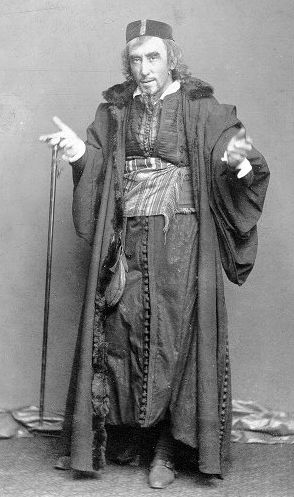
Henry Irving playing Shylock

I’m pleased that he comes down on the side of continuing to perform it, in spite of the discomfort it might cause to some members of the audience.

Is this just because the play is by Shakespeare, and therefore inviolate? I  don’t think so. Shakespeare never gives audiences or performers any easy answers, and the play contains more than its fair share of scenes questionning how people should behave. Shylock’s extremism is balanced by the humour of another Jew, Tubal. Just about all the Christians behave badly, Gratiano in particular displaying an appalling yobbishness. Even Portia has a racist moment.

 In another play which raises uncomfortable issues, All’s Well That Ends Well, an unnamed Lord puts it like this:

 The web of our life is of a mingled yarn, good and ill together: our virtues would be proud, if our faults whipt them not, and our crimes would despair, if they were not cherish’d by our virtues.

 Audiences leaving any good production of The Merchant of Venice should go home with questions about who’s right and who’s wrong. In our post-holocaust world it’s become difficult to raise the subject of anti-semitism, but Shakespeare allows, even encourages, us to talk about it. And that has to be a good thing.

Share
Posted in Plays and Poems, Shakespeare on Stage | Tagged , , , , , , | 13 Comments

The corruption of power

Ian Richardson as Angelo and Estelle Kohler as Isabella in the RSC’s 1970 production of Measure for Measure. Photograph by Tom Holte.

Political corruption was one of Shakespeare’s favourite subjects. You would expect to find it in tragedies like Hamlet and Richard III where power and its abuse are at the heart of the plot, but Shakespeare puts the subject of the corruption of power slap bang into a play categorised as a comedy, Measure for Measure.

Measure for Measure is one of my favourite plays, and I was planning a post about the leading female character, Isabella, when the allegation broke that International Monetary Fund head Dominique Strauss-Kahn was being accused of raping a chambermaid. All of a sudden there was one of Shakespeare’s favourite subject, politics combined with sexual misconduct, in the headlines.

 Covering the story in the Guardian of 16 May, the journalist made the link:

For some, the story of Strauss-Kahn’s fall from presidential hopeful to prison cell was a combination of sordid tale and Shakespearean tragedy.

Like Strauss-Kahn, the Angelo we see at the start of the play has a pretty well unblemished reputation.  He is known to be a man “whose blood is very snow-broth”, but he quickly finds himself overwhelmed by desire for Isabella, a young woman who comes to plead for her brother’s life. Up to this point it’s possible to be quite sympathetic to Angelo. At the beginning of the play his boss, the Duke, has set him up. Instead of doing something himself to enforce the laws regarding social disorder,  the Duke puts Angelo in complete control and announces his intention to leave the city.

 So although he may be severe, we’re not altogether against Angelo. For all we know, after Angelo’s first meeting with Isabella it’s just possible that the play could be about the redeeming power of love.

 By the time of their second meeting, Angelo has done some thinking, and explains the deal to Isabella. Now we find out he’s not at all interested in a relationship, but a grubby transaction: sex in exchange for the lifting of her brother’s death sentence. Isabella threatens to expose Angelo, and in a chilling moment he turns on her:  “Who will believe thee, Isabel? … Say what you can; my false o’erweighs your true”. Angelo, the political animal, “seeming, seeming”, reveals itself.

 Going back to Dominique Strauss-Kahn, it isn’t just the chambermaid’s word that is damaging. A further allegation has been made, of an attack on another woman several years ago, which was reported in a limited way but hushed up. It’s this cover-up which now is causing a major upset, and means that his political career is in tatters, his hope of being France’s next President gone.

Share
Posted in Legacy, Plays and Poems | Tagged , , , , , , , | 4 Comments

Shakespeare’s many lives

The book jacket for Schoenbaum's book Shakespeare's lives, one of James Shapiro's favourites

It’s said we know next to nothing about Shakespeare’s life, yet new biographies are published every year. Is this because new facts are always being discovered? Sadly not, although every now and then an extra piece is added to the jigsaw – but normally this is a bit of background rather than the main picture.

 In a recent interview, the distinguished scholar James Shapiro listed his five favourite Shakespeare biographies, a genre that he has contributed to himself. Shapiro’s list of suggestions is interesting as he has chosen books which he has found useful sources for biography rather than telling the story chronologically.

 During my work at the Shakespeare Centre Library and Archive I must have been asked hundreds of times to recommend a book about Shakespeare’s life. There’s no simple answer of course. Almost every book written on the subject will be someone’s favourite. Some could almost be classed as fiction, some concentrate on the facts: there is something for everybody here.

 The area that really divides opinion is the period of Shakespeare’s life known as the “lost years”, 1585 to 1592, between the baptism of his twins Hamnet and Judith in Stratford and the first record of him as a player and writer in London, in Greene’s Groatsworth of Wit. When I’m looking at a biography I always check this bit first. Some authors let their imaginations run riot, others list every possibility, some express a favourite, others don’t. I agree with Shapiro that Peter Holland’s essay in the Dictionary of National Biography is admirable (and freely available online to public library users), and Holland wastes no time on the debate:  “Biographers have created fanciful narratives for this period; none have any foundation”, before going on to mention just a couple of the theories.

I was surprised though that Shapiro is so dismissive of what I regard as the best biography of Shakespeare, Samuel Schoenbaum’s William Shakespeare: a Documentary Life. He describes it as “a very dry book – I suppose it’s kind of useful if you’re studying for an exam”, but I consult my dog-eared copy constantly, because I admire Schoenbaum’s reasonable, well-informed voice.

 Originally published as a lavish hardback, with all the documents relating to Shakespeare’s life reproduced at more or less full size, it was later published in paperback as A Compact Documentary Life, and is still in print. In his section on the lost years he considers all the options, from deer-poacher, butcher’s apprentice, schoolmaster, lawyer’s clerk, private tutor and player, before subtly suggesting that his vote goes for the idea that Shakespeare joined the acting company the Queen’s Men when they played at Stratford in 1587.

 Whatever the details, Shakespeare was blown from the country town of his birth to the big city, like Petruchio in The Taming of the Shrew, by

 Such wind as scatters young men through the world
To seek their fortunes farther than at home,
Where small experience grows

 I checked out the biographies in the Shakespeare Bookshop, a wonderful treasure trove of books by and about Shakespeare right opposite Shakespeare’s Birthplace. If you want to buy a book but don’t know what to choose I’d recommend them as they have an excellent range and helpful, knowledgeable staff. Their most popular biography at the moment is Bill Bryson’s Shakespeare, and it is a great basic introduction to the subject written in the authors’s wonderfully readable style. At the other end of the scale, I also like David Bevington’s recent discussion of the history of the books that have been written on the life, Shakespeare and Biography, in the Oxford Shakespeare Topics series.

If you want to read more about this subject, and you happen to be passing through Stratford-upon-Avon, all the books mentioned are available at the Shakespeare Centre Library and Archive, mostly in the Reading Room where they can be taken off the shelf to read.

Share
Posted in Legacy, Shakespeare's World | Tagged , , , , , , , , | 2 Comments

Sounds and sweet airs, that give delight

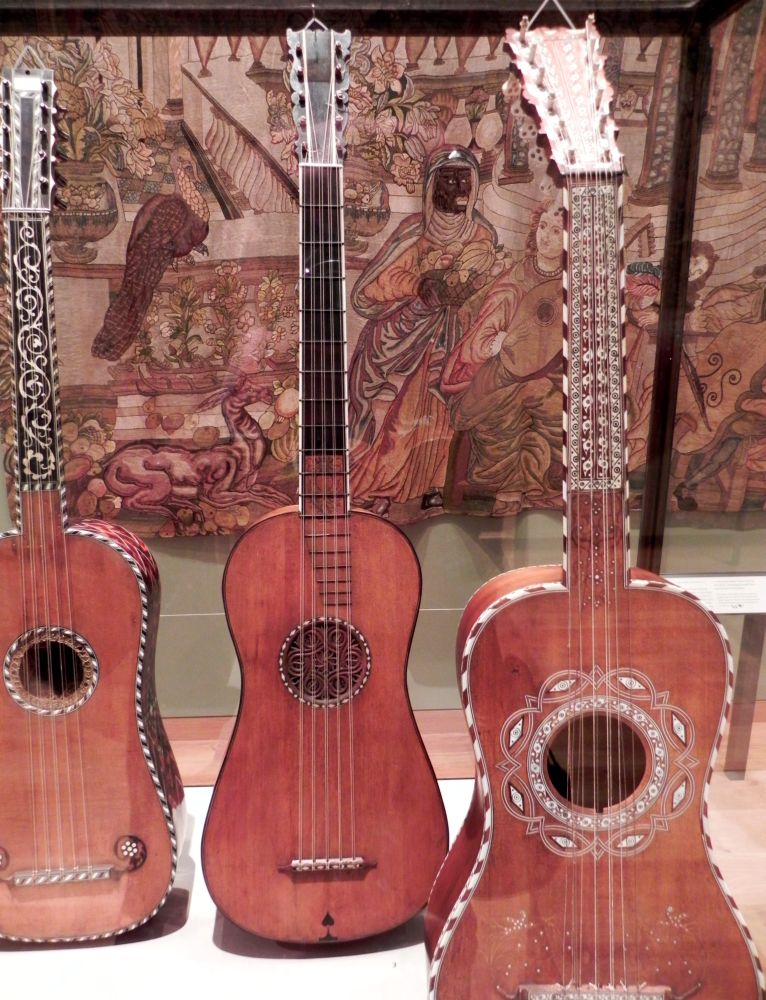
Early guitars on display in the Ashmolean Museum, Oxford

It seems that music, whether being listened to or performed, really is good for you. It was recently reported that musicians have better memories than the rest of us, and playing music may result in higher levels of proficiency in maths and foreign languages. We all know that music can change mood. Scientific research has found that music appeals to the most primitive part of the human brain, the cerebellum, which is responsible for emotion.  The brain breaks down music into different elements: pitch, rhythm, melody, harmony, tempo and metre. When language, in the form of words, is added, the meaning of the words is processed at a higher level by the cerebral cortex.

But hold on a bit. Pitch, rhythm, tempo, metre…. Aren’t all these features of poetry? Isn’t it possible that listening to poetry can affect the brain in the same way as listening to music, using that primitive, emotional part of our brains? This website explains the ideas in layman’s language.

One of the barriers to studying Shakespeare is the concern that the words are difficult to understand. If it’s the musical qualities of poetry that primarily appeal to our emotions perhaps actors, audiences and readers should stop stressing quite so much about intellectual understanding and let the sound wash over them.

I remember hearing Alex Jennings, a wonderful stage actor, talking about performing Hamlet. He didn’t worry that he didn’t understand every word, but concentrated on speaking the verse and let the sound do the work for him. An actor’s voice is his most valuable instrument which, when trained, can produce an infinite range of sound. I can still “hear” the elderly actor Griffith Jones performing the opening speech of Pericles, decades after he did it. After a lifetime of training for stage acting he was able to perform Gower’s speech in a way which sounded completely natural but also musical. I’ve heard the speech performed several times since, but have never heard it delivered so effectively.

Without knowing anything about the cerebellum or cerebral cortex Shakespeare seems to have been aware of the difference between music and language. Caliban, in The Tempest, the most primitive of Shakespeare’s characters, expresses a love of music:

                   The isle is full of noises,
Sounds and sweet airs, that give delight, and hurt not

Language had to be learned:

You taught me language; and my profit on’t
Is, I know how to curse

I was delighted to hear that a symposium is being held in California entitled Where has all the verse gone? Academics have done a huge amount to analyse and investigate Shakespeare from every angle, but sometimes the impact of the poetry on audiences, performers and readers has been overlooked or even dismissed. Paul Edmondson, Head of Learning and Research at the Shakespeare Birthplace Trust is delivering a paper called Shakespeare’s words and music, in which he will explore the musicality of Shakespeare’s language. His post on 12 May explains more about these ideas.

It’s great news that listening to Shakespeare’s poetry being beautifully spoken could be good for the memory. Now, where did I leave my keys?

Share
Posted in Shakespeare on Stage | Tagged , , , , , , , | 2 Comments

Those fabulous frocks

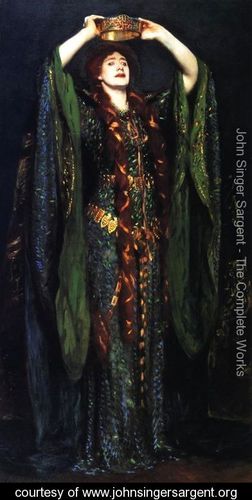
John Singer Sargent's portrait of Ellen Terry as Lady Macbeth

Why are we so fascinated by clothes that have been worn by the rich and famous? Kate Middleton’s wedding dress will attract enormous attraction when it is put on display (probably in Buckingham Palace). We will all admire the fabulous design and craftsmanship, but seeing the dress close up will also somehow make us feel closer to the person who wore it.

 Another iconic dress has recently been returned to public view. Ellen Terry’s costume which was made for her to play Lady Macbeth at the Lyceum Theatre in 1888 is probably the most famous theatre costume in existence.  For many years it has been at Terry’s house at Smallhythe, Kent, but a couple of years ago was taken away for essential conservation. After a £50,000 plus refurb it recently went back on display

 It wasn’t the only spectacular costume made for Terry, but it is easily the most famous. The reason for its fame is that a portrait of Terry wearing it was painted by John Singer Sargent, the finest portrait painter of the day. The painting was so admired that queues of people went to see it when it went on display, only a few of whom would have seen the play in the theatre. The painting remains one of the most popular exhibits at the Tate Gallery in London.

 The dress itself was amazing. In order to make it shimmer under the stage lights 1000 real beetle wings were individually sown onto the dress. Over the years the staff at Smallyhthe have collected the wings as they have dropped off, and wings have been gathered and contributed (the beetles shed their wings naturally so none were harmed).  I went to Smallhythe about a year ago and was disappointed not the see the dress, though I liked the way that the reproduction of the dress was inventively decorated with false fingernails instead of beetle wings! The dress was intended to look like fine chain mail, and the beetle wings gave a metallic sheen. Unlike some of her costumes, the dress was delicately constructed and moved with her. Ellen Terry was noted for her energy and grace of movement on stage, captured in a sketch also by John Singer Sargent and illustrated on the website devoted to his work. The finished painting shows her in a pose which she never actually struck in the play but it successfully illustrated the essence of the performance rather than being an accurate rendering of it, and the dress looks sensational.

 Part of the mythos surrounding the dress relies on the reputation of Terry herself. She was easily the most successful actress of her day, and except for the Queen herself, the most famous woman in the kingdom. She was so loved that she got away with being married three times, having numerous love affairs and two illegitimate children, without being branded a strumpet. A real beauty, a talented actress, with great charm, she was also blessed with a compelling voice. This rare recording gives a flavour of it.
http://www.youtube.com/watch?v=j8ETwca_27E
It’s of a recital of “The quality of mercy” speech from The Merchant of Venice. John Gielgud, her great-nephew, in his book An Actor and his Time, recounts how in her later years, she often performed it at charity matinees.

 Her voluminous correspondence is currently being edited by Katharine Cockin, and her letters will eventually be published in eight volumes. If alive today she would probably be a great tweeter.

Share
Posted in Legacy, Shakespeare on Stage | Tagged , , , , , | 2 Comments

The ups and downs of power

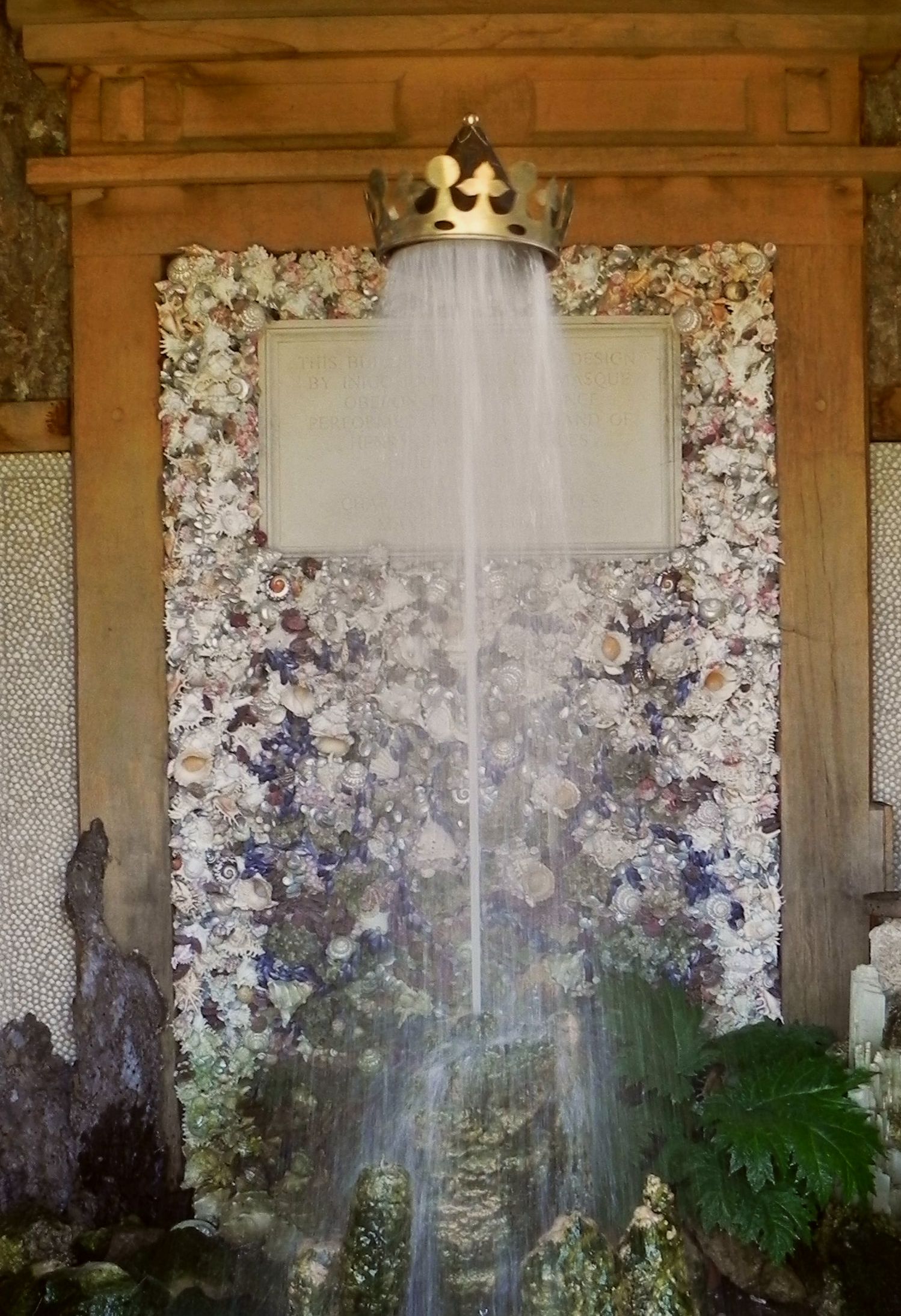
The dancing crown in the Inigo Jones inspired gardens at Arundel Castle

No matter what your political affiliation, you have to feel a bit sorry for Nick Clegg. Only a year ago he was the darling of the electorate.  In the televised debates between the leaders of the three main parties before the 2010 UK general election he made all the running. The recent local government elections and the Alternative Vote referendum though have shown a collapse in the support for the Lib Dems so disastrous there have been calls for him to resign. The fickleness of the electorate would not surprise Shakespeare.

In Richard II, the groom who visits Richard in prison describes how Henry IV, the new king, chooses to ride Richard’s favourite horse, Barbary, in the procession.

Even the horse seems to betray Richard:

 O, how it erned my heart when I beheld,
In London streets that coronation day,
When Bolingbroke rode on roan Barbary!
That horse that thou so often hast bestrid,
That horse that I so carefully have dressed!

 Nick Clegg would empathise with the situation Richard II finds himself in when handing over the English crown to Bolingbroke. Shakespeare makes the scene memorable by having the two men hold the crown, beautifully illustrating the shifting of power from one to another.

 Here, cousin,
On this side, my hand, and on that side, thine…
Now is this golden crown like a deep well
That owes two buckets, filling one another,
The emptier ever dancing in the air,
The other down, unseen, and full of water:
That bucket down, and full of tears, am I,
Drinking my griefs, while you mount up on high.

 This image came to mind when I visited Arundel Castle in Sussex a few days ago. Parts of the castle have withstood over 900 years of turbulent history, but it was in the formal gardens where I found a Shakespearian connection. These gardens were landscaped as recently as 2008, an attempt to reconstruct the early seventeenth century gardens created for Arundel House in London to designs by Inigo Jones. Within the garden is a kind of grotto, a reconstruction of Oberon’s Palace, which formed part of the set for The Masque of Oberon designed by Inigo Jones and written by Shakespeare’s friend Ben Jonson, in 1611. See here for information about these court masques, including a design for this feature.

Inside the grotto is this magical water featurewhere a crown is suspended on a column of water. It’s a wonderfully Shakespearean visual metaphor: a golden crown hovers above a column of water. As it hangs and dances in the air, without any means of support, it revolves. Like Shakespeare’s rising and falling buckets, it’s a spectacular reminder of the ephemerality of power. These were popular features of gardens of the nobility in 17th century Europe, and it’s an image that all politicians of the twenty-first century would be well advised to keep in mind.

Share
Posted in Legacy, Shakespeare's World | Tagged , , , , , , , , , , | 4 Comments

The first draft of history?

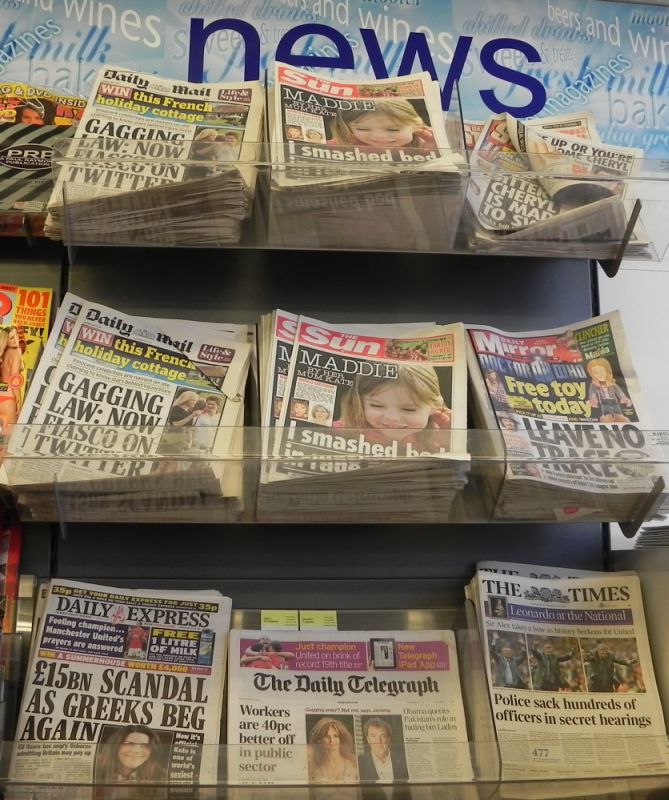
A news stand

Over the past week the news has been dominated by the killing of Osama Bin Laden. President Obama must have felt some satisfaction that he’d got an authoritative statement out before it was widely reported on Twitter and Facebook, though this report explains how the story began to break. Since then the handling of this major news story has taken on a life of its own.

 In the days following the President’s statement, and under severe pressure, Washington issued contradictory versions of events. Questions have continued to be asked and there are now demands for full disclosure.

 Veteran journalist Matthew Ingram expressed the difficulty back in February:

If there’s one aspect of the media business that has been disrupted more completely than any other, it’s the whole idea of “breaking news”. Just as television devalued the old front-page newspaper scoop, the web has turned breaking news into something that lasts a matter of minutes — or even seconds — rather than hours.

 Journalism used to be seen as “the first draft of history” but what we’re seeing now is rumours running wild through Twitter. Rumour has always arrived before the official or semi-official version of events. Even in Shakespeare’s time, before the advent of newspapers, it travelled quickly. In Henry IV Part 2, the figure of Rumour, the prologue to the play, is dressed in a gown “painted full of tongues”.

Rumour is a pipe
Blown by surmises, jealousies, conjectures

 Its inaccuracies are heard more loudly than the truth:

Open your ears; for which of you will stop
The vent of hearing when loud Rumour speaks?
I, from the Orient to the drooping West,
Making the wind my post-horse, still unfold
The acts commenced on this ball of earth.
Upon my tongues continual slanders ride,
The which in every language I pronounce,
Stuffing the ears of men with false reports.

 How long will it be before we see a production of the play in which Rumour is represented by people Tweeting on their smartphones?

Even if a full inquiry is held, historians will continue to debate the death of Bin Laden, and  there will never be a single authoritative version. It was easier to arrive at an official version of history in Shakespeare’s day. Publishing was controlled, and although books were becoming more widely available during Queen Elizabeth’s reign, it was relatively easy to ensure that it was the Tudor version of history that was left for posterity. Holinshed’s Chronicles of England, Scotland and Ireland, first published in 1577, then revised in 1587, demonized Richard III, the monarch immediately before Henry VII the first of the Tudors. We now know that Richard was not the embodiment of evil that Shakespeare, following Holinshed’s version of events, portrayed, but Holinshed’s version inspired what was to become Shakespeare’s favourite and most famous villain.

Share
Posted in Legacy, Shakespeare's World, Sources | Tagged , , , , , , , , , | 11 Comments

Cuckoos, cuckolds, and the coming of spring

Photograph of a cuckoo by John N Murphy, http://murfswildlife.blogspot.com/

According to one website, Shakespeare “writes more about birds than any other poet”, with 606 mentions of 64 different species. He certainly names many species, and associates them with feelings, people or events.

 The day before yesterday I heard my first cuckoo of the year. A website check revealed they have been back in this country since April 11. The one I heard was in a wildlife reserve in Sussex, and in spite of having been out in the Warwickshire countryside regularly over the past three weeks, I haven’t heard a single one. Shakespeare notes that in his time they were so common they were “on every tree”, and in Henry IV Part 1 the King warns that his predecessor Richard II   

          was but as the cuckoo is in June,
Heard, not regarded

If they are now difficult to hear, seeing them is really tricky. This reclusiveness, combined with the mystery of their migration, might contribute to the belief that it was lucky to see one, but unlucky to hear the call.

 Cuckoos are one of the few birds whose name comes from its call, and the Latin name too comes from this sound made by males on the lookout for a mate. It’s a bird defined by its call.

The now outdated English word cuckold is also derived from the call. A cuckold was a man whose wife had been unfaithful to him. The folklore associated with the bird relates to its extraordinary habit of laying its egg in the nest of another bird. The cuckoo chick hatches before those of the host bird, and immediately ejects all the other eggs from the nest so that it gets the undivided attention of its adopted parents.

 No wonder that the two-note call of the bird was a symbol of infidelity. A result of this predatory behaviour could be a man raising another’s child as his own. This verse is part of the song of the Owl and the Cuckoo from Shakespeare’s play Love’s Labour’s Lost.

The cuckoo then on every tree
Mocks married men; for thus sings he, “Cuckoo”;
Cuckoo, cuckoo” – O word of fear,
Unpleasing to a married ear

 As usual Shakespeare is an excellent observer of nature. He mentions the cuckoo’s habit of laying its eggs in other birds’ nests, in both The Rape of Lucrece, where “Hateful cuckoos hatch in sparrows nests” and in King Lear:

The hedge-sparrow fed the cuckoo so long,
That it had its head bit off by its young

 The legend that the bird was unlucky goes back long before Shakespeare’s time. Geoffrey Chaucer, in his poem The Cuckoo and the Nightingale, calls the bird “lewd” and “love’s enemy”.

 By the beginning of the nineteenth century, the bird’s image had been transformed. In his poem To the Cuckoo, William Wordsworth wrote:

 O blithe New-comer! I have heard,
I hear thee and rejoice.
O Cuckoo! shall I call thee Bird,
Or but a wandering Voice?

While I am lying on the grass
Thy twofold shout I hear,
From hill to hill it seems to pass,
At once far off, and near.

 Though babbling only to the Vale,
Of sunshine and of flowers,
Thou bringest unto me a tale
Of visionary hours.

 Thrice welcome, darling of the Spring!
Even yet thou art to me
No bird, but an invisible thing,
A voice, a mystery.

If you’re lucky enough to hear or even see a cuckoo this spring, enjoy it!

Update:  On 8am Tuesday 10 May I heard a cuckoo calling loudly from the Greenway overlooking fields at Luddington!

Share
Posted in Shakespeare's World | Tagged , , , , , , , , , , | 7 Comments