When shall we three meet again?

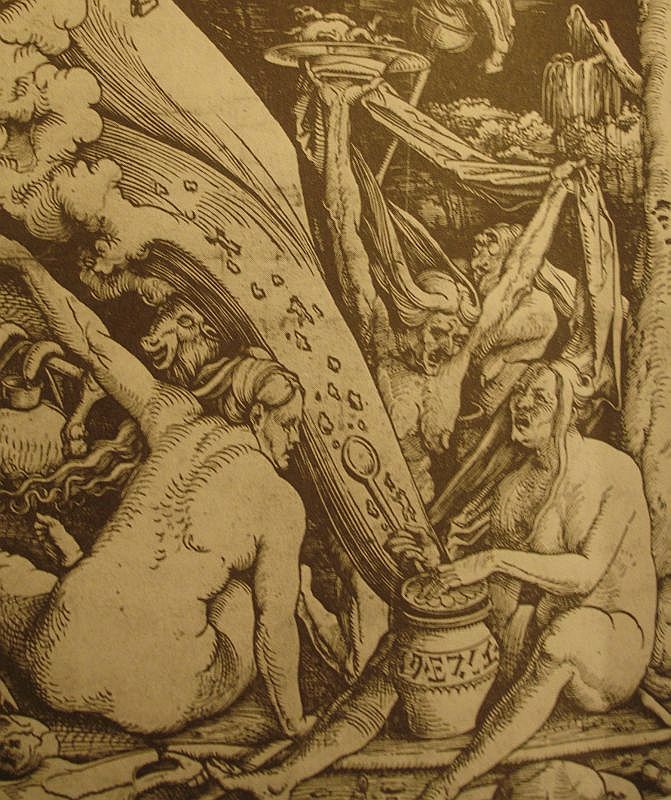
A witches sabbath as imagined in a book from 1510

When shall we three meet again?
In thunder, lightning or in rain?

 In a typically fearless decision Michael Boyd, the RSC’s Artistic Director has chosen to open the first brand new production in the newly redeveloped RST without one of the most famous openings in any Shakespeare play –  but then he’s already tempted fate by choosing Macbeth, the play universally associated with disaster.

 As a director, Boyd rarely takes the easy or predictable line, and his production of Macbeth, which casts the three weird sisters, usually known as the witches, as children, plays against not just theatrical tradition but also Shakespeare’s text.

 There’s no such thing as a standard Royal Shakespeare Company approach to staging these days. The theatrical approach is epitomised by Greg Doran, whose Swan production of the play back in 1999 opened with a complete blackout and loud bang (people screamed), before the play began. Boyd’s approach is more cerebral, though he’s not the first to have come up with the idea of casting children in the roles of the weird sisters.

 There have been many different interpretations of the witches, from the old hags described by Shakespeare to beautiful young women and Lady Macbeth lookalikes. For some examples take a look at Warwick University’s Reperforming Performance website’s section on Staging the Witches. Boyd’s production will provide students of the future with much to discuss in their work on the history of Shakespeare on stage.

 And see my video blog on Fuseli’s painting of the Three Witches, owned by the Royal Shakespeare Company made for the 2010 Shakespeare Centre exhibition on Shakespeare’s Women.

Share
Posted in Legacy, Shakespeare on Stage | Tagged , , , , , , , , | 4 Comments

Obama and Shakespeare

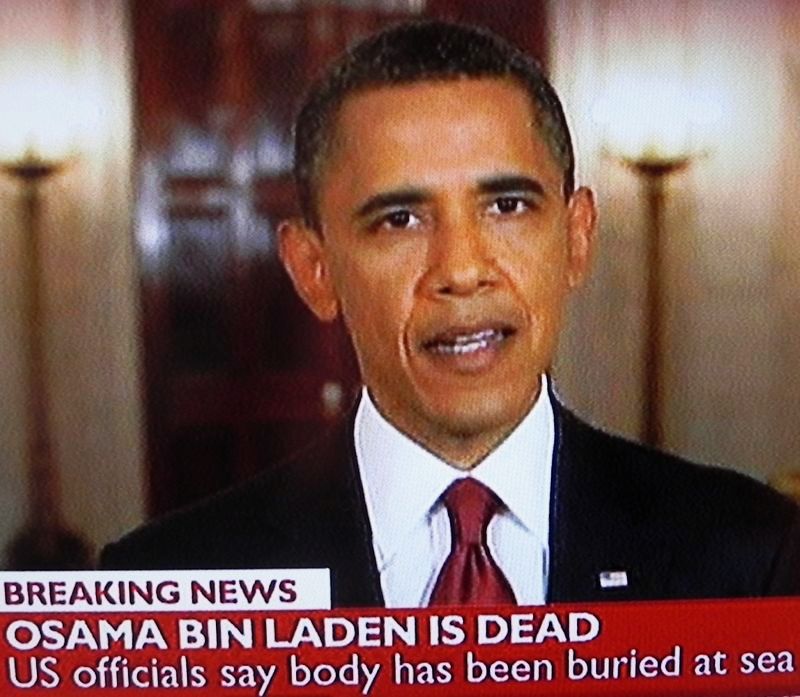
President Obama announcing the death of Osama Bin Laden

Watching President Obama make the official statement about the death of Osama Bin Laden, it was impossible not to be reminded of the Earl of Richmond’s speech at the end of Shakespeare’s Richard III. I almost expected him to say “The bloody dog is dead”. Obama, like Richmond and like every politician in circumstances such as these, talked about justice having been done, the need to heal wounds, and voiced the hope that a lasting resolution may have been reached. Richmond’s “God say Amen” found a close echo in Obama’s “May God bless the United States of America”

 Shakespeare was writing about many decades of civil unrest that took place on English soil, but modern international terrorism has resulted in the deaths of thousands of citizens of all countries and all faiths. The result of these conflicts is the same:

The brother blindly shed the brother’s blood;
The father rashly slaughter’d his own son;
The son, compell’d, been butcher to the sire.

The story of Richard III was the finale in Shakespeare’s line of history plays – he ended the play diplomatically predicting that under Richmond, as King Henry VII, peace would follow. In fact he founded a political dynasty which culminated in the reign of his grand-daughter Elizabeth I, during which Shakespeare wrote his eight great plays documenting the Wars of the Roses. The central theme of these plays is the cyclical nature of history. One unjust ruler is deposed, to be replaced by another who is quickly vehemently opposed. Another uprising follows and is put down, to be followed by another more successful coup, and so it goes on from the reign of Richard II right up to Richard III. Hoping for a period of peace Richmond prays:

 Abate the edge of traitors, gracious Lord,
That would reduce these bloody days again.

Tonight, another of Shakespeare’s political plays, Macbeth, is being performed at the Royal Shakespeare Theatre in Stratford-upon-Avon. At the climax of the play Macduff, a man whose family have been slaughtered on the commands of the tyrant Macbeth, leads the raid to kill him in his castle stronghold. Tonight of all nights, the audience watching this performance will be in no doubt of Shakespeare’s continuing relevance.

Share
Posted in Legacy | Tagged , , , , , | 2 Comments

Viva Espana

Performing Cervantes

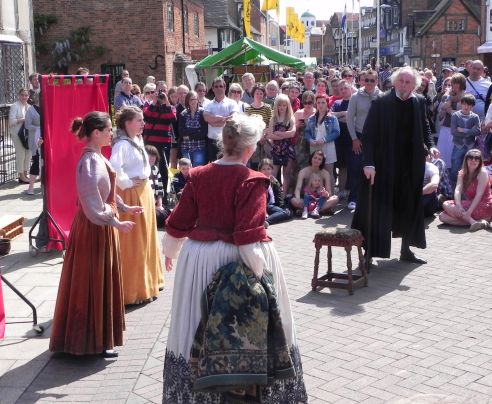
Crowds outside Shakespeare's Birthplace are entertained by a scene by Cervantes performed by actors including the RSC's Christopher Godwin

For most of us today, Spain means sun, sea and sangria, but for Shakespeare and his contemporaries Spain had less positive associations. The most powerful state in Europe, already feared and suspected, launched the Spanish Armada with the intention of invading England in 1588.

 This weekend in Stratford-upon-Avon, we’re celebrating Spanish culture as well as English. The period during which Shakespeare lived was so artistically rich in Spain that it has become known as the Spanish Golden Age. It’s hardly surprising to find echoes of Shakespeare in the Spanish plays of the period (or is it the other way round?) Among the artistic achievements of this period is Cervantes’ book Don Quixote, sometimes called the first novel. Cervantes was some years older than Shakespeare, but died on the same date, though sadly not the same day because the two countries were using different calendars.

 Extracts from Cervantes’ plays are being performed in front of Shakespeare’s Birthplace and this afternoon there is music and dancing in the street. For visitors to the Birthplace there is also a special display, for this weekend only, of material relating to Cervantes from the Shakespeare Centre Library and Archive, mounted by Jo Wilding. Items on display include a 1652 edition of the first translation of Cervantes’ Don Quixote, and copies of the 1728 published text of The Double Falsehood, the play which was claimed to be based on Shakespeare and Fletcher’s play Cardenio. This in its turn was based on a story in Don Quixote, which had first been published in English in 1612.

 RSC Director Greg Doran’s re-imagining of Cardenio is currently playing at the Swan Theatre, and is the latest of many Spanish plays to be performed in Stratford-upon-Avon. The play has a complicated pedigree, admirably explained in its own section of the RSC’s website . In 2004 The RSC performed a whole season of Spanish plays including Cervantes’ play Pedro, the Great Pretender. Earlier performances of Spanish Golden Age plays by the RSC include Life is a Dream, performed in 1983. This wonderful play by another Spanish writer, Calderon, toys with the concepts of dream and reality, a theme in Hamlet and other Shakespeare plays.

 Shakespeare was part of a much larger European cultural landscape in which cross-fertilisation flourished regardless of political differences. Shakespeare’s Birthday weekend, when people from around the world celebrate Shakespeare’s life and work, is a wonderful opportunity to look from the point of view of another of the world’s great writers.

Share
Posted in Legacy, Shakespeare's World | Tagged , , , , , , , , , | 5 Comments

There’s rosemary

William Tompkins at Shakespeare's grave, 1920

William Tompkins at Shakespeare's grave, 1920

It’s the official celebrations of Shakespeare’s Birthday here in Stratford-upon-Avon. For me, the part of this ceremony that really matters is the laying of the flowers on Shakespeare’s grave. The simple ritual was initiated by the boys of his own school, which is why the boys, clutching their posies, still lead the procession down to Holy Trinity Church. It’s so appropriate that Shakespeare, a great lover of nature, should be remembered by the placing of flowers on the place where he lies.

Tradition, memory, and honouring the past are subjects that mattered to Shakespeare, and ones he wrote about extensively. The photograph on the left is a personal one. It shows my grandfather, William Tompkins, sub-sacristan at Holy Trinity Church for many years, at Shakespeare’s grave and monument following the procession in 1920. For me the laying of flowers on the grave is a way of honouring my family’s past as well as Shakespeare’s.

There’s rosemary, that’s for remembrance; pray you, love, remember.

We shouldn’t think that Shakespeare’s importance is all to do with the past.  He and his work really are for all time as he continues to remind us what it means to be human, and  what people can achieve. Hamlet, as ever, says it all:

                                             What is a man,
If his chief good and market of his time
Be but to sleep and feed

And:

What a piece of work is a man, how noble in reason, how infinite in faculties

Happy Birthday, Will, and many more.

Share
Posted in Legacy, Stratford-upon-Avon | Tagged , , , , , , , , | 2 Comments

Kiss me, Kate

The wedding of Prince William and Kate Middleton

The wedding of Prince William and Kate Middleton

Today’s Royal wedding of Kate Middleton and Prince William has been the happiest of occasions. In both real life and fiction weddings symbolise harmony, and the marriage of the main characters, usually following a troubled courtship, is a satisfying end to any play or novel.

The two Kates who marry during Shakespeare’s plays have very different stories. Princess Katherine is the Princess of France who is married to the victorious Henry V at the end of the play of the same name. She has no choice but to accept this diplomatic marriage, but Shakespeare writes a wonderfully charming wooing scene to allow the play to close on a celebratory note. None but a killjoy would try to turn Kate into merely an unwilling pawn in the political game even if that was the historical reality.

The second Kate is the shrew in The Taming of the Shrew. Here, it’s not the courtship, but the marriage, that Shakespeare puts under the microscope. This Kate has a nightmare nuptial. Not only is she forced to marry a man she doesn’t love, who we know to be after her money, but her groom takes the opportunity of the wedding itself to humiliate his bride. The wedding day, of course, should be the bride’s big day, but Petruchio is firstly late, then turns up dressed outrageously. During the wedding itself he behaves in a way which might be acceptable at the stag party, but not on the day itself. To cap it all, he carts Kate away before the reception.

I vividly remember the way in which this scene was staged in the 1978 RSC modern-dress production directed by Michael Bogdanov. Paola Dionisotti, as Kate, wore a conventional wedding dress, and was kept waiting by Jonathan Pryce as Petruchio who took every opportunity he could to live up to Shakespeare’s description. It was a very Shakespearian moment, hilarious and heartbreaking at the same time. We find the methods Petruchio uses to tame his shrew unacceptable today, but we may concentrate too much on them rather than recognising that Shakespeare is asking questions about what marriage is really about, and how two very different people make a life together.

Perhaps it’s because weddings in Shakespeare’s plays so often end in disaster that the belief began that Shakespeare’s own marriage was unhappy. There’s little evidence either way, but according to historian Mairi Macdonald, the second best bed that Shakespeare’s widow was left in his will really doesn’t indicate anything about their relationship. Germaine Greer, in her book Shakespeare’s Wife, suggests that Anne Hathaway had a far more positive role in Shakespeare’s life than has been supposed.

We all wish the newlyweds every happiness, and that they manage to escape the tribulations of some of Shakespeare’s married couples.

Share
Posted in Shakespeare on Stage, Shakespeare's World | Tagged , , , , , , , , | 5 Comments

Hello world!

Blogging at last!

Share
Posted in Legacy | 10 Comments