Memory, forgetting, and performance

Rebekah Brooks and others testifying to the Leveson Inquiry claim to have staggeringly poor memories of events. Zoe Williams, in her Guardian article of 11 May commented “You couldn’t live a life with this bad a memory. Never mind that you’d never be able to do a demanding job, you wouldn’t be able to pass your GCSE’s”.

Without making any assumptions about the reason why those being investigated might have forgotten so much, it’s certainly true that memory does play tricks on all of us.

I’m currently reading Simon Callow’s book Charles Dickens and the Theatre of the World (a great read by the way). Memory took a major part in Dickens’ own life, his own story coming out in those semi-autobiographical novels. Callow points out that Dickens got his love for the theatre from his mother, who also tended to dramatise events from her own life.
She liked to say that she had been dancing all night the day before Charles was born; diligent research has shown that the ball took place four days earlier, which only goes to show what a spoilsport diligent research can be.

Peter Holland’s book Shakespeare, Memory and Performance is a collection of essays in which diligent academics look at memory and its reliability in many different ways.  In his own chapter he finds that the question “How do actors remember all those lines?” is not nearly so simple as you might think. Books on acting offer virtually no tips or advice, yet for ordinary people it’s the greatest mystery of the actor’s art.

He also  addresses the question of how actors often get it wrong, and tells some delightful stories of Harriet Walter substituting “gravy” for “glory” when playing Beatrice, and of Robert Stephens playing Falstaff towards the end of his life when remembering the lines every night was by far the most difficult challenge he faced in performing the role.

Costumes for Oberon and Titania from the RSC's 1981 production of A Midsummer Night's Dream

Other essays look at ways of pinning down performances by looking at material remains like costumes and props, as if these items retain within themselves some vestige of the performance. Official records, the archives such as prompt books, production photographs and even nowadays the archival video, seem to offer certainty, but as anyone who’s done any research into performance knows, all these can be misleading, and in any case don’t offer more than a misty reflection of the thing itself. Memory, whether it’s the actor’s memories of playing the role, the director’s or the audience’s, is in some ways the only real way of getting at the performance. Where would we be now without written down recollections like those of Simon Forman who inadvertently wrote the first review of Macbeth at the Globe?

Shakespeare’s plays are full of memories, whether it’s Oberon’s memory of “where the bolt of Cupid fell”, marking the place where love in idleness grows in A Midsummer Night’s Dream, Fluellen reminding Henry V of the garden where leeks grew, or Polonius losing his place in his speech to Reynaldo in Hamlet.

David Tennant in the RSC's 2008 production of Hamlet

At the beginning of the play the Ghost’s command “Remember me” sparks Hamlet’s response “Remember thee? Ay, thou poor ghost, whiles memory holds a seat in this distracted globe”.  Hamlet is a play obsessed with memory, from Hamlet’s remembering of his mother’s love of his father “Why she would hang on him”, Horatio’s comparison of old Hamlet with his ghost “I knew your father. These hands are not more like”, Hamlet remembering the Player’s speech about Hecuba, “I heard thee speak me a speech once” and most powerfully, the moment when Hamlet picks up the skull of Yorick and memories of his childhood come flooding back.

Memories of performance can be powerful, and discussing a production from the past goes beyond the “Do you remember the bit where…” chat. Every person who sees a production sees something different because of where they were sitting, and because each performance is different from the next. But we also see productions differently because of who we are at the moment when we see them. Memories, can be deeply personal and may be much more compelling than the facts. Nobody wants their memories shattered.

The Leveson Inquiry is charged with researching diligently, probing deep into the recollections of conversations and events. In remembering performance, though, diligent research can indeed be just a spoilsport.

Share
Posted in Legacy, Plays and Poems, Shakespeare on Stage, Uncategorized | Tagged , , , , , , , , , , | Leave a comment

Nine Men’s Morris and the English weather

The Nine-Men's Morris in Stratford

Last week I was contacted by a reader of this blog with a query about the Nine Men’s Morris in the Theatre Gardens in Stratford-upon-Avon. How old, he wondered, was it?

I should explain. Nine Men’s Morris is an ancient game which has been played in one form or another  for thousands of years. It’s played on a square board with marked fixed points, as in the illustration.

In England the layout of the board has been found incised into the stones of some churches, but it’s a game that unlike chess or backgammon, is no longer popularly played, so here’s a link to the rules.

The Nine Men’s Morris in Stratford, though, is marked out on the ground by concrete or stone markers in the grass. The reason why it’s there is of course because Shakespeare mentions the game, in Titania’s speech in A Midsummer Night’s Dream where she talks about that favourite topic of conversation, the weather:
The nine men’s morris is filled up with mud,
And the quaint mazes in the wanton green
For lack of tread are undistinguishable.
But when did the Nine Men’s Morris get put near the theatre?

The osier beds with Holy Trinity Church beyond

I conferred with expert local historian Mairi Macdonald who suggested it was not earlier than twentieth century, perhaps 1920s or 1930s. A photograph taken around 1870 shows the osier beds which used to grow on this area before they were removed to be turned into decorative gardens. It’s always been a wet area, and the depressions round the markers are still often filled up with mud, (did they put the Morris there deliberately, so people could see that nothing’s changed?). The RSC planned to move the Morris as part of its recent reconstruction for exactly this reason, even quoting Titania’s speech in their application, but it remains where it’s been for so long just opposite The Dirty Duck.

I’ve consulted a few histories of the town, none of which mention it, even a little book dating from 1911 by Reginald Buckley called The Shakespeare Revival, and the Stratford-upon-Avon Movement. The movement referred to was an attempt to build on the current revival of interest in folk art. Frank Benson, the director of the Shakespeare Festivals in Stratford-upon-Avon, had for several years promoted the connection between Shakespeare and the traditions of England, culminating in 1910 in a Folk Festival that ran alongside the summer Shakespeare Festival, featuring Morris dancing, singing, drama and games.

The photograph from this book shows young girls Morris dancing on a raft actually floating in the river. This must have been done for the camera! There is still a link to this tradition in the folk-dancing which is performed by children of the town on the morning of Shakespeare’s Birthday. I’m sure this book would have mentioned the Morris if it had been there in 1911, and my guess is that it was laid out shortly afterwards when the enthusiasm for folk art was still high. I’ve never been quite sure why the game shares its name with Morris dancing, except that both are traditional English pastimes.

April this year was the wettest on record, and the weather has been a reminder of the conditions Titania speaks of:
Therefore the winds, piping to us in vain,
As in revenge have sucked up from the sea
Contagious fogs which, falling in the land,
Hath every pelting river made so proud
That they have overborne their continents.

Over the weekend we have seen the usually gentle River Avon turn into a dangerous and deadly place. Saturday afternoon was sunny, but the river was running high. At Barford, a village not far from Charlecote, a few miles upstream from Stratford, a man and one of his three children lost their lives when their rowing boat capsized in a tragic accident. Even in this normally quiet and tranquil part of England it’s been a sad reminder that we need to be take account of nature’s power.

Share
Posted in Legacy, Shakespeare's World, Stratford-upon-Avon | Tagged , , , , , , , , | 1 Comment

The Comedy of Errors

Stephen Hagan as Antipholus of Ephesus and Felix Hayes as Dromio of Ephesus

The RSC’s Shipwreck trilogy is subtitled “What country friends is this?” and in the production of The Comedy of Errors directed by the Palestinian Amir Nizar Zuabi, it’s a question that the audience might easily find themselves asking. Set in a modern industrial port full of smugglers and traders in dodgy goods, governed by a dangerous and unpredictable ruler, the threat is real. Much is made of the comic potential of oil drums and packing cases, and there’s plenty of slapstick. The violence of the tableau presented at the interval, though, meant that when I saw it the audience remained completely silent until the house lights were fully up.

The grimness of the setting must reflect the Director’s experience, but is it really called for? Surely the play asks enough serious questions about identity and relationships for it to deserve its place, without making it unnecessarily violent. 

The Comedy of Errors is a play usually overlooked in favour of more mature comedies like A Midsummer Night’s Dream and Twelfth Night.  And it sounds both heavy going and inconsequential: an adaptation of Plautus’s Roman comedy Menaechmi, a farce, all plot.

But Shakespeare made some bold changes to the Latin original, not least the addition of a second pair of twins to make the confusion even greater and the questions about identity sharper. Shakespeare’s play is brilliantly plotted, keeping all the balls spinning. In his hand it’s not just a breathless romp: there are wonderful moments where he stops the action of the play and connects with the audience. Here, you can see Shakespeare becoming Shakespeare, and its the success or failure of these moments that for me make a successful production.

The first of those still moments comes early in the play. Shakespeare changes the balance from Plautus: in Menaechmi we first meet the brother who is “at home”. But Shakespeare introduces us first to the other brother, Antipholus of Syracuse, who in the violent setting of this production, like us wants to know “What country friends is this?” In this production Jonathan McGuinness, left alone on stage, steps forward and directly addresses the audience:
I to the world am like a drop of water
That in the ocean seeks another drop,
Who, falling there to find his fellow forth,
Unseen, inquisitive, confounds himself.
So I, to find a mother and a brother,
In quest of them, unhappy, lose myself. 

A little later, the wife of the other brother reminds us of that image of the drop of water. Instead of adding a drop to the ocean, she talks about the impossibility of removing one drop to divide man and wife.
For know, my love, as easy mayst thou fall
A drop of water in the breaking gulf,
And take unmingled thence that drop again
Without addition or diminishing
As take from my thyself, and not me too.

Kirsty Bushell as Adriana, Jonathan McGuinness as Antipholus of Syracuse

In Plautus’s play the Courtesan is the main female part, but Shakespeare chooses to concentrate on Adriana, who instead of a scold, becomes at times a poignantly neglected wife in a largely loveless marriage. It’s this characterisation, combined with the potential for comedy, that has ensured distinguished actresses like Diana Rigg, Judi Dench and Zoe Wanamaker take the part.

Shakespeare introduces a sister for the wife, a counterpoint to her sister with her own serious view of marriage, who also completes the symmetry of the play as the love interest for the visiting Antipholus. I was puzzled by the costuming of Emily Taaffe as Luciana, who appears little more than a child making Antipholus’s declaration of love seem inappropriate. A pity, because although it’s not Romeo and Juliet, you can see how Shakespeare could develop into the author of the great romantic drama:
Teach me, dear creature, how to think and speak;
Lay open to my earthy-gross conceit,
Smother’d in errors, feeble, shallow, weak,
The folded meaning of your words’ deceit….
Are you a god? Would you create me new?
Transform me, then, and to your power I’ll yield….
Sing , siren, for thyself, and I will dote;
Spread o’er the silver waves thy golden hairs;
And as a bed I’ll take them, and there lie,
And, in that glorious supposition, think
He gains by death that hath such mean to die.

Slowing down the frenetic comic scenes, Shakespeare also includes a wonderful comic sequence: the master/servant double act, so like a music hall sketch, where the servant “finds countries” in the fat kitchen wench who is chasing him. In this production Jonathan McGuinness and Bruce Mackinnon thoroughly enjoy this fun exchange.

By the end, the audience for this production has as usual with this play forgotten its earlier seriousness, celebrating the joyous reunion of the family. But The Comedy of Errors is also worth considering for those moments where Shakespeare begins to show his ability as a creator of real characters and situations.

The RSC photographs are taken by Keith Pattison and copyright of the Royal Shakespeare Company

Share
Posted in Plays and Poems, Shakespeare on Stage, Sources, Stratford-upon-Avon | Tagged , , , , , | Leave a comment

Painting the Boydell Shakespeare Gallery

The Boydell Shakespeare Gallery influenced how many people visualised Shakespeare’s plays for most of the nineteenth century, and I’m going to look at some of the images, following up my post on 20 April. The gallery of images is at the end of the post.

33 painters were commissioned to produce nearly 200 paintings, from which 46 engravers made black and white engravings, large and small. With such a large project, it isn’t surprising that it was unwieldy. Nobody had really decided how the painters should approach Shakespeare’s plays as subjects. Were the artists to represent key moments in the plays, or the inner struggles of the characters? Should the paintings represent the best of stage productions, be portraits of real people, or purely the products of the artist’s imagination?  Should they include scenes which are merely described in the plays, or just the scenes as written? Every variation is represented by paintings in the Gallery.

The painters came from many different backgrounds: some specialised in portraits, others in landscape, some were book illustrators, and at least one was a painter who painted sets for theatres, while another had been the official painter on foreign expeditions. Many had spent years studying the Italian Old Masters, or the great Dutch painter Rembrandt.

The entire enterprise depended on the paintings being turned into black and white engravings, so scenes that use dramatic variations of light and shade were always favoured. The nocturnal image of The Merchant of Venice is a landscape of a classical garden in moonlight complete with temple reminiscent of the Rotondo at Stowe Gardens, which successfully conveys the romantic mood of Shakespeare’s scene.

Scenes of the supernatural were also effective, such as the ghost of Julius Caesar appearing to Brutus, Romney’s picture of The Tempest, which includes individualised portraits of the sailors on the tempest-tossed ship and the controlling figure of Prospero, and John Opie’s fantastic scene of Mother Jourdain conjuring a devil in Henry VI Part 2. These dramatic engravings must have been greatly admired when first produced.

Some of the painters included an extraordinary amount of detail based on Shakespeare’s text, as in Fuseli’s painting of the awakening of Titania in A Midsummer Night’s Dream and Reynolds’ Macbeth with the apparitions. I particularly like the way in the Macbeth picture that the apparitions appear as if from underneath a blanket thrown into the air.

Some of the paintings are composed as if the scene was played in a theatre. It’s easy to imagine a stage version of The Two Gentlemen of Verona with the final scene played in front of a forest backdrop just like this, and similarly the scene in Measure for Measure, where Angelo, on the throne, hides his face in guilt from the Duke, could easily be imagined as a stage performance.

There are few attempts at historical authenticity, but several of the characters in The Comedy of Errors wear Eastern costume, and the cluttered Richard II deposition scene revels in the heraldry, armour and religious robes of the medieval setting.

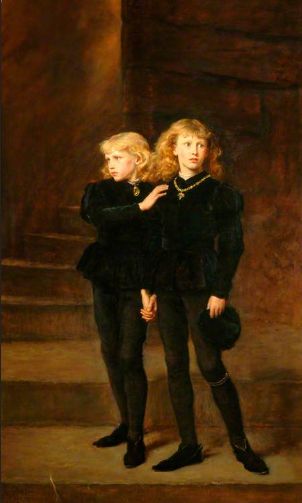
Northcote’s two pictures of Richard III, the smothering of the little princes and the removal of their bodies, are powerful imaginings of awful events in the plot which Shakespeare only hints at. The composition adds to the power of the pictures: the second is drawn from Caravaggio’s Deposition of the body of Christ.

Some paintings were straightforward portraits: Romney’s painting of Cassandra raving is a portrait of Emma Hamilton and she also turns up as Miranda in The Tempest painting.

Humour isn’t easy to convey on canvas, and these paintings rarely managed it successfully. Fuseli seems to want to keep the mood light in his painting of Falstaff and Doll Tearsheet, but Falstaff has more the appearance of an indulgent uncle than a ridiculously lecherous old man, and Doll, perched on his knee, looks respectable rather than comic wearing her jaunty feathered hat.

My favourite picture though is one which makes no attempt to be anything other than a flat image: West’s King Lear on the heath. The characters fill the frame, leaving no room for a historical or topographical setting. The image is full of movement and emotion, and contains telling details like the way Gloucester’s and Lear’s faces are set against their dark billowing cloaks.


These are less then ten per cent of the images in the Boydell Shakespeare Gallery. The scans don’t do the originals justice, but I hope they give you a flavour of these images.

Share
Posted in Legacy | Tagged , , , , , , , , , , , , , , | 1 Comment

Shakespeare, Italy and the theatre

With so much going on in the World Shakespeare Festival at the moment it’s hard to keep up. I spent last week away, with no TV or internet access and just catching programmes I missed is quite a job. 

One that I didn’t realise I was going to be missing was the first of Francesco da Mosto’s two-part series on Shakespeare in Italy. His interest in Shakespeare is genuine:
Among Italians, Shakespeare is certainly the best-known foreign writer. It’s interesting for us to see how he describes Mark Antony, and how his Octavius resembles Machiavelli’s Prince. But the most important this is the way he described emotions that are universal. It hits you like a punch in the stomach. 

In the first programme he talked about Shakespeare and the universal emotion of love, but the one going out this Thursday looks at the political landscape, visiting Venice’s Jewish ghetto, Rome and Sicily which the Radio Times confidently assures us was the setting for The Tempest. Really? 

The Sunday Telegraph on 6 May ran a three-page piece on the programmes in its Travel section, which in itself tells us something about the aims of the series. It does sound more like an advertisement for the beauties of Venice, da Mosto’s home, than an attempt to find Shakespeare connections, some of which seem a little strained.  In The Merchant of Venice, Launcelot Gobbo gives deliberately confusing directions: “Turn up on your right hand at the next turning, but at the very next turning of all, on your left…turn of no hand but turn down indirectly”. This, the programme suggests, is recognisable as Venice with its maze of alleyways, as if Venice was the only city with a complicated layout. Da Mosto has his own ideas about the identity of Othello which I suspect indicate more about the myths and legends that have sprung up about Shakespeare in the past four hundred years than actual fact. But even if the programme doesn’t provide any new insights into the “did he or didn’t he” question it’ll be worth watching for the images of  this beautiful country, accompanied by the always charming  Francesco da Mosto driving his Alfa Romeo. 

On returning to Stratford I wandered into the Royal Shakespeare Theatre to find a little pamphlet discussing Shakespeare’s life, entitled Alas Poor Yorick, or What if Shakespeare fell off the wall?, written by Peter Brook. The eminent Shakespeare director’s essay has been published to celebrate Shakespeare’s Birthday and as a tribute to Michael Boyd who leaves the RSC later this year after ten years as Artistic Director.

I was quite surprised to see Peter Brook joining the fray surrounding the authorship question, but as the most important figure in theatre in the second half of the twentieth century, nobody is better qualified than he to point out the impossibility of an imposter being able to pass himself off as the author of the plays.
Who was this man, acting, rubbing shoulders in rehearsal, sitting for hours talking to all and sundry in the taverns without anyone suspecting he was a fake! An actor says to an author – “Can’t you change that line?” or “I haven’t enough time for the costume change – could you write a soliloquy or a little scene on the forestage to help?”…

No one smelt a rat amongst all those spiteful and jealous rivals? I’m sorry academics – if you’d been part of any rehearsal process you would think differently. Even today, imagine a phoney writer. The cast would begin to notice and gossip about the fact that every time you ask something, the author slips into the wings with his cell phone. 

Brook’s estimate of Shakespeare’s genius is more cerebral than Francesco da Mosto’s, but does not exclude it:
But Shakespeare was unique. He never judged – he gave an endless multitude of points of view with their own fullness of life, leaving the questions open both to the humanity and to the intelligence of the spectator.

Copies of the essay are being given away in the theatre and there’s an article in The Daily Telegraph giving more details. Later this year it will form part of a new book on Shakespeare by Peter Brook, The Quality of Mercy, being published by Nick Hern Books.

Share
Posted in Legacy, Shakespeare's World | Tagged , , , , , , , , , | 1 Comment

Remembering Shakespeare at Yale

I know I’ve written about it before, but if you’re interested in the history of Shakespeare in print you really should take a look at the blog attached to Yale University’s current exhibition Remembering Shakespeare.  The University’s Beinecke Library contains a wonderful collection of early editions, illustrated books and material about Shakespeare on stage, and PhD student Matt Hunter has been doing a great job of putting images of these treasures onto the blog with his informative commentary.

 Following the theme of remembering Shakespeare, I’ve been particularly interested in things that were written about Shakespeare after his death. I’m highlighting three of these, two of which contain manuscript additions to the printed text, making the books unique. 

The first example, in the blog for 18 April, was published in 1687, before Shakespeare’s reputation had begun to rise above the level of a normal man. In his Lives of the Most Famous Poets, William Winstanley wrote of Shakespeare and Ben Jonson in a humorous, informal way.
“Many were the Wit combats betwixt him and Ben Jonson,” he wrote, “which two we may compare to a Spanish Galleon, and an English Man of War; Mr. Jonson (like the former), was built far higher in Learning, solid, but slow in his performances; Shakespeare, with the English Man of War, lesser in bulk, but lighter in sailing, could turn with all Tides, tack about, and take advantage of all winds by the quickness of his Wit and Invention.”

It’s one of the most delightful references to Shakespeare, and comes relatively soon after his death, before, for instance, Nicholas Rowe’s attempt to construct a biography for his edition of the plays which was published in 1709. Incidentally there are also many illustrations of this edition on the blog.

 The second example was published on 20 April, the 1778 Modern Characters of Shakespeare. This little book  prints extracts from Shakespeare’s works, but it’s an irreverent view. To each quotation the author has attached the name of a contemporary figure – leaving a few gaps in the name to avoid getting into trouble. The disguise was never meant to be a hard puzzle to solve, and the owner of the book has gone through it, filling in the names by hand. 

The final one was published on 21 April, and it’s a 1773 volume of poems. This takes a really satirical look at Shakespeare’s poems. Not for the last time, Hamlet’s “To Be or Not To Be” is parodied. In this book, the poem is headed “Hamlet’s soliloquy, imitated” and its first line reads “To print or not to print – that is the question”.

 These examples all illustrate the fact that Shakespeare’s plays and poems were seen as fair game for writers and printers, even in the late eighteenth century when Garrick was promoting the idea of the divine Shakespeare.

 The exhibition catalogue, which the curator David Scott Kastan has very kindly sent me, is a beautiful, highly informative book on the subject of the history of the appreciation of Shakespeare from the earliest days. I haven’t been able to get to the exhibition itself, but he and Matt Hunter are doing Shakespeare-lovers and students a great service by making the holdings of the Beinecke Library available online.

Share
Posted in Legacy | Tagged , , , , , , | Leave a comment

Stratford’s American Fountain: a monument to temperance?


The American fountain

In recent weeks I’ve written several times of Stratford-upon-Avon’s links with America, and how Shakespeare supplies shared cultural values in spite of political differences.

The American Fountain is a favourite focal point in the town’s marketplace, and its creation brought together an unlikely mixture of people. It was intended as a tribute to Queen Victoria, whose Golden Jubilee was being celebrated, to Shakespeare, and to the relationship between the USA and England. The fountain is heavily decorated with quotations and sculptural details which enforce these messages.

But where did the fountain come from? It was the gift of the American newspaper publisher and philanthropist George Childs. He was born in 1829 and rapidly became wealthy, co-purchasing the loss-making newspaper The Philadelphia Public Ledger and turning it into a hugely profitable enterprise. He had a deep love of Englandand its writers, erecting windows in memory of William Cowper, George Herbert and John Milton, and a monument to the great critic Leigh Hunt.

Stratford was not short of monuments: the Shakespeare Memorial Theatre had been completed in 1879, and there were already at least three statues of Shakespeare in the town. A different sort of monument was required.

The unveiling by Henry Irving

The Foundation stone was laid on 20 June 1887, by Lady Hodgson, wife of the town’s mayor. Builders and sculptors must have worked swiftly as it was unveiled on 17 October, less than four months later, by the renowned actor Henry Irving. Irving was the best-known actor of his day, who had also successfully toured several of his Shakespeare productions to the USA.

The fountain and clock-tower is Victorian gothic in style. It includes two quotes from Shakespeare, one celebrating the drinking of water, “Honest water, which ne’er left man i’the mire”, from Timon of Athens, and the other, several lines from Henry VIII, which praise the reign of Elizabeth 1, but which are here applicable to Victoria, England’s other long-reigning female monarch:
In her days every man shall eat in safety
Under his own vine what he plants, and sing
The merry song of peace to all his neighbours.
God shall be truely known, and those about her
From her shall read the perfect ways of honour
And by those claim their greatness not by blood..

It contains many lovely details such as floral roundels, tudor roses, grotesque imps and my favourite, an owl.

The fountain also contains a quotation in praise of Shakespeare from the distinguished American writer Washington Irving. “Ten thousand honours and blessings on the bard
who has gilded the dull realities of life with innocent illusions”. And prominently on each corner are English lions and American eagles, each holding their country’s heraldic shields.

Horse-troughs, now filled with flowers, stand on each side, and the fountain no longer provides water. After restoration a few years ago, though, the clock works and its bell gently chimes.

I’ve often wondered whether the water fountain was meant to be a rebuke to the drinkers of the town and in particular the local brewers, the Flower family. Stratford was renowned for its many public houses, and the popular temperance movement must have had a difficult time rallying support here. Flowers beer was famous, and the brewery was a major employer. The family were also local philanthropists, having funded much of the theatre themselves (it was known as the theatre built on beer).

In 1889 the church’s vicar, the Reverend Arbuthnot, published a short guide to the town, entitled Two Hours in Stratford-on-Avon. He mentions the water fountain, recording “our poet’s praise of cold water”, and suggesting “we shall do better to drink of it, rather than to patronise any of the Public Houses which abound in the town”. On market days the market place would have been particularly busy for the pubs.

Henry Irving, although not involved with the temperance movement, helped to promote the respectability of the stage by his own charitably giving and moderate way of life. He was so successful in this that in later life he was the first actor to be honoured with a knighthood.

George Childs’s gift helped to strengthen links with America, where Shakespeare has been and continues to be admired and honoured.

Share
Posted in Legacy, Stratford-upon-Avon | Tagged , , , , , , , , , , , , , , | 2 Comments

Julius Caesar: Shakespeare’s African play

In this year of firsts, Greg Doran, who’s about to take over the running of the Royal Shakespeare Company, is creating a few firsts of his own. He’s currently rehearsing the first RSC Shakespeare production featuring a completely black cast. The play will be set in modern Africa, another first. And for the first time the company is recording a filmed version of the play at the same time as rehearsing the stage production. Here’s a link to the RSC rehearsal photographs.

This is what Greg Doran has to say about the play:
One of the inspirations behind setting Julius Caesar in Africa was discovering the Robben Island Shakespeare and that Nelson Mandela had chosen to autograph lines from the play, asserting that it spoke in a particular way to his continent. It also struck me that there must be some reason why Julius Nyerere, the first president of Tanzania, had translated the play into Swahili. The actor John Kani put it most succinctly when he told me that Julius Caesar was quite simply “Shakespeare’s Africa play”.

If you consider the history of the Continent since Independence over the last fifty or sixty years, it has witnessed a series of freedom fighters turned democratically elected Presidents, turned despotic rulers, who have pulled all the power to themselves in one party States. The fear of that tyranny has led to multiple military coups, assassinations and civil wars which continue to ravage the continent. Caesar could be Amin or Bokassa, Mobutu or Mugabe.

The set model for the 2012 RSC production

My first instinct was to set the play in a non-specific setting sometime in the last half century, definitely sub-Saharan – but of course History overtakes us. One of the urgent questions arising from the Arab Spring last year, was not would they get rid of Gaddafi, but what would replace him. This makes the second half of Julius Caesar, instead of frequently feeling a bit on an anticlimax, suddenly seem urgent and thrilling. Or that is what I hope will happen.

Greg Doran and Trevor Macdonald talk about this and Nelson Mandela in a Radio 4 Midweek programme, still available to listen to. His section begins 12.5 minutes in.

This statement, and much else about this project, is contained in several posts on the terrific Illuminations blog written by John Wyver who’s been involved in filming several of Greg’s productions in the past.

The Robben Island Shakespeare, which Greg mentions, was brought to this country in 2006 as part of the Complete Works Exhibition hosted by the Shakespeare Birthplace Trust which took place at Nash’s House in Stratford-upon-Avon. Robben Island, off the coast of South Africa, was where political prisoners were imprisoned, some for decades, during the apartheid era.

Sonny holding the Robben Island copy of Shakespeare

At the opening ceremony, in this beautiful house with the wisteria just outside the window in full bloom, we listened as the book’s owner, Sonny Venkatrathnam told us its the story. He explained how he smuggled the book into the prison and the guilt he continued to feel over lying to his guards by telling them it was his Hindu bible. Over a period of several years this ordinary volume of Shakespeare’s Complete Works circulated among the prisoners in the notorious jail, providing spiritual nourishment, and before Sonny’s release each man marked his favourite passage. After the official opening  I remember Greg’s partner, Tony Sher, himself a South African, saying that it was, for him, the most important object in the exhibition. Here’s a link to a recent article about the book, including an interview with Sonny himself.

Thirty-two passages are marked as favourites in the book:  Billy Nair marked Caliban’s  lines in The Tempest  which begin “This island’s mine”, and Walter Sisulu Shylock’s speech in The Merchant of Venice which includes ”for sufferance is the badge of all our tribe”.

Nelson Mandela's markings

Nelson Mandela, though, picked telling lines from Julius Caesar:
Cowards die many times before their deaths:
The valiant never taste of death but once.
Of all the wonders that I yet have heard,
It seems to me most strange that men
Should fear…
Seeing that death, a necessary end,
Will come when it will come.

This year, too, a new book by Ashwin Desai, called Reading revolution: Shakespeare on Robben Island has been published. He’s interviewed many of the people who signed, not all of whom were members of the African National Congress. Within the prison many books were circulated that prompted political discussion among inmates, who acknowledged their differences to promote the aim of national unity. At the heart of Desai’s book is the view that “Reading changes our lives, and our lives change our reading”, Shakespeare being a vital part of this transformation.

On 7.45 on 3rd July another spinoff from this remarkable book reaches the stage, when Matthew Hahn’s play The Robben Island Bible will be performed as part of the London Literary Festival’s Africa Utopia Series, at London’s Southbank Centre.

Finally, the Robben Island Shakespeare is to be displayed as part of the British Museum’s Shakespeare: Staging the World Exhibition and the final programme in Neil MacGregor’s Radio 4 series on 11 May will feature it.

This humble little book speaks to us about Shakespeare’s importance in not just his, but our restless world, and I for one can’t wait to see how the African context  for the new RSC production of Julius Caesar will illuminate this 400-year old play.

Share
Posted in Legacy, Plays and Poems, Shakespeare on Stage, Uncategorized | Tagged , , , , , , , , | 2 Comments

Shakespeare’s well-apparell’d April

Shakespeare loved spring, and April, with its freshness and optimism is the month of which he writes most fondly.

I couldn’t let it go by without a post containing a few of his lines, together with a selection of photographs taken mostly this year in or around Stratford-upon-Avon. I hope you enjoy them.
Such comfort as do lusty young men feel
When well-apparell’d April on the heel
Of limping winter treads, even such delight
Among fresh female buds shall you this night
Inherit at my house.
Romeo and Juliet Act 1 Scene 2

Yet I have not seen
So likely an ambassador of love.
A day in April never came so sweet
To show how costly summer was at hand.
The Merchant of Venice Act 2 Scene 9

He dances, he has eyes of youth…he writes verses, he speaks holiday, he smells April and May. He will carry it.
The Merry Wives of Windsor, Act 3 Scene 2

O, how this spring of love resembleth
The uncertain glory of an April day,
Which now shows all the beauty of the sun,
And by and by a cloud takes all away.
The Two Gentlemen of Verona, Act 1 Scene 3

And he wasn’t alone. Nicholas Breton, in his 1626 book Fantasticks, writes this exuberant description of the delights of the month:

It is now April, and the Nightingale begins to tune her throat against May; the sunny showers perfuse the air, and the bees begin to go abroad for honey:…the garden banks are full of gay flowers, and the thorn and the plum send forth their fair blossoms; the March Colt begins to play, and the cosset lamb is learned to butt. The Poets now make their studies in the woods, and the youth of the country make ready for the Morris-dance; the little fishes lie nibbling at the bait, and the porpoise plays in the pride of the tide; the Shepherd’s pipe entertains the Princess of Arcadia, and the healthful soldier hath a pleasant march… The aged hairs find a fresh life and the youthful cheeks are as red as a cherry: It were a world to set down the worth of this month; but in sum, I thus conclude, I hold it the Heavens’ blessing and the earth’s comfort. Farewell.

Share
Posted in Plays and Poems, Stratford-upon-Avon | Tagged , , , , | 4 Comments

Global Shakespeares

The World Shakespeare Festival, which has just begun, is already opening our eyes to performances of Shakespeare from some of the most remote corners of the world. Nothing does more to prove that Shakespeare is the world’s dramatist than productions which originate in places where Shakespeare is, you would think, not on the cultural menu, and these productions often demonstrate the persistence and bravery of those involved.

At the Swan Theatre in Stratford you’ll find Romeo and Juliet in Baghdad, set in modern Iraq where the usual feud between the Montagues and Capulets becomes the sectarian division between Sunni and Shia. The cycle of violence and revenge is fuelled by intervention from outside forces, which may make some of this production uncomfortable viewing.

But most of these zingy productions are happening as part of the Globe to Globe Festival in London. Here will be The Two Gentlemen of Verona from Zimbabwe, and Cymbeline by the South Sudan Theatre Company. The Republic of South Sudan became the world’s newest country in April 2011 after 50 years of violent struggle. Cymbeline‘s a play which examines the nationalistic desire of a small country to liberate itself from external powers. The resulting adaptation draws on local traditions to create a show that resonates with the politics and celebrates the traditions of South Sudan.

But the most unlikely company visiting the Globe must be Roy-e-Sabs, from Afghanistan. They have been described as “a theatrical miracle”. In 2005 they performed Love’s Labour’s Lost in war-ravaged Kabul. Controversially, men and women acted together, the women sometimes not wearing headscarves, and lovers held hands, all of which had been strictly forbidden. It’s truly amazing that this group are now bringing a new production of The Comedy of Errors to London.

The story of the 2005 production of Love’s Labour’s Lost that took place in Kabul is told in a new book, Shakespeare in Kabul. On 26 April the authors, Stephen Landrigan and Qais Akbar Omar, are talking at the Shakespeare Centre in Stratford-upon-Avon as part of the Stratford Literary Festival. It’s a fascinating story, beginning with the difficulties of translating the play, and the problems of finding actors since theatre is not part of Afghanistan’s culture. Unexpected barriers were encountered: some of the actors could barely read, for instance. Several of the actors had been wounded themselves, or had seen relatives killed. And they had to overcome the fact that a woman on stage is still thought no better than a prostitute. The play was adapted and directed by the French actress Corinne Jaber for a local audience and taking their sensibilities into account, so the young men, played as nobles of Kabul, disguised themselves as itinerant Indian dancers rather than Russians.

But the major hurdle was the political situation. There can be no country in the world with a more troubled history than Afghanistan. In 2005 there was a feeling of optimism: “the future held no limits, the actors believed”.

The production was received with rave reviews from foreign journalists and the cheers of local audiences. But just as in the play, the end was tinged with sorrow. Recently that hope for the future of Afghanistan has turned to fear of what may happen when the peacekeepers depart. Love’s Labour’s Lost ends with the possibility that a resolution will be found in time, and this hope can still be seen with the visit of the company to London with another Shakespeare play. Perhaps the choice is significant: The Comedy of Errors is a play in which the happiness promised in Love’s Labour’s Lost becomes a reality, all disputes ended and families reunited.

Reactions to all of these productions will form part of the new project Shakespeare’s Global Communities. Look out for its official launch.

Share
Posted in Legacy, Shakespeare on Stage | Tagged , , , , | 3 Comments