Ben Jonson and Anne Hathaways’s shared anniversaries

I couldn’t let the 6 August go by without mentioning that it’s the anniversary of the death of two of the people most important to Shakespeare.
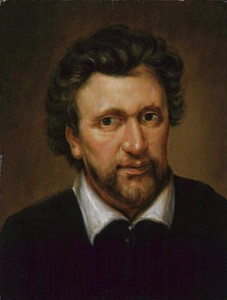
 

Ben Jonson

Ben Jonson’s relationship with Shakespeare spanned almost twenty years, beginning, according to Rowe’s account in 1709, when Shakespeare, already an established dramatist, “luckily cast his eye” upon one of Jonson’s first plays and gave him his first break in the theatre. Once Jonson became established, the two had a competitive professional relationship. There’s a wonderful description in Fuller’s Worthies of England, dating from 1662:

Many were the wit-combats betwixt him and Ben Johnson, which two I behold like a Spanish great galleon and an English man-of-war. Master Johnson (like the former) was built far higher in learning; solid, but slow, in his performances. Shake-spear, with the English man-of-war, lesser in bulk but lighter in sailing, could turn with all tides, tack about and take advantage of all winds, by the quickness of his wit and invention.

 In private, though, Jonson wrote that he “lov’d the man, and doe honour his memory (on this side Idolatry), as much as any”.

 According to a story told to John Ward, vicar of Stratford during the 1660s,  Jonson may have been partly responsible for Shakespeare’s death. “Shakespeare, Drayton, and Ben Jonson had a merry meeting, and it seems drank too hard, for Shakespeare died of a fever there contracted”

 Jonson wrote two poems dedicated to Shakespeare in the collected edition of the plays known as the First Folio, published in 1623. In the years following Shakespeare’s death Jonson became a favourite at court, and was effectively the first Poet Laureate. He died in 1637 and was buried in Westminster Abbey.
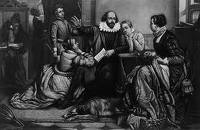
 

Engraving imagining Shakespeare reading to his family including Anne

The other anniversary is that of Anne Shakespeare, his wife, who died on 6 August 1623, the same year that Shakespeare’s monument was placed in Holy Trinity Church, Stratford-upon-Avon and the First Folio was published. Anne is buried near her husband, and there is a Latin inscription on her grave. The lines were probably written by John Hall, her son in law, but the sentiments are those of her two daughters. This translation of part of the inscription is in the book Shakespeare’s Church:

 Mother, you gave me the breast, you gave me milk and life;
Woe is me, that for so great a gift my return will be but a tomb.
                                          … come quickly, Christ!
That my mother, though shut in the tomb, may rise again and seek the stars

 It’s a surprisingly personal epitaph for so public a spot.

 The sonnet Anne Hathaway written by Carol Ann Duffy refers to Shakespeare’s bequest to his wife. Unusually it describes Anne and William’s relationship as a loving one and imagines the intimacy and closeness that they shared in that second best bed.

The bed we loved in was a spinning world
of forests, castles, torchlight, clifftops, seas
where we would dive for pearls. My lover’s words
were shooting stars which fell to earth as kisses
on these lips; my body now a softer rhyme
to his, now echo, assonance; his touch
a verb dancing in the centre of a noun.
Some nights, I dreamed he’d written me, the bed
a page beneath his writer’s hands. Romance
and drama played by touch, by scent, by taste.
In the other bed, the best, our guests dozed on,
dribbling their prose. My living laughing love-
I hold him in the casket of my widow’s head
as he held me upon that next best bed.

History has not been kind to the memory of Anne Hathaway, so these poem may help to redress the balance, particularly today.

Share
Posted in Legacy, Shakespeare's World, Stratford-upon-Avon | Tagged , , , , , , , | 4 Comments

I’ll write it straight: The Catalogue of English Literary Manuscripts 1450-1700

This is the second post looking at the subjects raised by the 29 July conference launching the new online Catalogue of English Literary Manuscripts 1450-1700.  

The first paper was contributed by the prolific writer and academic Germaine Greer. Ever since the publication of her famous book, The Female Eunuch, sexuality has been the focus of Greer’s work. Her current research is on the poet Ann Finch (1661-1720). Ann’s poems were published during her lifetime and Greer wondered why it was that on her death her husband Heneage, who had encouraged and supported her writing, ordered that all her manuscripts should be destroyed. The fact that only a few  survived brought home how important the author’s manuscripts are to anyone wanting to connect with the author’s thoughts, and set the tone for the rest of the day.
 In his opening statement Peter Beal had commented on the increased interest in women’s writing since the original Index was published forty years ago. Over 60 women are represented in the new Catalogue of English Literary Manuscripts as opposed to just one, Aphra Behn, and there is growing interest in women’s education and literacy in the early modern period.

 One of the papers was on the letters written in Italian by Queen Elizabeth, and as commented by Peter Beal and Grace Ioppolo in their book Elizabeth I and the Culture of Writing, “Elizabeth I …lived immersed in a culture of writing, one in which she herself participated and which to some degree she helped to create”. Fluent in several languages she encouraged writers, and the spread of education.

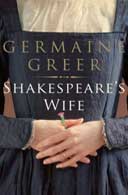
 A few years ago Greer published another book heavily based on manuscripts, a study of Anne Hathaway, Shakespeare’s Wife. Greer argued that Anne, far from being the neglected and despised wife, left only the infamous “second best bed” in her husband’s will, was a resourceful woman who during her husband’s long absences managed the household in Stratford and may have made substantial financial contributions to the family.

 There is no evidence of Anne’s ability to read or write, but it’s always taken for granted that she was illiterate. It’s also frequently said that in spite of evidence to the contrary, Shakespeare did not care about his daughters’ education. But as Greer points out “Anne’s staunchly protestant family would have had her taught to read if only so that she could read her Bible every day” and up to the age of seven both boys and girls would have attended dame schools which taught reading.

 Queen Elizabeth was a clear example of women’s capability of learning to the highest standards.  Mulcaster’s influential 1581 book Positions concerning the training up of Children was dedicated to her. He suggests there are “many and great contentments …which those women that have skill and time to read, without hindering their housewifery, do continually receive by reading of some comfortable and wise discourses”.


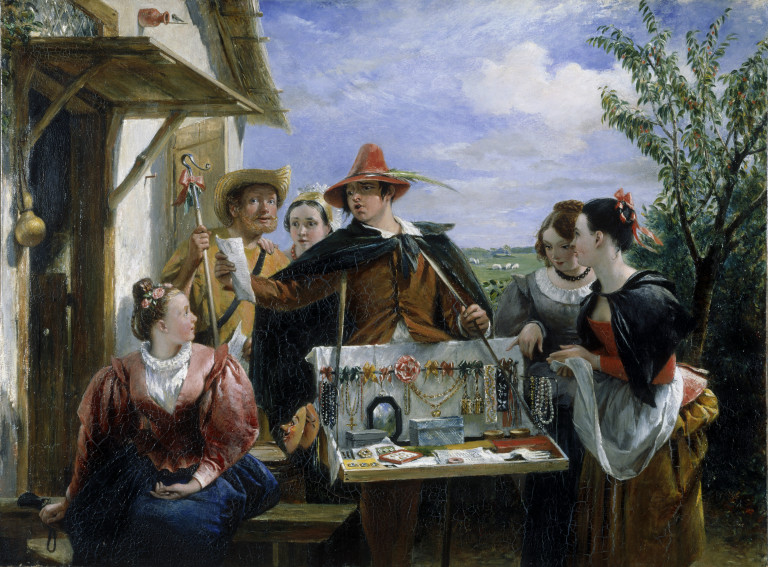
Charles Leslie's painting of Autolycus selling ballads to Mopsa and Dorcas

What do we find if we look at the women in Shakespeare’s plays? Many of them can read from the country girls Mopsa and Dorcas in The Winter’s Tale who “love a ballad in print …for then we are sure they are true” to Alice Shortcake who is lent a book of riddles, and the merry wives who receive Falstaff’s letters. The more advanced skill of writing is known by some of Shakespeare’s girls. Phebe, a shepherdess inArden, writes a “very taunting letter”, and Maria in Twelfth Night forges a letter to Malvolio in her mistress’s hand.

 None of these women read religious or instructive works, and Nicholas Bownde’s 1595 words might have been written for them:

“in the shops of artificers, and cottages of poor husbandmen … you shall sooner see one of these new ballads, which are made only to keep them occupied… than any of the psalms….   So that in every fair and market almost you shall have one or two singing and selling of ballads”

 Poor Ophelia is given a devotional book to read by her father when meeting Hamlet:

                             Read on this book,
That show of such an exercise may colour
Your loneliness…. With devotion’s visage
And pious action we do sugar o’er
The devil himself.

 Hamlet immediately sees through the pretence. Apart from the conventional Ophelia, Shakespeare’s spirited women use their reading and writing skills to outwit the men in their lives.

Share
Posted in Legacy, Plays and Poems, Shakespeare's World | Tagged , , , , , , , , , , , , , , | 3 Comments

Living monuments: Shakespeare’s epitaphs

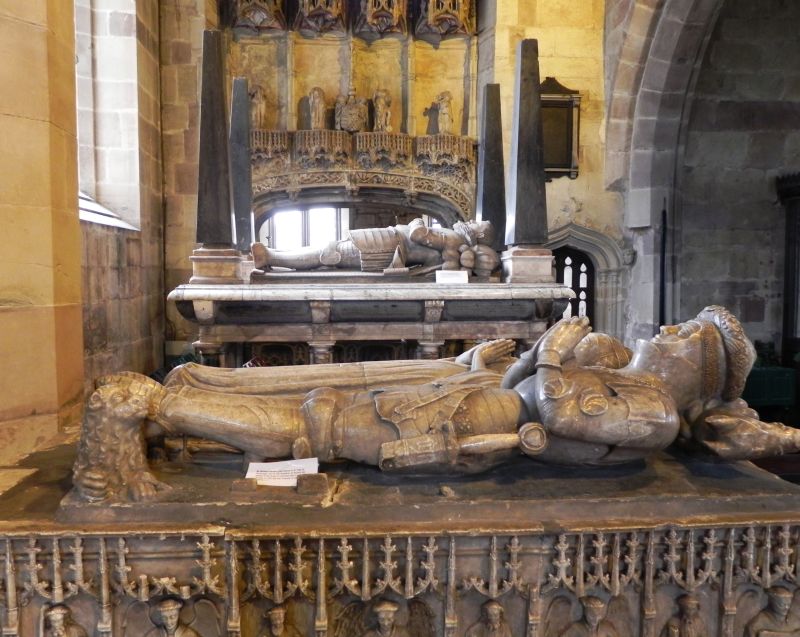
The monument to Richard Vernon, with the Stanley monument behind

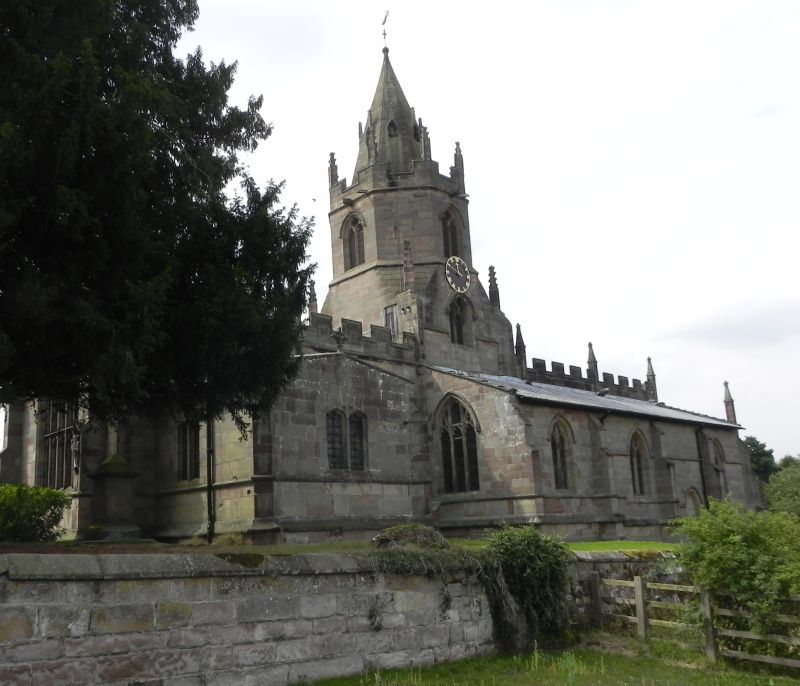
I’d never heard of the little village of Tong and its church until recently when some visiting relatives mentioned its Shakespeare connections. So I paid a visit to this tiny village in Shropshire to find out more.

 The church is sometimes called the “village Westminster Abbey” because of the large number of magnificent tombs it contains, mostly for the Vernon and Stanley families.  The name Stanley will ring a bell with you if you know Richard III. Towards the end of the play Stanley, who wants to fight for Richmond against King Richard, is forced to remain neutral in the run-up to the battle of Bosworth because the king has taken Stanley’s son George hostage and threatens to kill him. Young George is Richard III’s last potential victim. After the death of Richard during the battle, Richmond is proclaimed King Henry VII.

 As usual, Shakespeare is pretty casual about historical details. “Young George” was actually quite mature, and the Stanley in the play is a conflation of two members of the family. Stanley is referred to as Earl of Derby before he was granted this honour. The key elements of this story, though, are taken accurately from the play’s sources, Sir Thomas More’s Life of Richard III and the Chronicles of Halle and Holinshed.

The tomb of Henry Vernon, with the Stanley monument visible behind

Stanley did delay as long as he could before coming in on Richmond’s side, and after the battle George is released unharmed.  The new King Henry VII rewarded Stanley for his loyalty by creating him 1st Earl of Derby in 1485.

The magnificent tombs in Tong Church are not, though, of the Earls of Derby, but less prominent members of the family. They are so tightly packed it’s difficult to get clear photographs, especially of the impressive double-decker Stanley monument erected to Sir Thomas Stanley and his wife Margaret Vernon and their son Sir Edward Stanley (1562-1632).  Sir Thomas (died 1576) was the second son of the third Earl of Derby. At each end of the upper tomb are lines of poetry.

Detail of the coloured decoration on the Stanley monument

Ask who lyes heare but do not weep,
He is not dead he dooth but sleep
This stoney register, is for his bones
His fame is more perpetual than theise stones
And his own goodness with himself being gon
Shall lyve when earthlie monument is none

On the other end of the tomb:

Not monumental stone preserve our fame,
Nor sky aspiring pyramids our name
The memory of him for whom this stands
Shall outlive marbl, and defacers hands
When all to tymes consumption shall be geaven
Standly for whom this stands shall stand in Heaven.

 It’s rumoured that these lines were written by Shakespeare for this tomb, and there are links between Shakespeare and the Stanley family. The strongest comes about because Ferdinando, Lord Strange, had his own company of players who performed some of Shakespeare’s plays. One copy of the book Plutarch’s Lives of the noble Grecians and Romans, published in 1579, now owned by the Shakespeare Birthplace Trust, has a fascinating history. On publication it was given to Henry Stanley, 4th Earl of Derby and from him it passed to his son Ferdinando, 5th Earl of Derby, who died in 1594. Shakespeare based his Roman plays, including Antony and Cleopatra and Julius Caesar, on the stories in this book, and because Ferdinando and Shakespeare knew each other there is a strong possibility that this could be the copy he used.


Effigy of Edward Stanley

There is a signature in the book indicating that in 1611 it became the property of Edward Stanley, probably the man whose effigy is on the lower deck of the monument and a real Shakespeare connection.

 But did Shakespeare write the epitaph? Shakespeare might have written the words on his own grave, and there’s an old tradition that he wrote an epitaph for a Stratford neighbour, John Combe, so it seems possible. The story is made more complicated because the exact date of the tomb is unknown, though there is apparently a reference to the poem in a document dated 1620. Sir Thomas Stanley died when Shakespeare was only 12, so if Shakespeare wrote them to him they can only have been written years later, and Sir Edward Stanley died 16 years after Shakespeare’s death.


Tong Church

As so often with anything relating to Shakespeare, the rumours far outnumber the certainties, and the monuments in Tong Church remain a magnificent mystery.


Share
Posted in Legacy, Plays and Poems, Shakespeare's World, Sources | Tagged , , , , , , , , , , , , | 8 Comments

Shakespeare writing fair: The Catalogue of English Literary Manuscripts 1450-1700

Last Friday I attended a conference organised by the University of London School of Advanced Study to celebrate the imminent launch of a great new online resource, the Catalogue of English Literary Manuscripts 1450-1700. This will supersede the printed Index of English Literary Manuscripts, published in four large volumes beginning thirty years ago. Now only the proof-checking and final alteration phases remain before it is made freely available on the internet.

The mastermind of this work is Peter Beal, who has personally examined the majority of the 35,000 documents listed. He’s expanded the number of authors from 123 to 237, over 60 of whom are women compared to just one in the original Index.   The technology will ensure the Catalogue is fully available and will also allow for more flexible searching.

 During the day papers were delivered by many scholars who had examined manuscripts featuring in the Catalogue including Queen Elizabeth’s Italian letters, the poems of Ann Finch, and a commonplace book held at the Somerset Heritage Centre.

 Grace Ioppolo spoke about documents relating to Shakespeare, difficult because none of Shakespeare’s manuscripts have been found in spite of three centuries of searching. To date, apart from the few signatures, only a few pages of the play Sir Thomas More are thought to be in Shakespeare’s hand, but it is still impossible to be certain. Almost more mysteriously, why are there no presentation copies of Shakespeare’s plays made for wealthy patrons by professional scribes? Employing someone to make copies was expensive: Edward Alleyn paid for legal documents to be copied, paying up to a shilling (5p) a sheet, twice the cost of a printed copy of a single play in Quarto.

I particularly enjoyed Steven May’s paper on Samuel Watts’s anthology, a commonplace book mostly compiled between 1615 and 1622. Shakespeare’s Venus and Adonis, Lodge’s Rosalinde (a source for As You Like It) Spenser’s Faerie Queene and Marlowe’s Hero and Leander are frequently quoted in this collection which focuses on courtship and romantic love.

 One entry in the anthology is a piece of text containing gaps where it appears the name of the lady being wooed is to be inserted. There’s a direct parallel here with The Merry Wives of Windsor, where Falstaff writes identical love letters to both Mistress Page and Mistress Ford. Unfortunately for him, they compare notes: “I warrant he hath a thousand of these letters, writ with blank space for different names -sure, more!- and these are of the second edition”, says Mistress Page. “Why, this is the very same…the very hand…the very words!” replies Mistress Ford.


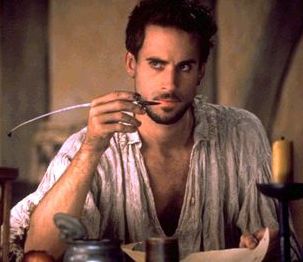
Joseph Fiennes in the act of composition in the film Shakespeare in Love

Although we don’t have any of Shakespeare’s own letters, 111 letters feature in his plays, only five of which don’t contain any letters. These include love letters and poems like Don Armado’s letter to Jaquenetta and the four poems written to the French girls in Love’s Labour’s Lost, letters written to deceive, such as Edmund’s forged letter in King Lear which persuades Gloucester that Edgar plans to murder him, and undelivered letters like the one Friar Laurence writes to Romeo explaining Juliet’s sleeping draught. The dedications to the Earl of Southampton printed in Venus and Adonis and The Rape of Lucrece are the nearest we get to letters written by Shakespeare as himself.  Alan Stewart’s recent book Shakespeare’s Letters is an admirable study of the subject.

 One of the great benefits of the Index has been the growth of research using original documents in the thirty years since it began to be published. The online catalogue will continue to open up study of these original materials. Perhaps there are still documents somewhere relating to Shakespeare just waiting to be discovered.

 I’ll be writing a second blog based on this conference later in the week.

Share
Posted in Legacy, Plays and Poems, Shakespeare's World | Tagged , , , , , , , | 1 Comment

Shakespeare’s Avon, Act 8: Sweet Swan of Avon

Ben Jonson’s memorial poem to Shakespeare published seven years after his death in the First Folio contains lines which famously link Shakespeare to the River Avon and to the magnificent birds that live on it.

Sweet Swan of Avon! What a sight it were
To see thee in our waters yet appear,
And make those flights upon the bankes of Thames
That so did take Eliza and our James!

 Swans are associated with beauty, fidelity and strength. They have their own myths: Shakespeare refers several times to the idea that although mute, they sing before they die. In Othello, Emilia says “I will play the swan,/ and die in music”.  They are, inevitably, linked with beauty. Trying to persuade Romeo to forget Rosaline Benvolio tries to find him another love “I will make thee think thy swan a crow”.

 Swans have been on the Avon for centuries. The medieval Guild of the Holy Cross which then ran the town held annual feasts in which swans were served as delicacies. An eighteenth century painting shows a swan on the river near the church.

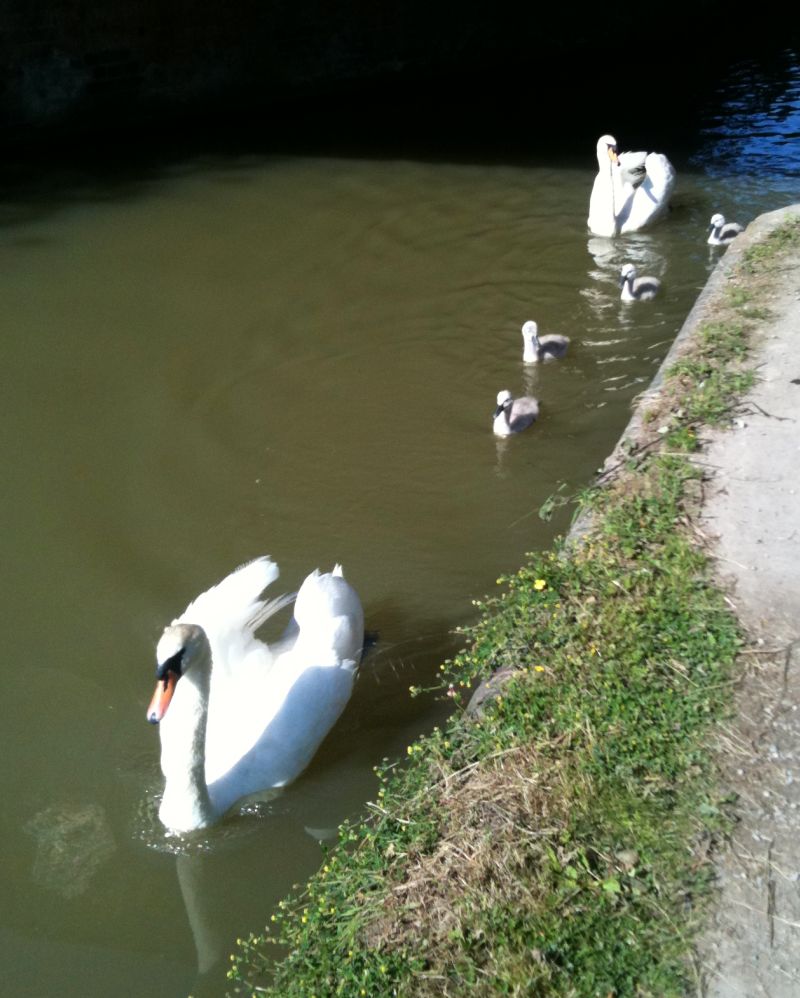
The river had a healthy population of swans until the 1970s when, along with much of the rest of the country, numbers declined and the Swan Management Committee was set up to promote the health and welfare of Stratford’s swans. A swan reserve was opened in 1981, lead angling weights were banned, and by the mid 1980s swans were again breeding. The committee still cares for the birds, operating a feeding programme, ringing and monitoring the flock and carrying out rescues. Money is raised to pay for this work and for medical treatments. As a result there are now around 50 adult swans to be seen on the river every day, and on average three pairs breed every year.


The birds are so closely associated with the town that in the 1980s Stratford-on-Avon District Council incorporated swans into their coat of arms.

 Swans are to be found everywhere. The RSC’s Swan Theatre, right by the river, opened in 1986, and for many years a swan was the symbol of the RSC. The striking metal sculpture of a pair of swans in the Bancroft Gardens was opened by the Queen in 1996. The town’s classical orchestra is named the Orchestra of the Swan.

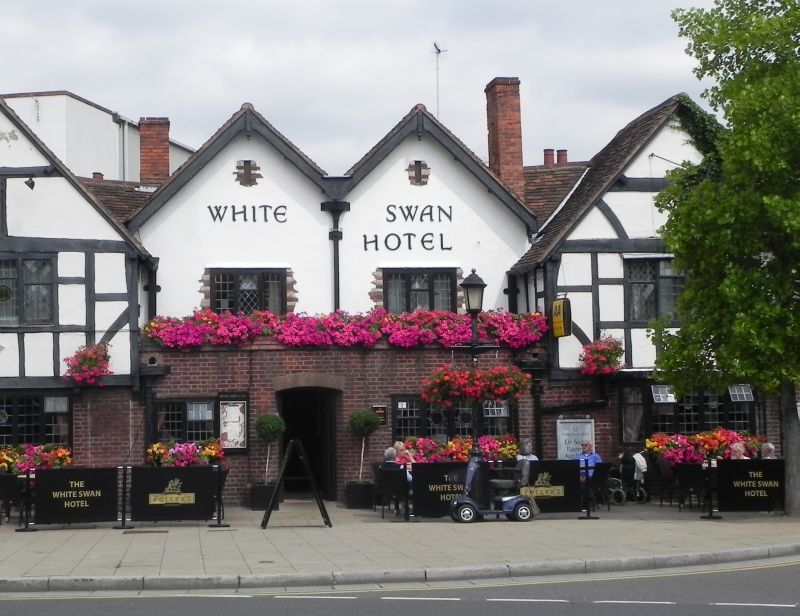
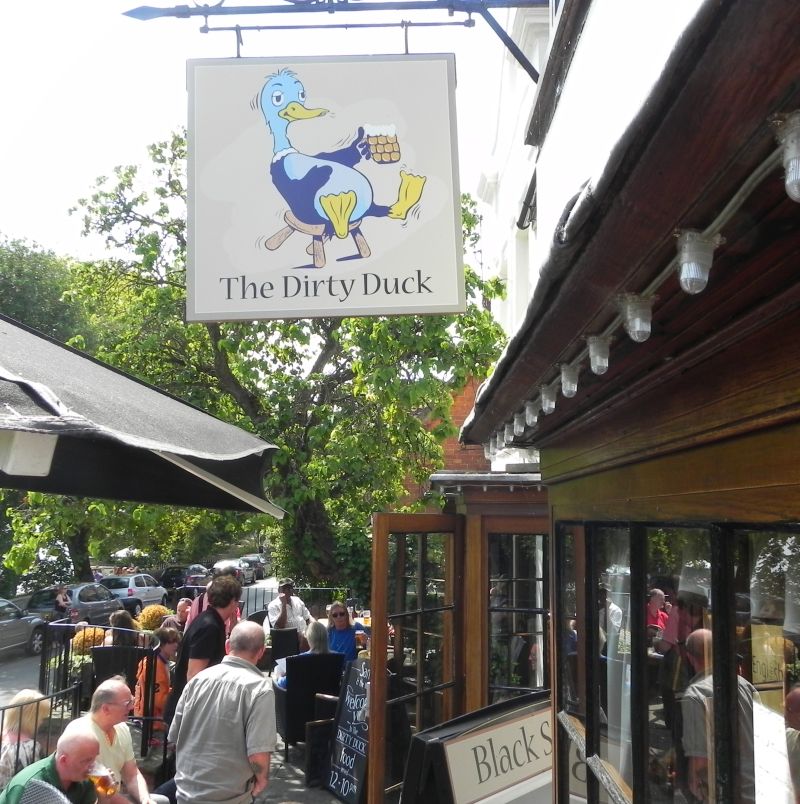
 After Shakespeare’s time, the building in which he was born became a public house called The Swan and Maidenhead, and there are many other pubs and hostelries associated with swans: the nearest hotel to the Birthplace is the White Swan, and near the river is the Black Swan, universally known as the Dirty Duck, its pub sign decorated differently on each side. Near the Clopton Bridge is the Swan’s Nest Hotel. Another hotel, the Alveston Manor, has a Victorian stained glass panel which includes an image of a swan.

 The popular American poet of the late nineteenth and early twentieth century Ella Wheeler Wilcox wrote a poem On Avon’s Breast I saw a Stately Swan. It’s a nostalgic poem written during a period of strife, discord and unrest, longing for the innocence and simplicity of the past. Although he isn’t mentioned directly Shakespeare is identified with the swan throughout the poem:
All heaven was one blue background for the grace
Of Avon’s beautiful, slow-moving swan. 

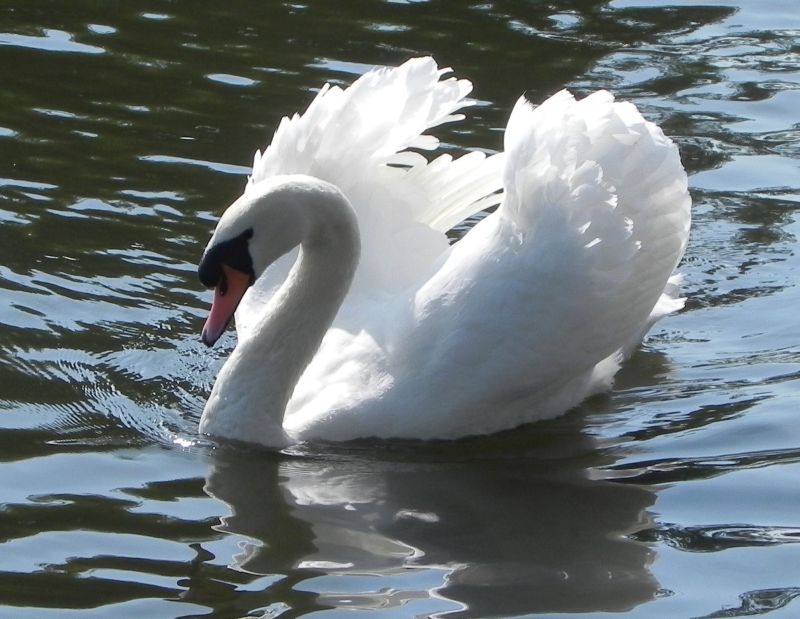
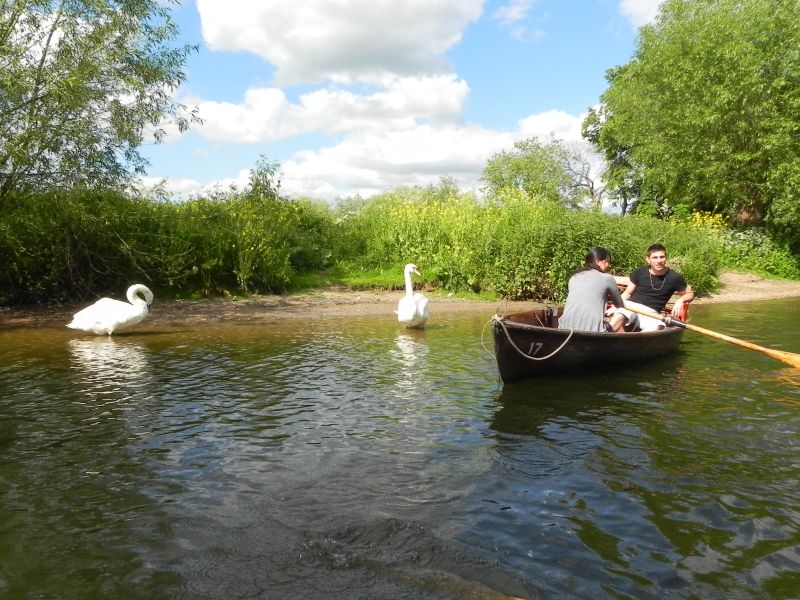
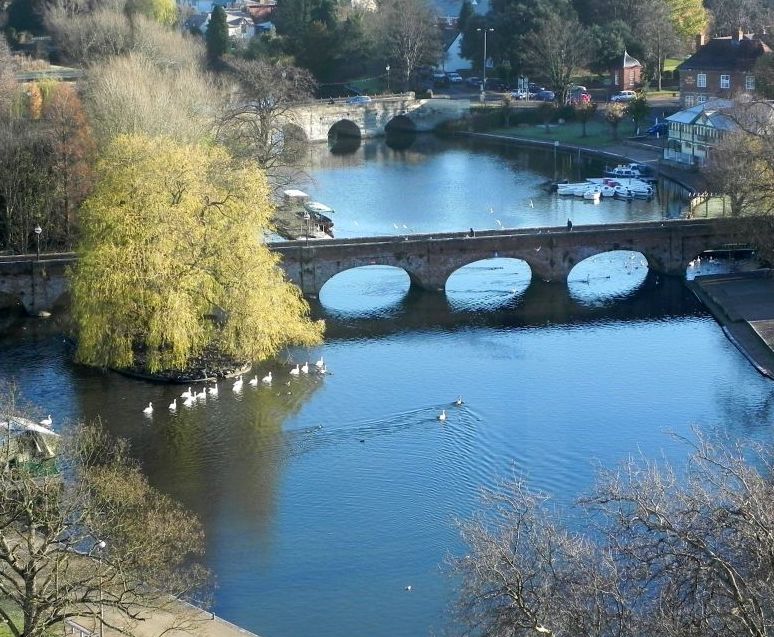
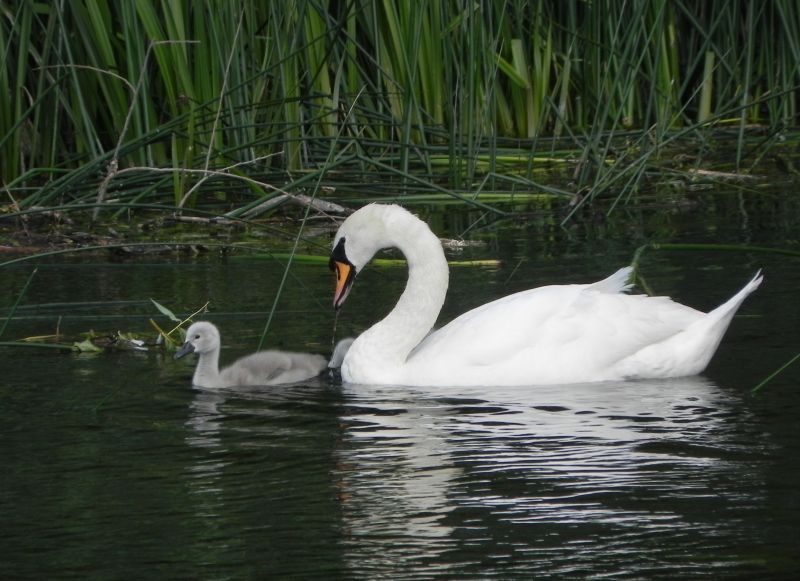
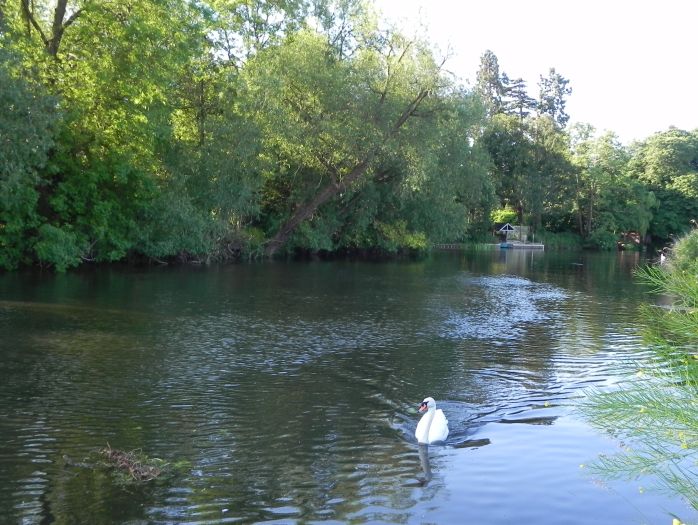
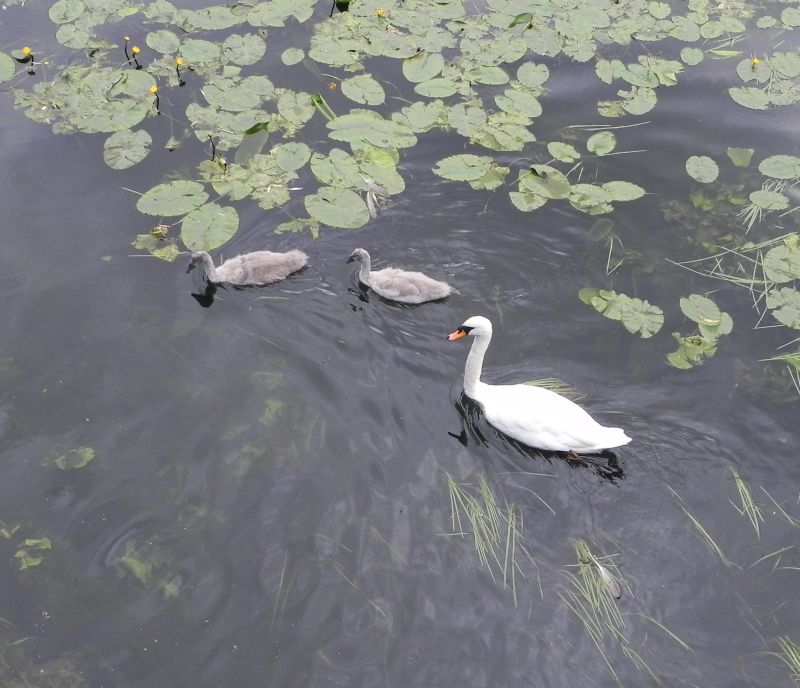
This is the last in the series on Shakespeare’s Avon. Here are some of our photographs of Stratford’s swans taken within the past year


Share
Posted in Legacy, Shakespeare's World, Stratford-upon-Avon | Tagged , , , , , , , , , , , , , , | 5 Comments

Shakespeare, portraits, and finding the mind’s construction in the face

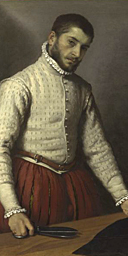
The Tailor, by Moroni

Last week I spent some time admiring a group of portraits now in the National Gallery, London, by the North Italian painter Moroni who lived from around 1520 to 1579. One is very well known. In The tailor the subject is an artisan, holding his scissors to cut a piece of black cloth, the expensive material that most of Moroni’s wealthy subjects wear. As explained in this video, by the mid-sixteenth century having your portrait painted was no longer the preserve of the rich or famous.

Moroni would have been paid to paint these portraits of important people, soldiers, gentlemen, churchmen. While they are very much real people, their expressions are often distant, superior. I was particularly intrigued by the Portrait of a Man holding a letter. Follow the link to Moroni above to see this painting and others. Why would you want a portrait to make you look so severe and haughty? Later I realised that the sitter was probably a lawyer and you can imagine this man was superbly good at arguing his case in the court room. He certainly doesn’t want to be liked.

Later that day I heard that Lucien Freud, another great portrait painter, had died. Unlike Moroni and most portrait painters from the past, Freud chose who he wanted to paint and didn’t work to commission. He didn’t have to flatter his subjects and rather than allow them to shield themselves with clothes, he often painted them naked. As he put it:

I’m really interested in people as animals. Part of my liking to work from them naked is for that reason. Because I can see more; and it’s also very exciting to see the forms repeating right through the body and often the head as well. I like people to look as natural and as physically as ease as animals.

This sounds relaxed, but Freud’s portraits often show people as vulnerable and troubled, and can be difficult to look at.

Florence Waters, in the Daily Telegraph  on 22 July points out:

Freud had an almost visceral hatred of almost all art of the Renaissance. It makes sense: the Renaissance was the period, above all, during which man was celebrated as the crown of creation. Freud’s belief was the opposite: man, he seems to say, must never forget the fact that he is deteriorating matter.

But Moroni’s portraits, beautiful as they are, don’t simply celebrate the human form. His subjects are clever, brave or shrewd but sometimes also aging or ill. Like Freud, Shakespeare too reminds us of our mortality. As artists, all are interested in psychological truth though they approach it by different routes.

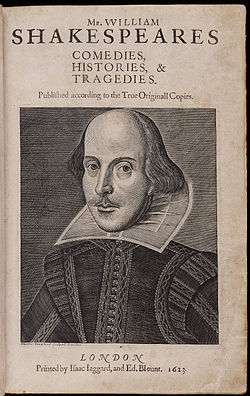
The Droeshout engraving of Shakespeare, 1623

There’s often a sense that portraits of Shakespeare can, or should, capture the essence of the writer. Even in 1623, though, the people who contributed poems to the First Folio pointed out that Shakespeare was best portrayed in his works rather than the authenticated engraved portrait in the book. Hugh Holland, Leonard Digges and James Mabbe all make the same point. As Digges put it:

                                This book,
When brass and marble fade, shall make thee look
Fresh to all ages.

 Other supposed portraits of Shakespeare like the Chandos or the recently-attributed Cobbe show a more handsome man but are no more successful in showing Shakespeare’s mind.

In Macbeth Shakespeare warned:

                             There’s no art
To find the mind’s construction in the face.

and Ben Jonson wrote that if the engraver of the First Folio portrait could have done so “the print would then surpass/ All that was ever writ in brass”.                                  

 What, I wonder, would a portrait of Shakespeare by Moroni or Freud have been like?


Share
Posted in Legacy, Shakespeare's World | Tagged , , , , , , , , | 2 Comments

Catch some Shakespeare at a cinema near you

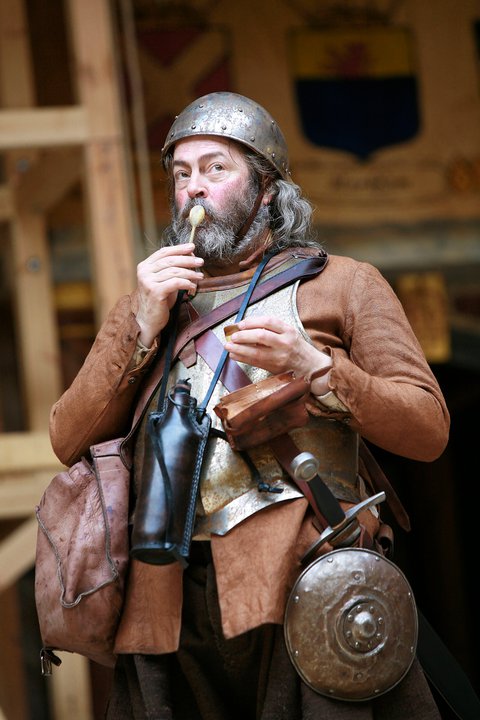
Roger Allam as Falstaff in the Globe's 2010 Henry IV production

This summer’s going to be a good time to see some great Shakespeare productions, and you might be able to catch some of them without going any further than your local cinema. The idea of screening live or recorded theatre productions has been around for a while now, but this year it seems to have really taken off with some mouth-watering events on offer.  The picture’s a little complicated because there are so many organisations involved, but certainly in the UK and USA, and in some other parts of the world, there’s a chance you’ll be able to join in.   

In the United States,  NCM Fathom, Shakespeare’s Globe Theatre, London and Art Alliance Media have come together to screen a whole series of  films of stage performances which are to be shown in cinemas nationwide. Among a huge range they include the Shakespeare’s Globe London Cinema Series of the two Henry IV plays, The Merry Wives of Windsor and Henry VIII

In England, the Netherlands and New Zealand the same plays are being screened, but on different dates. The details are  here  

Click here for a video preview.

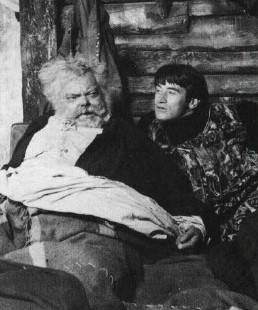
In the UK the independent cinema chain Picturehouses are running the ScreenArts Festival from 29 July to 11 August which includes three of the four same Shakespeare Globe productions as well as many ballet, opera and dance productions. All the Shakespeare offerings are based around the character of Falstaff so as well as the recordings of 2010’s Globe Henry IV plays there are screenings of Orson Welles’ great film

Orson Welles as Falstaff and Keith Baxter as Hal in Chimes at Midnight

compilation Chimes at Midnight and a recording of  Verdi’s opera Falstaff from Glyndebourne.   The recordings of  the two Henry IV plays feature Roger Allam’s Olivier-award winning performance as Falstaff. 

Not actually Shakespeare, but of interest to lovers of classic theatre, the Screen Arts Festival is also showing the National Theatre’s current production of Chekhov’s The Cherry Orchard in the National Theatre Live series. It’s recently been announced that one of this season’s most successful onstage hits, One Man, Two Guvnors, an adaptation of Goldoni’s classic play The Servant of Two Masters, will be screened live in September.    

I wouldn’t suggest that these cinema screenings can substitute for attending a live performance, but the advantages are obvious. Even a successful production is likely to be seen by only tens of thousands, just a fraction of the potential worldwide audience using cinemas. People who live far from live theatres, who can’t travel, or who can’t afford the price of a ticket, will be able to attend the screenings and those who wouldn’t even think of going to a theatre might try going to one of them in the familiar surroundings of the local cinema. They’ll even be able to eat popcorn should they want to! Hopefully some of them will get a taste for the performances and want to experience the real thing. All sorts of wonderful things are on offer and I’m certainly looking forward to catching up with some of them, in my case without the popcorn.

Share
Posted in Legacy, Shakespeare on Stage | Tagged , , , , , , , , , | 6 Comments

O power, what art thou in a madman’s eyes

Anders Behring Breivik

Any other weekend, the death of singer Amy Winehouse would have been enough to brand it as her family have, “this terrible time”, but over the last few days the unfolding national tragedy in Norway has stolen the headlines, all the more unbelievably because it appears to be the responsibility of one man.

Anders Behring Breivik spent around ten years planning his attack on what he calls “cultural Marxists/multicultural traitors”, intending to bring about a revolution in Norwegian society. He recently posted a 1500 page manifesto on the internet, in which he repeatedly refers to multiculturalism and Muslim immigration, and in his police statement he has called the killings “gruesome but necessary”.

 The methods adopted are new, but the attitude is not. The play Sir Thomas More is thought to have been partly written by Shakespeare, and much of the play concerns riots taking place in London against immigrants. In the section ascribed to Shakespeare rioters talk about their intention to set fire to the houses of immigrants, “audacious strangers”. The rioters are “gallant bloods …whose free souls do scorn to bear the inforced wrongs of aliens”.

Referring to the immigrants one asks,  

       shall these enjoy more privilege than we

In our own country?

 Thomas More asks the rioters to think about the results of their proposed actions:

Imagine that you see the wretched strangers,
Their babies at their back and their poor luggage,
Plodding to the ports and costs for transportation,
And that you sit as kings in your desires…
What had you got? I’ll tell you: you had taught
How insolence and strong hand should prevail,
How order should be quelled.

 A different character agrees:

O power, what art thou in a madman’s eyes.

The Sir Thomas More manuscript in the British Library

The play’s subject matter was contentious, and it was never approved for performance, existing in a single manuscript version in the British Library. It’s assumed that Shakespeare was asked to write this section because of his ability to write persuasively.  You can’t ever deduce Shakespeare’s opinions from his writings, but there is a reason to suppose that Shakespeare had sympathy for the immigrants.

 Around 1604 Shakespeare lodged in London with a French Huguenot family of skilled artisans, the Mountjoys. While lodged with them he became involved in their family affairs. Mr Mountjoy wanted his former apprentice, Stephen Belott, to marry his daughter.  Following the marriage, the agreed dowry remained unpaid, hence in 1612 the law suit Belott v. Mountjoy. Shakespeare, it seems, had been asked to put in a good word for the match, and he was called on to testify in the case.

It’s unthinkable that Shakespeare would have lodged with an immigrant family and got involved in their personal lives if he opposed their presence.

 In the other main story of the weekend, Amy Winehouse has been described as a tortured soul, and the circumstances of her death remind us of the death of another vulnerable young woman, Ophelia.  Her “live fast, die young” lifestyle seems though to be more reminiscent of the short but eventful life of the superbly talented Christopher Marlowe. This has been a truly tragic weekend for the waste of promising young lives.

Share
Posted in Legacy, Plays and Poems, Shakespeare's World | Tagged , , , , , | Comments Off on O power, what art thou in a madman’s eyes

Was Shakespeare a soldier?

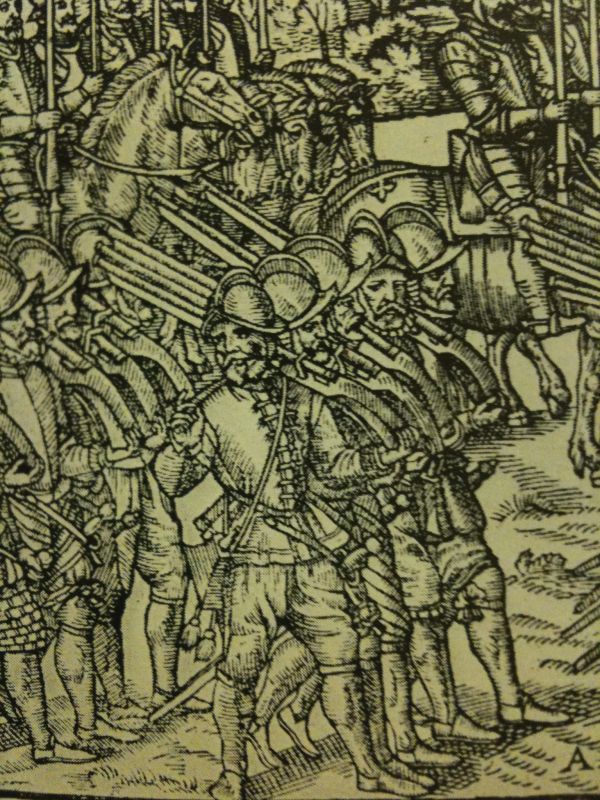
English soldiers, from an illustration in Derricke’s Image of Ireland, 1586

The one-man play Being Shakespeare is just reaching the end of its run at the Trafalgar Studios. It’s a real tour de force by distinguished actor Simon Callow who switches effortlessly from narrative to speeches from Shakespeare’s plays, bringing characters as diverse as Juliet and Falstaff to life.

 The play, written by Shakespeare academic Jonathan Bate traces Shakespeare’s life by following the Seven Ages of Man speech from As You Like It. One of the seven ages is the soldier,

Full of strange oaths, and bearded like the pard,

Jealous in honour, sudden and quick in quarrel,

Seeking the bubble reputation

Even in the canon’s mouth.

The play examines the possibility that Shakespeare spent some time as a soldier during the so-called lost years between the birth of his twins in Stratford  and his appearance in London as a budding playwright around eight years later.

 Shakespeare does indeed make frequent references to battles, armies, and weapons, painting vivid pictures in words of scenes of military life including the recruitment of would-be soldiers. In Henry IV Part 1 Sir John Falstaff describes the soldiers he has recruited, “discarded unjust serving-men, younger sons to younger brothers, revolted tapsters and ostlers trade-fallen, … and such have I, to fill up the rooms of them that have bought out their services”.

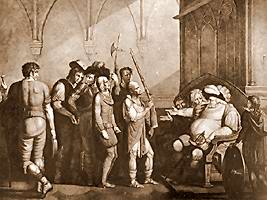
Illustration of the recruitment scene from Henry IV Part 2

In the follow-up play, Henry IV Part 2, he dramatises the actual process by which men were put on the muster roll.  Four men are needed, but the two likeliest ones buy their way out leaving the “scarecrows” appropriately named Shadow, Feeble and Wart.

 Among the Stratford Corporation’s Miscellaneous Documents at the Shakespeare Centre Library and Archive is a single page dating from 1588, in the middle of  Shakespeare’s lost years and the year when the country was in turmoil because of the threat of invasion by the Spanish Armada.

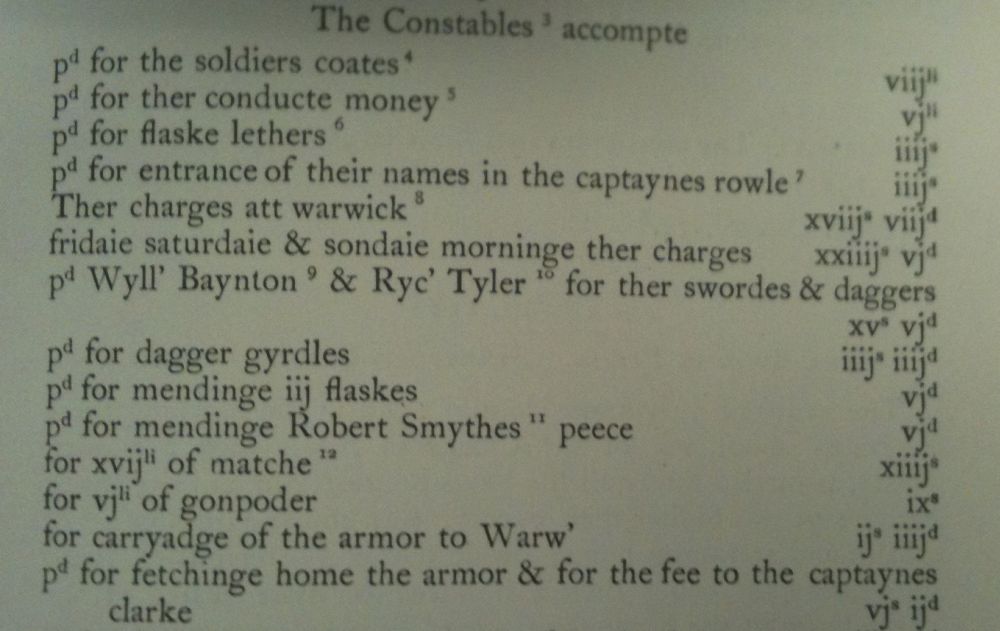
The document (BRU15/12/34) is the Constable’s Account demonstrating how much was spent in Stratford in fitting out the recruits to the militia. In it we find that the total of £23 18s 0d was spent on items like coats, dagger girdles and gunpowder. On this occasion the general muster took place in Stratford instead of the county town, Warwick.  The event is described in Edgar Fripp’s posthumously published book Shakespeare, Man and Artist, as “an imposing affair, attended by leading magistrates, bailiffs of neighbouring towns, officers of various ranks, and a special preacher. Wine flowed freely, with the customary sugar (as costly as the wine) and minimum of bread”.

Transcript of the Constables Account 1588

Was this the occasion that Shakespeare was remembering when he wrote the scenes in the two parts of Henry IV? Even if he wasn’t there on this occasion he would have been aware of how the mustering system worked. The town had provided soldiers earlier in Shakespeare’s lifetime, in both 1569 and 1577, and the town armoury was kept next to the school which Shakespeare would have been attending. In The Taming of the Shrew, Petruchio appears with “an old rusty sword ta’en out of the town armory, with a broken hilt”.

 To my mind, these scenes aren’t written from the point of view of the recruits, all of whom are simple uneducated men. It’s implied that anyone bright enough would have managed to get out of being recruited, and Shakespeare was certainly smart enough to talk his way out of this tricky situation.

Share
Posted in Plays and Poems, Shakespeare's World, Sources, Stratford-upon-Avon | Tagged , , , , , , , , , , , | 1 Comment

World Shakespeare Congress putting a girdle round about the earth #wsc #wscPrague


One of the plenary sessions taking place in Prague


The biggest meeting of Shakespeare scholars for five years is taking place in Prague this week, 17-22 July. The theme of the World Shakespeare Congress is Renaissance Shakespeare, Shakespeare renaissances, and the conference is undergoing its own renaissance as it explores the concept of making extracts of its proceedings available on the internet. 


Video blogs include extracts from conventional lectures, workshops in action, interviews with speakers, and responses from people who have attended sessions. 


As well as making those of us not able to get there feel involved, these blogs will also be useful for conference-goers as a way of catching up with some of the sessions they missed.


The International Shakespeare Association was founded in 1974 and since then there have been nine five-yearly conferences. Each one has been in a different venue; Washington, DC, Stratford-upon-Avon, Berlin, Tokyo, Los Angeles, Valencia, Brisbane and now Prague. The organisation is run from the Shakespeare Centre in Stratford-upon-Avon.


It’s probably routine for many subject areas, but I think it’s a first for a Shakespeare conference to use video blogging in this way. In previous years the complications of printing have meant that the only record of the conferences has been a collection of highlights, published some time after the event, so the video blogs will give a great sense of immediacy. The blogs also allow sessions which aren’t easy to record in print, like workshops, to be shared.
 

Lectures and seminars scheduled to take place during the week have included When Shakespeare Met Kafka, Asian Shakespeare and multicultural performance, and Shakespeare’s plays in print outside Britain and workshops on new ways of teaching Shakespeare,  Shakespeare without chairs, and the Cambridge World Shakespeare online project.


These conferences bring together many of the best minds working on Shakespeare and by the time of the next conference I’d love to see a full recording made available on the internet, which could then be a high quality resource for universities and interested groups to generate further discussions.


TV viewers and cinema goers are getting used to the idea that they can tweet or email questions during live debates and if in the future live streaming of sessions can be introduced this will be a way for people who are not at the conference to join in the conversation. At conferences the formal sessions are often the springboards to further informal discussions and being able to continue an exchange of opinion with an online group would enliven the conference for all.


On Thursday at 1.30 a session is timetabled entitled Putting a girdle round about the earth, to look at how the Shakespeare Birthplace Trust is using online resources to engage with people around the world. I’m sure they’ll be looking beyond what’s been achieved so far towards finding ways of increasing engagement between visitors and users and the staff and collections, whether actual or virtual, to increase knowledge of Shakespeare’s works, life and times.


With constantly changing technologies and expectations it will be fascinating to see how conferences develop by the time of the next World Shakespeare Congress in 2016. 

Share
Posted in Legacy | Tagged , , , , , , , | Comments Off on World Shakespeare Congress putting a girdle round about the earth #wsc #wscPrague