Getting to grips with Shakespeare in Education

A photo from the Folger Shakespeare Library's education pages

A photo from the Folger Shakespeare Library’s education pages

This week I attended a symposium titled Shakespeare in Education: Current Trends and New Directions, organised and led by students of The Shakespeare Institute, University of Birmingham.

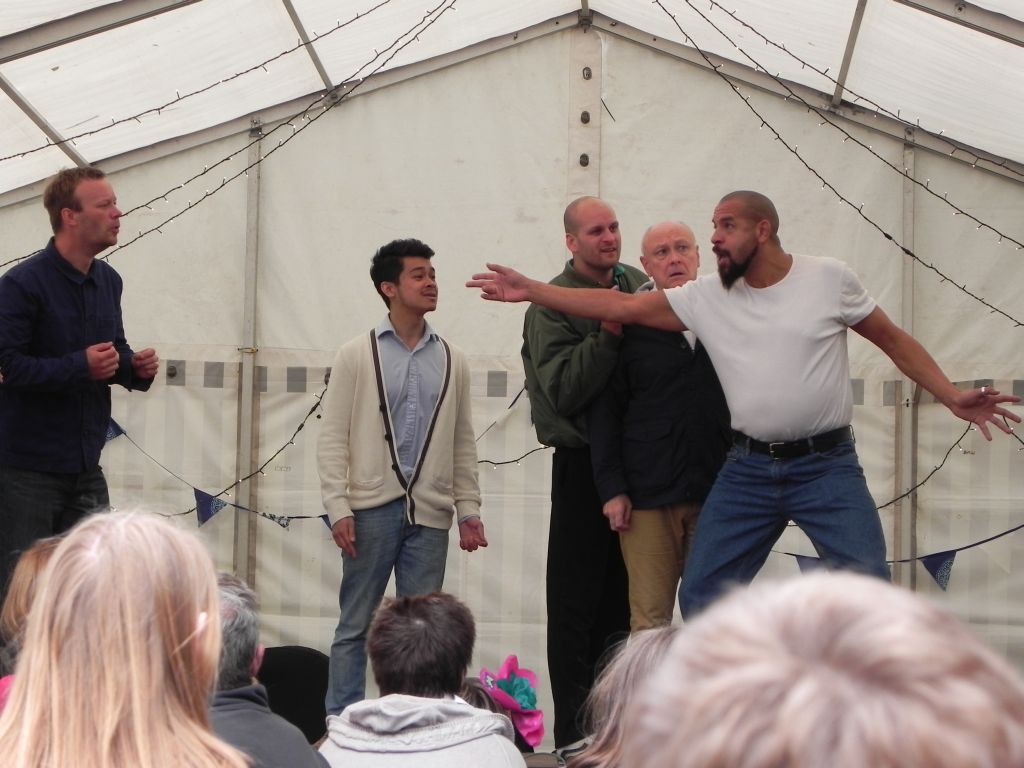
Just between you and me, I was hoping to spend most of the day hearing about other people’s experiences as educators and learners, but it turned out to be a much more active day than that. Breaking the ice by offering each other Shakespearean compliments was a great way to start, and I’d like to thank Laura, Thea, James and the other attendees for making the participatory sessions such fun.

Nobody there needed any convincing on the question of why Shakespeare deserves to be taught in schools, so the day focused very much on the “How?” With a mixture of experienced teachers, students and interested observers the day gave all of us a fresh look at this developing subject. Many of the participants had taken part in recent international Shakespeare conferences, in particular last year’s Worlds Together Conference on Shakespeare in education in London sponsored by the Royal Shakespeare Company, and the recent Folger Shakespeare Library educational workshop on Setting Shakespeare Free and at the 2013 Shakespeare Association of America (SAA) Conference, Toronto.
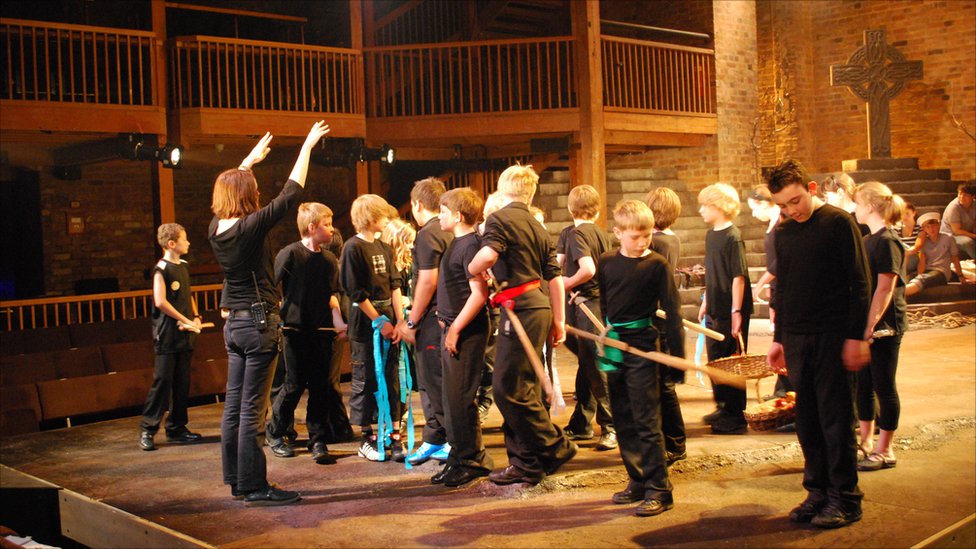
A photo of an RSC education session

A photo of an RSC education session

The morning focused on active approaches to Shakespeare, looking at ways of using theatrical techniques rather than examining Shakespeare simply as a piece of text.  With no glitzy presentations the sessions had more of the flavour of a self-help group, and all the better for it as discussions centred on practical issues and solutions to real problems.

James Stredder led the morning’s main session with Shakespeare in the Cyberage: can collective theatre-making survive in today’s classroom? A few years ago James used his vast experience to write the invaluable teaching resource The North Face of Shakespeare. He involved us in several levels of activity from those that demanded no acting skills at all, to setting up tableaux based upon a line from a play and finally to the acting out of key moments from Act 1 of Hamlet using short pieces of dialogue. Making all the participants active is the ideal but later in the day some of the teachers commented on how difficult this can be to achieve given the reluctance of some teenagers to join in. Some of the suggestions offered to reduce students’  self-consciousness included using masks and acting scenes out using toys as models.
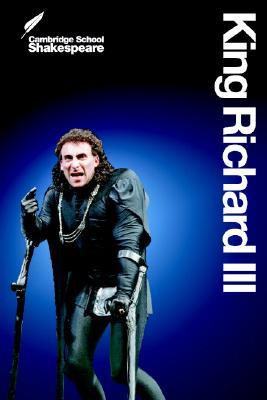
king-richard-iii cambridgeIn his career James has worked with many of the best educators and suggested a number of resources to use for inspiration: I was pleased to be reminded of the work of the late Rex Gibson whose Cambridge School Shakespeare editions cover 27 of Shakespeare’s plays. These editions print the text on one side of the page while the facing page suggests ways of  teaching it. These down to earth editions, born of real experience, have provided teachers with practical help for a number of years.

After lunch the day got a lot more digital. Andrew Kennedy demonstrated his Moviestorm system which allows anybody to create their own movies by combining their own sound with avatars, and has a number of uses from creating training videos and commercial presentations to educational use in classrooms. The beauty of the system is that pupils can take the software and either by themselves or in groups put together a scene from Shakespeare. Although this might be seen as a “sitting down” rather than a “standing up” activity, in fact it gives those who don’t have acting skills or ambitions the chance to create their own performance. I found the way that the avatars can be manipulated to convey meaning and emotion by quite subtle facial expressions and body language absolutely fascinating.
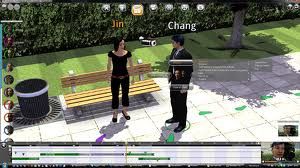
moviestormWhile it was agreed earlier in the day that it was more important to make young pupils comfortable with the language rather than trying to make them understand every word, at some point it’s necessary for students to really engage with the words. This system allows a combination of approaches. Andrew Kennedy has been working with actress/academic Abigail Rokison on making the software more appropriate for education, and as an example he demonstrated how an avatar could be created to “speak” some text recorded by Abigail, standing on a representation of the Globe’s stage.

moviestorm webpageMoviestorm is a commercial product and one of the main constraints for teachers is lack of funding, but it has great potential and for any of you who would like to check it out and have a bit of time to play with it, there’s a two-week free trial available.

I’d like to thank Laura Nicklin and Thea Buckley for allowing me to take part, and all the other participants for making this a fun yet informative day. Thanks are also due to the Shakespeare Institute for hosting the event and the Library staff for their display of resource materials.

The British Shakespeare Association’s Educational Network exists to help support anyone interested in teaching Shakespeare and information about the day will be posted on its blog shortly. Anyone who wants to share their teaching experiences is welcome to post on the site.

Any teachers looking for ideas should also check out the Folger Shakespeare Library and the Royal Shakespeare Company as both websites contain masses of helpful online resources.

Share
Posted in Legacy | Tagged , , , | 2 Comments

Blogging with Titus Andronicus, part 2

  Matthew Needham (Lucius), Kevin Harvey (Aaron)

Matthew Needham (Lucius), Kevin Harvey (Aaron)

At the end of last week I wrote about the RSC’s current production of Titus Andronicus and the blogging event to which I was fortunate enough to be invited.

In that first post I put up a few clips I made at the Q&A with the director and some of the leading actors, talking about different areas of the play and rehearsal period. Much of the discussion was about the key issue of violence in the play, on which this post is going to concentrate.  Again, I apologise for the quality of the recordings, made at the Q&A. Mark Neal, another of the bloggers present has written his own review of the production and summary of the event.

Most commentators agree with the RSC’s description of it as “Shakespeare’s bloodiest and most violent play” : popular in Shakespeare’s own lifetime but thereafter neglected. Samuel Johnson could not believe that Shakespeare wrote any part of it, and declared that “the barbarity of the spectacles, and the general massacre which are here exhibited, can scarcely be conceived tolerable to any audience”.  With the magnificent black actor Ira Aldridge looking for suitable roles the play was revived in the nineteenth century, but heavily rewritten to make Aaron heroic rather than evil. Then the 1923 revival at the Old Vic, the first for many years, seemed to confirm Johnson’s view, the audience laughing at the final bloodbath. It took another 32 years and the casting of the greatest heroic actor of his time, Laurence Olivier, before the play was given another showing, this time in Stratford-upon-Avon.  The director Peter Brook defused the potential for unwanted laughter by ritualising the violence of the play.

Sonia Ritter as Lavinia, Donald Sumpter as Marcus

Sonia Ritter as Lavinia, Donald Sumpter as Marcus

Since then there have been several productions at Stratford, including one featuring Patrick Stewart, directed by John Barton, which added a framing device to distance the play being performed by a band of travelling players. My favourite production was that in 1987, at the newly-opened Swan Theatre, directed by Deborah Warner (see photo to right).  I remember the simple but bold staging and costuming and the raw emotional power of the play. As a member of the audience I felt involved and drawn into the world of the play in spite of its obvious theatricality.

In this clip Michael Fentiman, the director of the current production, talks about staging the violence of the play, and the sense of austerity he has tried to maintain despite the expectations raised by the show’s video trailer.

Although the actual violence of the play tends to overshadow it, the subject matter of the play is very political. It expresses the anxiety of Elizabethans about the hottest subject of the day: what happens when the succession is unclear, or there are conflicting claims to the throne. The memory of the years after the death of Henry VIII would have been strong. And brutality was part of life, with bear-baiting for entertainment, public executions and the heads of traitors on display on London Bridge. In the Q&A, Stephen Boxer who is playing Titus talked about how Shakespeare discusses the dangers of tribalism and reminds us of the violence that is in all of us.

Rose Reynolds as Lavinia

Rose Reynolds as Lavinia

I’m uneasy at being expected to find violence entertaining, and I found the mixture of styles of costume and set in the current production distracting.  But after the wildness of the bloodbath in the final scene I enjoyed the quiet sense of ambiguity of the final moments of the play, when Young Lucius, surrounded by bodies, cradles Aaron and Tamora’s baby in one arm, a knife in the other hand. In this last clip the director talks about the three different endings which they rehearsed, which encapsulate the alternatives offered by the play.  Will one or both of these children fall prey to the violence of Rome, the “wilderness of tigers” or will they be the instruments of peaceful reconciliation, as Marcus hopes:
You sad-faced men, people and sons of Rome,
By uproar severed, as a flight of fowl
scattered by winds and high tempestuous gusts,
O, let me teach you how to knit again
This scattered corn into one mutual sheaf,
These broken limbs into one body.

For any of you receiving this post by email, you may need to click on the link to the blog itself at the end of the email then click on the orange circles to play the sound clips. Both the photos from the current production are by Simon Annand. And many thanks again to the RSC Press Office for organising and managing the evening and the actors and director for their performances and insights during the Q&A.

Share
Posted in Plays and Poems, Shakespeare on Stage | Tagged , , , | 2 Comments

Planning for the future of Shakespeare’s town

POI-17-2The future of Stratford-upon-Avon is under discussion as never before, with two separate schemes currently under consideration. Anyone who cares about the history of the town and its Shakespearian heritage now has an opportunity to make their feelings known.

Firstly, everyone is being encouraged to comment on the Stratford-upon-Avon Neighbourhood Plan. This plan has been facilitated by the Town Council, and created by 40 Stratford residents representing a large number of local associations and organisations. On Sunday 30 June the first consultation was held at the Town Hall, and there’s another chance on Monday 1 July from 1-8pm. Display boards give additional information about some of the specific ideas and lots of people are there to answer questions about the plan and what it will mean. At the Town Hall you can pick up a questionnaire, but if you’re not able to get there yourself you can check out the website and fill in the same questionnaire online. Non-residents can fill in the questionnaire but only locals will be able to vote on the finished plan, though I get the impression it will be open to all residents, not only those on the electoral roll. It’s also possible to sign up on the site to be kept informed of the date of the vote.  The final date for questionnaires to be completed is 22 July 2013.

POI-02-1The survey covers a number of areas: Housing, Employment, Town centre, Heritage, Environment, sustainability and open spaces, Infrastructure and Leisure and wellbeing and community. Perhaps inevitably given my obvious interest in all things Shakespearian, I’d like to see more weight given to the Heritage section, and I’m disappointed to find Shakespeare’s name mentioned only once within the entire document. Stratford is unique. The document claims that Stratford-upon-Avon is probably the best known heritage market town in the country. I’d say it’s probably the most famous small town in the world, loved by many people for whom every visit is special and for some a once-in-a-lifetime event, all because of its connection with the most famous writer who ever lived.

Stratford can’t and shouldn’t be preserved in aspic but the building of new houses, schools and roads needs to fit with its historic and cultural setting. This is the first time people have actually been asked for their opinions so don’t waste the chance.

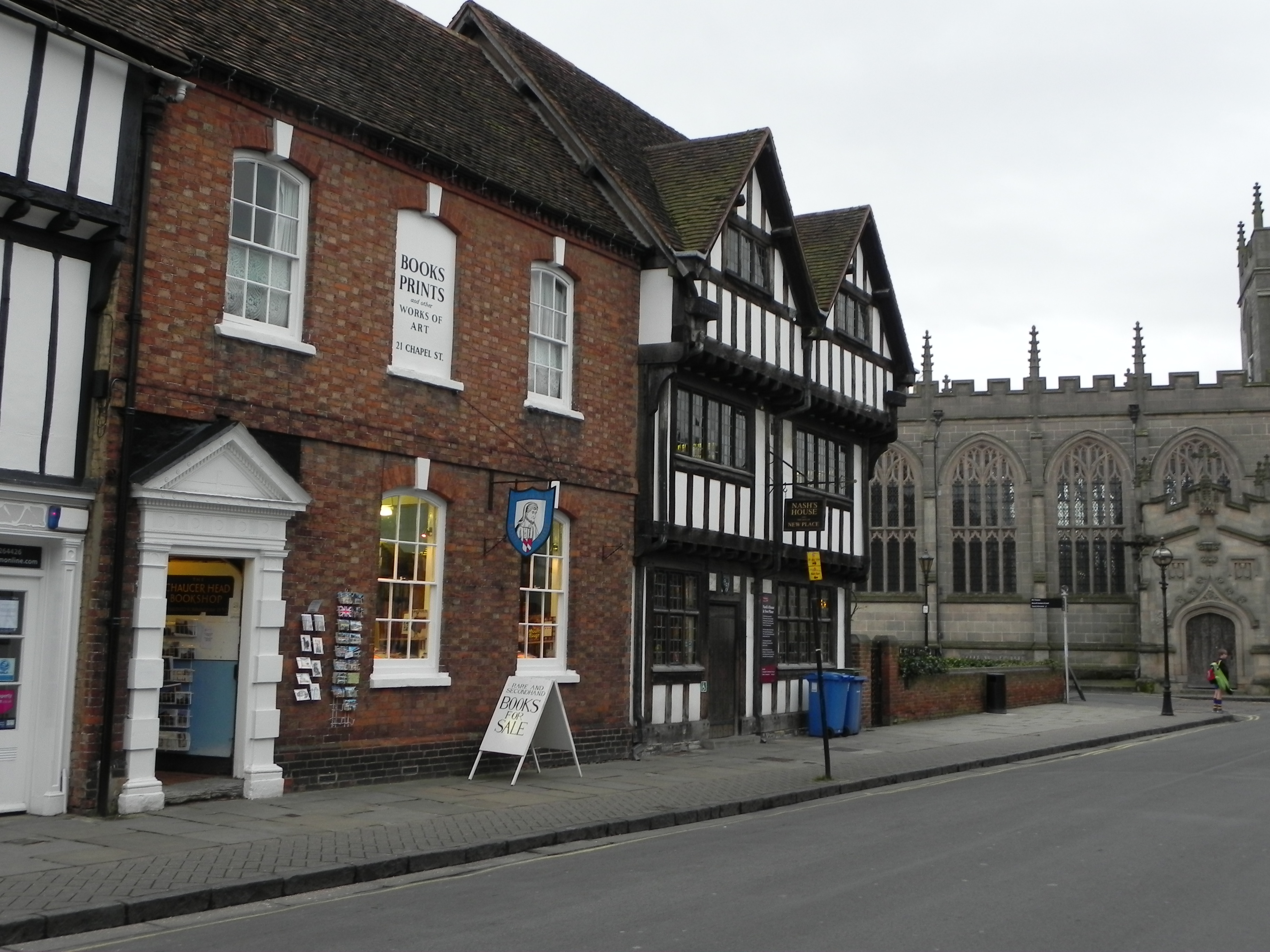
POI12 DSCN1185The second consultation currently taking place relates to the site of New Place, Shakespeare’s house. The site itself, Nash’s House next door, and the extensive gardens behind, are owned by the Shakespeare Birthplace Trust. It’s a beautiful place, but one which I think has never been as engaging as it could be bearing in mind that this is where Shakespeare lived and died, and where he may have written some of his late plays.  The Trust’s Head of Major Projects, Mark Armstrong, explains that they aim to “bring to life the story of this wonderful site with many layers of cultural heritage and Stratford-upon-Avon’s history”. Unlike the Neighbourhood Plan draft, which asks people to  choose which objectives to prioritise and to agree or disagree with a range of general options, the Trust’s plans are well advanced. In the garden they aim to retain much-loved elements like the Knot Garden and the Yew Walk, as well as the historic mulberry tree while adding contemporary planting. They also aim to enhance Nash’s House to include better facilities such as a lift to the first floor, a first-floor space from which the Knot Garden can be viewed, and a new exhibition centre which will tell the story of Shakespeare, the man, and his life in Stratford.

Sketch-diagram_1The Trust has already held one consultation day and is having another on Friday 12 July when members of the public are welcome to view and give their comments. Again, if you’re unable to visit in person there is a lot of information online, and feedback is welcomed.

These are important initiatives. They both give all of us who care about Shakespeare, wherever we come from, the chance to have a say in how the town in which he famously was born, lived, and died will celebrate him long into the future.

Share
Posted in Legacy, Stratford-upon-Avon | Tagged , , , , , | Comments Off on Planning for the future of Shakespeare’s town

Blogging with Titus Andronicus

 Stephen Boxer (Titus Andronicus) and Rose Reynolds (Lavinia) Photographer Simon Annand

Stephen Boxer (Titus Andronicus) and Rose Reynolds (Lavinia)
Photographer Simon Annand

Last Thursday, 25 June, I attended an event at which the Royal Shakespeare Company invited bloggers to a performance of their current production of Titus Andronicus followed by a Question and Answer session with the director and members of the cast. I’m going to be writing more about this event later, but for now I’m posting a few sound clips from the Q&A which featured director Michael Fentiman and cast members Katy Stephens (Tamora), Stephen Boxer (Titus) and Rose Reynolds (Lavinia).

The discussion ranged around many areas of the production, the performance experience and the rehearsal period, as well as some wider thoughts about how the play relates to others written by Shakespeare.

The quality of the recordings is a bit hit and miss, but it’s still interesting to hear the voices of the actors and director talking about a production which has obviously been an absorbing project for all the participants.

Violence is a key theme of the play and of the production, and I begin with Rose talking about playing Lavinia, in particular after she has been horribly violated.

This second clip is of Stephen talking not about his own performance but about the character of Aaron, prejudice and human nature as described by Shakespeare.

Music is a notable feature of the production and here is Michael talking about the way in which music is used.


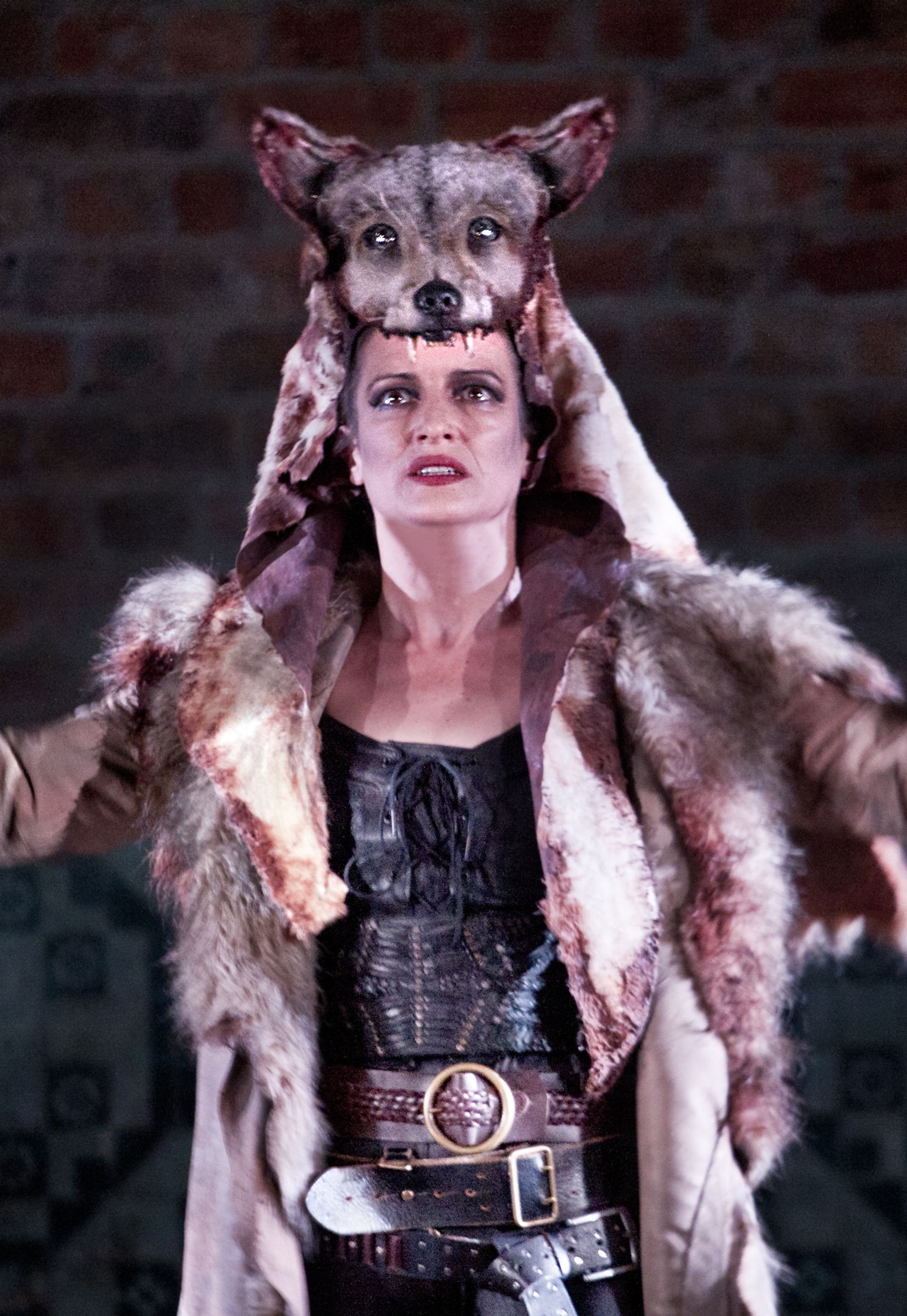
And finally here is Katy talking about performing Shakespeare’s women. A few years ago she played both Joan of Arc and Queen Margaret in the Henry VI plays for the RSC, and here she discusses the threads that link those characters, Tamora, and Shakespeare’s later creation, Lady Macbeth.

Katy Stephens (Tamora) Photographer Simon Annand

Katy Stephens (Tamora) Photographer Simon Annand

I’d like to thank all the participants for so generously giving their time, to the RSC for organising this event, and to the other bloggers who took part for their stimulating questions.

Share
Posted in Plays and Poems, Shakespeare on Stage | Tagged , , , , , , | Comments Off on Blogging with Titus Andronicus

Shakespeare’s world view: the history of maps

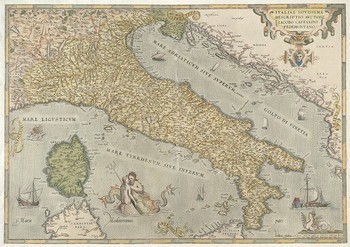
Map of Italy dated 1579

Map of Italy dated 1579

It’s hard, indeed impossible, for us to imagine what it would be like to live without a clear idea of the world outside our own immediate locality. But many people of Shakespeare’s period might never have seen what we would call a proper map. Laurence Nowell’s map of the British Isles was published in 1564, and Christopher Saxton’s map of Warwickshire appeared in 1576. And these maps, as well as earlier manuscript maps, would have been seen by only a fraction of the population.

Shakespeare, obviously, was familiar with maps. In Henry IV Part 1 the rebels look over a map and discuss how they will divide land between themselves, and in the same vein, in King Lear, the map begins the very real fracturing of the country that follows its division. Onstage it’s quite common for the map to be torn apart as the play progresses, and as the inner world of the characters falls apart. Then of course there is the lovely section of The Comedy of Errors where one of the characters is described as “spherical, like a globe”, and two characters proceed to bawdily “find out countries in her”.

Maps were seen as factual, so symbolically honest. In Henry VI Part 2, the king exclaims:
 Ah, uncle Humphrey! in thy face I see
The map of honour, truth and loyalty

But maps were mostly about power, not about travel. Queen Elizabeth 1, in the Ditchley Portrait, stands with her feet firmly planted on a map of her kingdom. Nowell’s map was made not to help people move around the country, but on the command of  Elizabeth’s first minister, William Cecil, who is supposed to have carried a small version with him at all times.

Some clues about how people communicated are to be found on this site, a history of the postal service that includes a map of the network of post roads during Shakespeare’s lifetime and describes the structure that ensured the delivery of items sent by post.

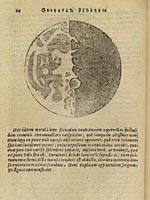
Galileo's view of the moon, 1610

Galileo’s view of the moon, 1610

Maps became common enough for jokes to be made about them: in Twelfth Night,  Malvolio is said to:
smile his
face into more lines than is in the new map with the
augmentation of the Indies:
a reference to Mercator’s map of around 1592.

Our modern obsession with maps has resulted in many online resources, and the rest of this post is going to expand on some of those which I’ve recently discovered and been intrigued by. The most comprehensive is Old Maps Online, a collaborative project that does what it says on the tin. It’s easily searchable through a map of the world, and includes a timeline.  There’s a review of the site here.

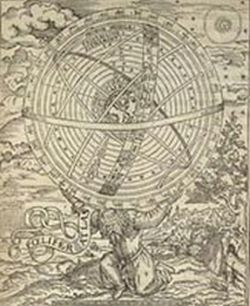
A Ptolemaic view from 1559. Atlas bearing the universe on his shoulders

A Ptolemaic view from 1559. Atlas bearing the universe on his shoulders

Another treasure-trove of map images, which provided several of those reproduced here, is the Library of Congress. Both these projects  demonstrate through maps the development of scientific knowledge about the world during Shakespeare’s time, when the ancient Ptolemaic system, in which the earth was at the centre of the universe, gave way to Copernicus’s discovery that the planets revolve around the sun.

If you’re interested in finding out more about early maps you might like to check out the British Library’s map project in which members of the public can link old maps with online ones by a process called Georeferencing.

And here’s a project I heard about just as I was writing this piece. Tate Gallery’s Art Maps project aims to get people to help locate exactly where paintings were made. The website claims:
It also will allow people to record and share their memories and emotional or creative responses to the places associated with the artworks in ways that will generate learning experiences and create new communities.
Sounds fascinating, do take a look.

For those of you who like a mystery, you might like this story about the Vinland map. This manuscript map appeared to show that the Vikings had discovered America before Columbus. It was found in the 1950s and in 1965 experts dated it to around 1440. It’s authenticity has always been in question, but what is particularly pleasing about this story is that it’s an amateur researcher who has done some sleuthing, following up early records of the documents of which this is a part, and found no mention. It looks like the Vinland map is a clever fake.

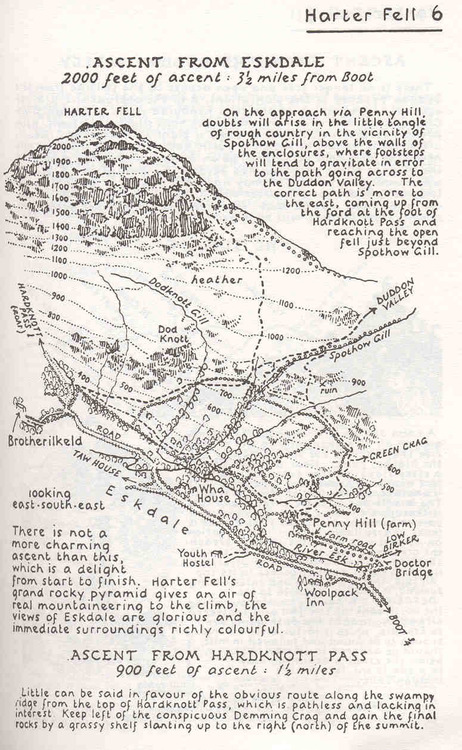
One of Alfred Wainwright's Lake District maps
One of Alfred Wainwright’s Lake District maps

While we’re thinking about handmade maps, the Guardian recently ran a piece on why hand-drawn maps are back in the picture. With their personal associations, they warm our hearts just as any other recollection of a favourite place. My favourites are the delicate walking maps, part of Alfred Wainwright’s multi-volume Pictorial Guides to the Lakeland Fells, each one a perfect combination of the aesthetic and the practical, and a labour of love.

And this link is to a new book telling the story of our infatuation with maps from Ptolemy onwards. Will people ever have the same feelings for a sat nav? I somehow doubt it.


Share
Posted in Shakespeare's World | Tagged , , , , , | 1 Comment

Midsummer Night’s Dreaming: online experiment and real-time event

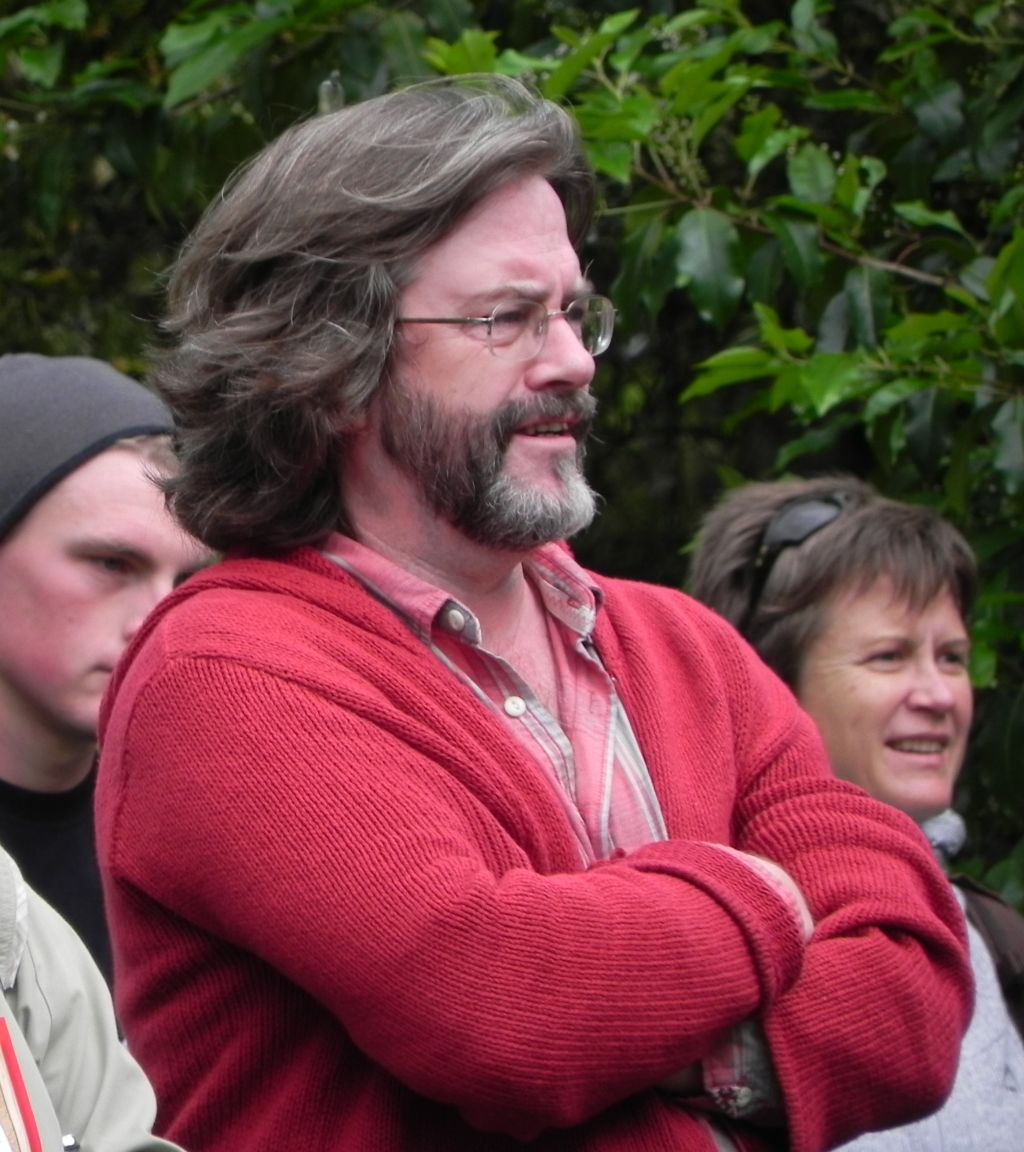
Gregory Doran watching the performance

Gregory Doran watching the performance

This weekend Stratford-upon-Avon has been the venue for a “daring new collaboration” between the RSC and Google’s Creative Lab to stage a real-time performance of A Midsummer Night’s Dream while simultaneously creating a digital presence in which anybody could join. The whole thing has been led by the RSC’s Artistic Director, Gregory Doran.

John Wyver of Illuminations and the RSC’s Media Associatie has posted two blogs, here and here describing the unfolding of the event and asking some important questions about it. He quotes Google’s Tom Uglow’s explanation of the project:

Conventional theatre starts with a stage. An audience comes, sits in front of it, they suspend reality, enter the narrative’s reality and are entertained. But why a stage? We don’t need a stage. Modern theatre makes the audience walk, or puts them in a car, or makes them the actor; our stage is online, it is fragmented, glimpsed, experienced and amplified through sharing – the narrative exists around us and immerses us…

Today’s big news events—riots, bombings, royal weddings—all become subject to this anarchic, multi-dimensional, multi-authored storytelling. About 18 months ago we started wondering if one could apply the same treatment to a fictional narrative, like a play? Could we bring a play out of the scenic world and into the real and online worlds? Could we generate the same storytelling impetus using Google+ as a platform? … A world of peripheral, unwritten parts occurring simultaneously within and around the main play.

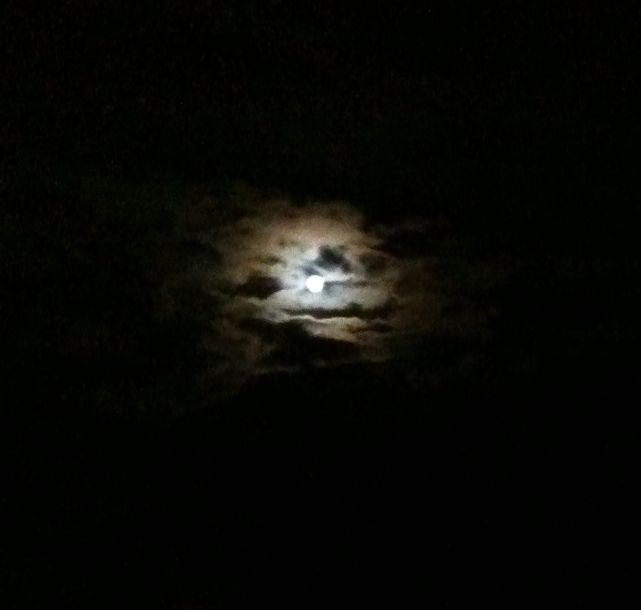
moonThe performance began on Friday evening with the preliminary scenes of the play, and continued on Saturday night, or perhaps I mean Sunday morning at 2.30 am when they performed the main section of the play up to the waking of the lovers in the forest. Many of the tweets sent by people in the audience mentioned the magical effect of staging these scenes in real time in Stratford, hearing the dawn chorus of birds and seeing the sky lightening outside the Ashcroft Room. For me, just before “deep midnight” on Saturday, when Lysander and Hermia were due to be making their fictional escape from Athens, I spotted the full moon through the clouds.

Joe Dixon as Bottom returns to his fellow-actors

Joe Dixon as Bottom returns to his fellow-actors

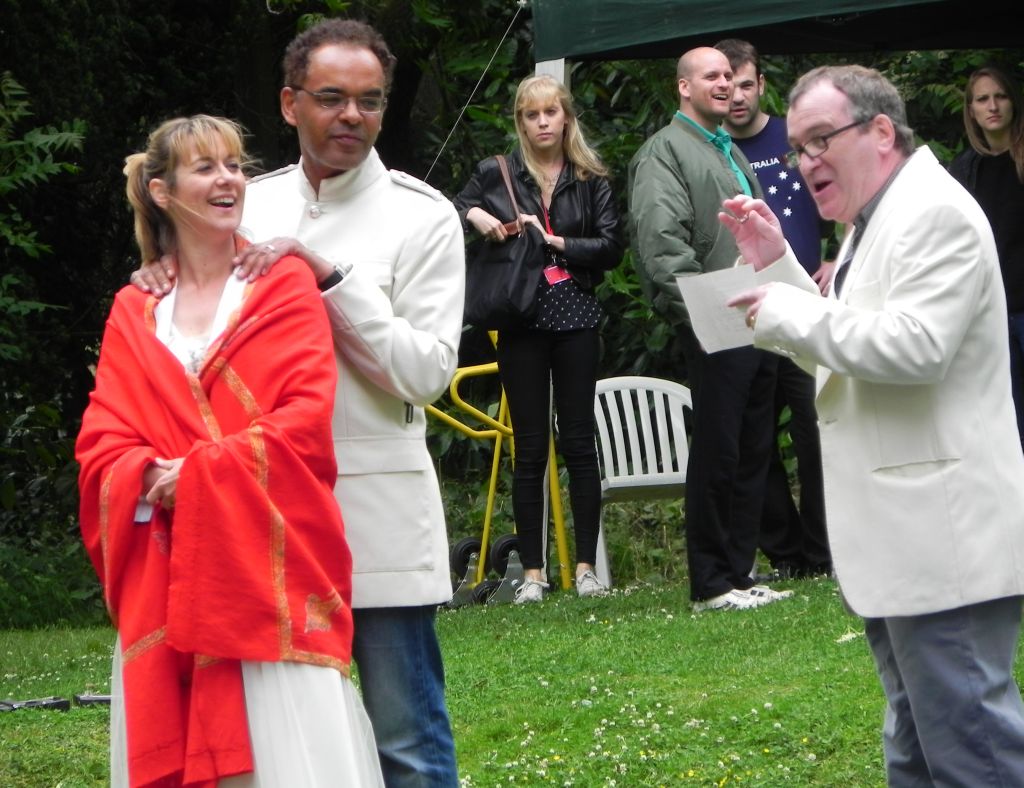
On Sunday afternoon I joined the throng of people in Avonbank Gardens and the Dell for a performance of Act 4 Scene 2, in which Bottom returns to his fellows, and for a rehearsal of the final act in advance of the performance scheduled for 11.30.

Inevitably, rain stopped the rehearsal before the end, after an afternoon plagued by mostly grey skies and blustery wind that snatched the words from actors’ mouths. The play was continued at 11.30 pm and as they reached the end of the mechanicals’ play the bells of Holy Trinity Church just over the wall chimed the hours.
The iron tongue of midnight hath told twelve.
Lovers, to bed; ’tis almost fairy time.

Rehearsal: Philostrate reading the titles of potential entertainments to Hippolyta and Theseus

Rehearsal: Philostrate reading the titles of potential entertainments to Hippolyta and Theseus

This has all been great, and the magic of performing this play in real time in Shakespeare’s Stratford makes it an event very much worth repeating. The RSC has brought in some of its most polished performers including Peter de Jersey, Alexandra Gilbreath and Mark Hadfield. But it will be interesting to see how it is regarded as a digital event, or as a hybrid digital and real-time event. As John Wyver has pointed out in his second post, there doesn’t seem to have been the sense of a conversation going on in the online exchanges. I was pleased to receive photographs on Google+ of the play taking place during the night, but they didn’t draw me in.

Watching the rehearsal in The Dell

Watching the rehearsal in The Dell

I only felt part of the event when I actually went along to the afternoon staging. Several of the online responses commented on how much they wish they were in Stratford. And John Wyver quotes a tweet he received asking if the web presence has been just “digital candyfloss”.  Here’s a link to Pete Kirwan’s response to the online material.

Midsummer Night’s Dreaming has been a step towards finding methods of involving new audiences who would never set foot in a theatre but love their smartphones. Where, I wonder, will this take us next?

Share
Posted in Legacy, Shakespeare on Stage, Stratford-upon-Avon | Tagged , , , , , , , , , | 6 Comments

The Beaumont and Fletcher marathon

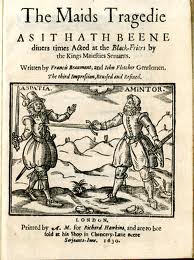
Title page of The Maid's Tragedy

Title page of The Maid’s Tragedy

The students of the Shakespeare Institute in Stratford-upon-Avon are currently undertaking a project which I think is almost certainly unique: to read out loud all the works of the playwrights Francis Beaumont and John Fletcher in what they are calling the Beaumont and Fletcher Marathon. Beginning on 10 June, and ending on 29 June they are reading three plays a day, taking just Sundays off.

This link takes you through to Dr Martin Wiggins’ account of the project, and of the careers of Beaumont and Fletcher themselves.

Dr Wiggins is the author of the multi-volume British Drama 1533-1642: A catalogue, the first two volumes of which are already published. The Marathon reading will be supporting his work on the dating of these plays by field testing his proposed chronological order of the composition of the plays.

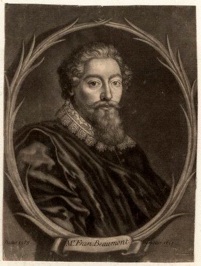
Francis Beaumont

Francis Beaumont

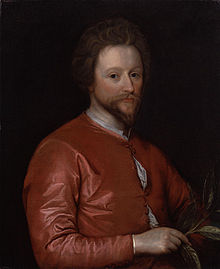
Beaumont and Fletcher are always mentioned in the same breath, but in fact they did not always write together. Beaumont died aged only 32 just weeks before Shakespeare, in 1616, after only a few years of working with Fletcher. Fletcher was a few years older, and as well as collaborating with Beaumont he wrote many plays on his own and in collaboration with a string of other writers including Shakespeare and Massinger. Fletcher died in 1625, aged 46. Their most famous plays include The Knight of the Burning Pestle (which was actually entirely written by Beaumont) and The Maid’s Tragedy. Fletcher worked with Shakespeare on Henry VIII, The Two Noble Kinsmen, and the largely lost play Cardenio. After Shakespeare’s retirement Fletcher became the leading playwright for the King’s Men and following the reopening of the theatres after the restoration of the monarchy in 1660 his plays were among the most performed.

John Fletcher

John Fletcher

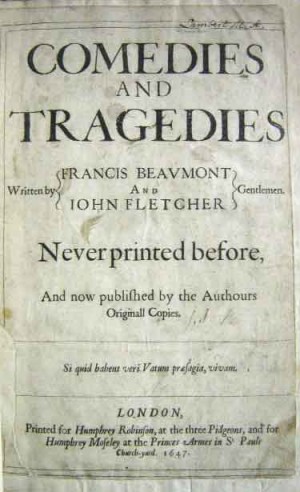
The choice of plays currently being read is a little complicated because of the mysteries surrounding collaborative writing: the first collected edition of the plays was published in 1647, the second in 1679, but because modern academic work has established that some of the plays included in the latter are not the work of either man these are being omitted. Both men had been dead for many years before these publications. A few plays not in either (such as Henry VIII, written collaboratively by Shakespeare and Fletcher), are being read. False attribution is not uncommon later in the seventeenth century: the third Folio of Shakespeare’s plays, published in 1663-4 contains several plays that Shakespeare had no hand in, such as The London Prodigal.

See here for more about the project, including a complete list of the 58 plays and 1 masque plays being read.  Visitors are welcome to attend, and the text is being simultaneously projected so it will be easier to follow. The readings are taking place in support of the Lizz Ketterer Trust. More information about the aims of the Trust, and how to sponsor the readings, is to be found on the site.

Earlier in the week I mentioned the Shakespeare productions listed on the Shakespeare Institute’s Touchstone site. For those interested in plays of the period not by Shakespeare, there is also a listing of Current and Forthcoming Renaissance Drama Productions in the UK.

Beaumont and Fletcher's First Folio

Beaumont and Fletcher’s First Folio

It’s particularly exciting to report that the Shakespeare Institute’s copy of the Beaumont and Fletcher First Folio is on display during this period. This copy was once owned by the writer Anthony Trollope, who noted on the title page that the last play being read, The Fair Maid of the Inn, “is the worst play in the volume”. Will, I wonder, those reading and listening agree after their three week marathon? And will their appreciation of Shakespeare be heightened after their experience?

Share
Posted in Legacy, Shakespeare's World, Stratford-upon-Avon | Tagged , , , , , | 3 Comments

Robes and furred gowns: costume in Shakespeare’s England

tudor costumeOne of the most compelling exhibitions of the year for anyone with an interest in life in Shakespeare’s period is that currently at the Queen’s Gallery, Buckingham Palace where In Fine Style: the Art of Tudor and Stuart Fashion is running until 6 October.

The exhibition follows the changing fashions of the period, including cross-fertilisation across Europe, using paintings from the Royal Collection. Over 60 paintings are on display as well as original garments, jewellery and accessories. Clothing indicated social status and the members of the court and royal families were the leaders of fashion, wearing the most sumptuous of clothes. What you wore, and how you wore it, also sent out important messages.

study day picAs well as the exhibition, events are also taking place: a study day on 22nd June is coming up, and a concert on 3 July.

It wasn’t of course just the nobility who were interested in clothes. In his 1577 Description of England William Harrison complains:
The phantastical folly of our nation (even from the courtier to the carter) is such that no form of apparel liketh us longer than the first garment is in the wearing… And as these fashions are diverse, so likewise it is a world to see the costliness and the curiosity, the excess and the vanity, the pomp and the bravery, and finally the fickleness and folly, that is in all degrees, insomuch that nothing is more constant in England than inconstancy of attire. 

The 1574 Sumptuary laws were set up to prevent people of modest means wearing costumes that were too expensive for them, as well as making sure people of modest backgrounds did not dress above their social station. They were though often ignored, so strong was the desire for the latest fashions.

Clothing is often mentioned by Shakespeare, and in The Taming of the Shrew there is a scene in which a tailor brings in a gown for Katherina to try on. She’s promised the very best:
With silken coats and caps, and golden rings,
With ruffs and cuffs and farthingales and things.

Only for Petruchio to complain about the over-elaboration of the latest fashions:
What’s this? A sleeve? ‘Tis like a demi-cannon.
What, up and down, carv’d like an apple tart?
Here’s snip and nip and cut and slish and slash.

A reconstruction of one of Schwarz's costumes

A reconstruction of one of Schwarz’s costumes

Some recent work has drawn attention to a piece of evidence that confirms that an interest in clothes was widespread. The Schwarz Book of Clothes dates back to the first half of the 1500s, and is a unique record of one man’s interest in fashion. What’s particularly interesting is the fact that Matthaeus Schwarz wasn’t a nobleman, but an accountant working for a banking organisation in Augsburg, Germany.

“He started to record his appearance in 1520, initially commissioning 36 images to retrospectively cover his appearance from childhood up until the age of 23. Over four decades he commissioned a total of 137 original watercolour images of his outfits, painted by three principal artists. “

Although Schwarz’s obsession was extreme, according to Jenny Tiramani it  “challenges the cliche that everyone who didn’t attend at a royal court went around dressed in grey rags and sack cloth.” Fashion was a subject in which the middle classes might also take an interest. The book is kept in a museum in Braunschweig, and is now receiving academic attention. The web page contains a huge amount of information and I would encourage you to follow it up.

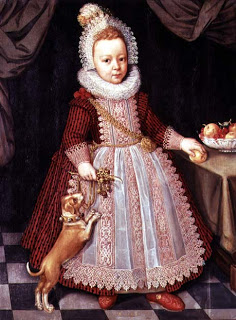
Portrait of a child with a rattle

Portrait of a child with a rattle

I’ve also discovered this blog post which reviews a recent book on childrens’ clothing, Jane Malcolm-Davies, Ninya Mikhaila and Jane Huggett’s The Tudor Child: Clothing and Culture 1485 to 1625. Boys and girls were dressed alike for their first few years until boys were breeched, but the book suggests that the sex of the child could be indicated by more subtle means such as the shape of the collar.

This quote from the book explains one of the mysteries, what Elizabethan mothers made nappies from:

In 1573, Anne Bacon wrote to her stepmother asking for some old linen “to make cloutes for myself & the childe. Your Ladyship knoweth how good old linen is [for] such uses, yea better than new.” Used linen was suitable because it was softened and became more absorbent with repeated washing. The linen clout may have been doubled and lined with a layer of soft rags or with an absorbent material, such as sphagnum moss, and was usually fastened with pins.

We’re always fascinated by what’s being worn underneath, aren’t we? As Shakespeare put it “”Robes and furred gowns hide all”.

Share
Posted in Shakespeare's World | Tagged , , , , | Comments Off on Robes and furred gowns: costume in Shakespeare’s England

Shakespeare festivals here, there and everywhere

twelfth_weblogo_comingsoonIt’s that time of year when at least for those of us in the northern hemisphere thoughts turn to summer Shakespeare festivals.

It’s a subject that has recently been in the mind of Hardy M Cook, the man behind SHAKSPER, the Global Electronic Shakespeare Conference.

A number of years ago he was responsible for compiling the list of summer Shakespeare festivals which appeared in the journal The Shakespeare Newsletter, which helpfully provided a list of addresses and contact details for festivals which otherwise might slip through the net of the keen Shakespeare-goer. Times have changed, and his recent idea is to use the members of the SHAKSPER list to provide no only the details of the festivals, but also to review any productions they had seen. SHAKSPER entries are already archived so these reviews will be there for anyone to check out in the future.

In only a week the page has been created and the tab is there ready for use. One of the great advantages of the internet is, as Hardy suggested in his post on 6 June, that a simple system can be set up with the minimum of fuss.

I am not proposing a formal apparatus. I am not suggesting there be reviewer selection or peer review of performance accounts. I am simply suggesting that if a SHAKSPER member attends a production this summer and wishes to do so that she send the review/account to the list as just another possible subject for discussion.

There is no need to discuss this idea, no need to establish a structure, no need to do anything other than provide a review/account of productions you see this summer. 

Photo-9-PressIf you’d like to check out the listing, here’s the link, and information is on the site regarding how you can add your review.

Inevitably others trying to do something similar have got in touch. Colleen Kennedy has created another list including European festivals, and here’s the link to her post.

Internet Shakespeare Editions have also pointed out that it’s already possible to add your review of a production to their site. I’m particularly grateful for this information as I hadn’t realised this, called the ISE Performance Chronicle, was a feature of this important website. If you want to add your review you have to register but otherwise it’s available for anyone, and reviews submitted to SHAKSPER will be shared with it.

Here’s the description:

The ISE Performance Chronicle is a unique new platform for Shakespearean performance criticism. It provides, for the first time, a dedicated online space in which theatre practitioners, scholars, critics and members of the public can analyze and interactively discuss contemporary Shakespearean performance. The Chronicle has a dual purpose. First it aims to raise current awareness, understanding and enjoyment of the diverse ways in which Shakespeare is performed in venues around the world in the twentieth, and early twenty-first century. Second, over time, the Chronicle create a substantial and permanent database of informed criticism for future historians, scholars, actors, theatre-goers, and students of Shakespeare in performance. 

ayli_zoomBut what about UK productions? You might say these don’t need extra publicising, with Shakespeare being performed in so many major theatres, but in fact there are performances of Shakespeare happening all the time which slip off the radar. The best place to find these is on the University of Birmingham’s Touchstone site, where Current and Forthcoming Shakespeare productions in the UK are listed.

The final suggestion, made via SHAKSPER, was for an app, to be called SHAKES-where?, which would bring up suggestions for Shakespeare performances wherever in the world you and your smartphone happened to be. There are lots of examples of similar apps for different kinds of events and this could be terrific.

As regular followers of this blog will know I have my own interest in reviews of performances of Shakespeare, though my main area is Stratford-upon-Avon (not just the RSC). I’m continuing to make recordings of people’s memories of attending, being in, or contributing to Shakespeare productions from the past. Although it’s easy to film or record your impressions to post on YouTube, write your own blog, or contribute a review to SHAKSPER or the Internet Shakespeare Editions, these options were not available to audiences and practitioners in the past. I’ve already captured some memories of Hamlets in performance in Stratford from as early as the 1950s which you can find in the Listening to the Audience section of my website and there’s lots of scope for others to do the same sort of thing for themselves.

I’m looking forward to seeing how these projects continue to develop, and would welcome any thoughts about how memory projects like mine might be included or expanded.

Share
Posted in Legacy, Shakespeare on Stage, Stratford-upon-Avon | Tagged , , , , , | Comments Off on Shakespeare festivals here, there and everywhere

Into the Wild with Timothy O’Brien’s Love’s Labour’s Lost

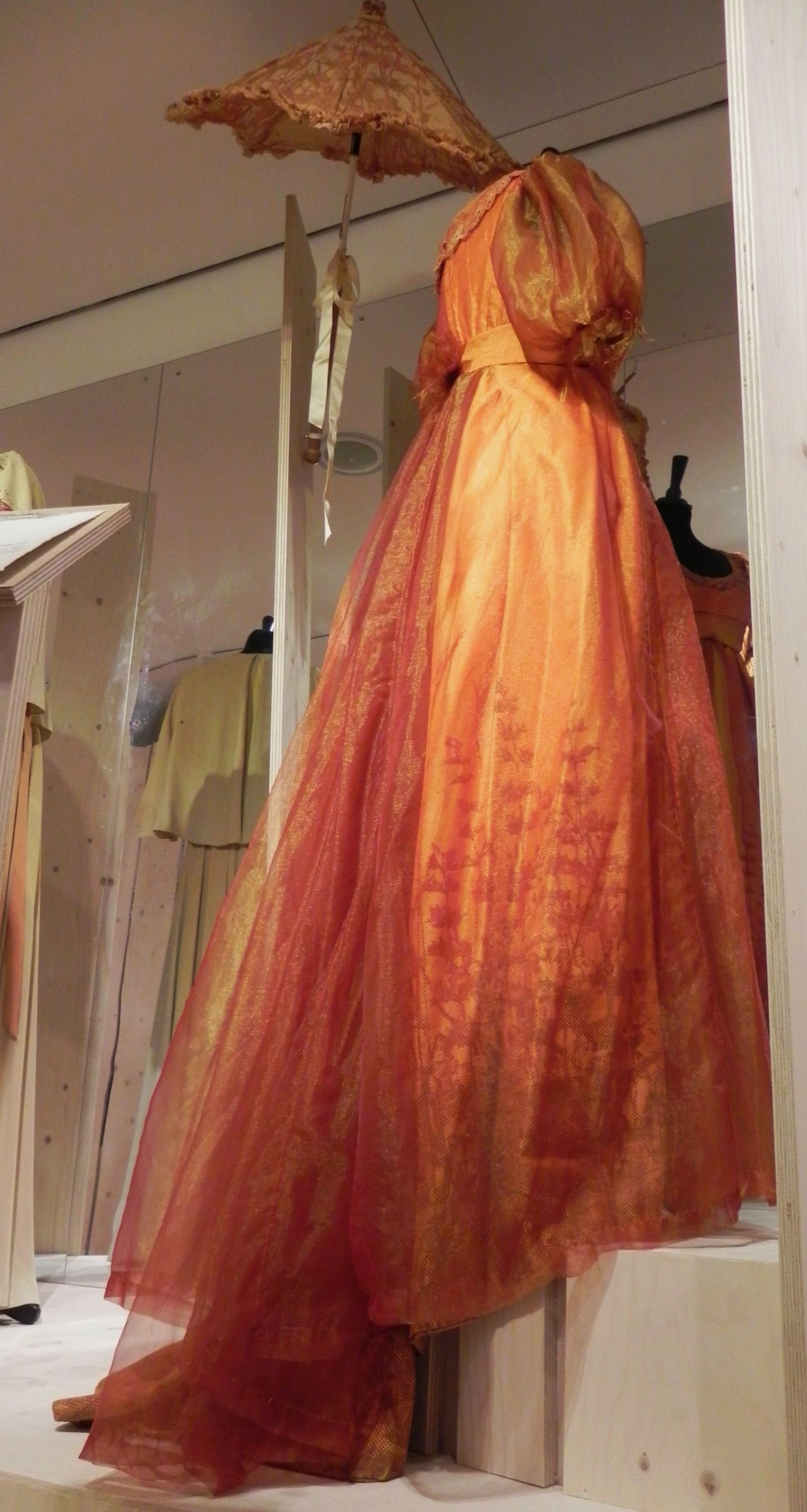
Estelle Kohler's costume as Rosaline

Estelle Kohler’s costume as Rosaline

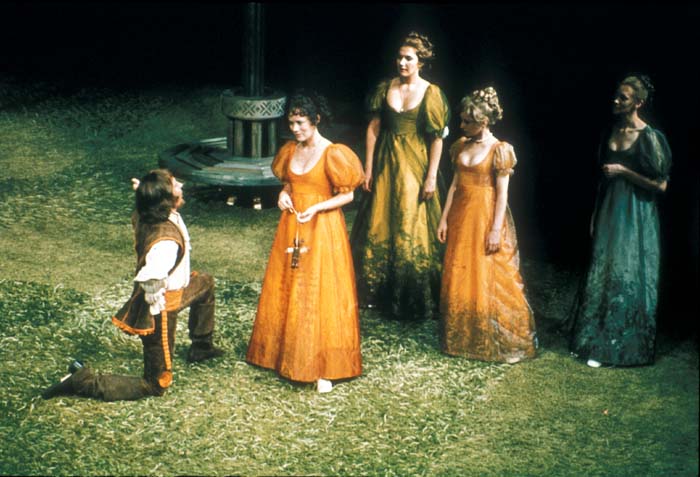
I’m revisiting the RSC’s Into the Wild exhibition again, where one of the costumes from the RSC’s 1973 Love’s Labour’s Lost is exhibited. It’s the formal version of Rosaline’s costume (Estelle Kohler) with a train and matching parasol. One of the production photographs shows her and the other ladies of the French court, including Susan Fleetwood as the Princess.

The lead designer for the production was Timothy O’Brien, along with Tazeena Firth. O’Brien joined the RSC in 1966 and his designs added to the success of many of the Company’s notable productions including John Barton’s Richard II and Troilus and Cressida and two productions of Love’s Labour’s Lost, the first in 1973 directed by David Jones, the second by Terry Hands.

Berowne (!an Richardson) kneels before Rosaline (Estelle Kohler). Behind her is the Princess, played by Susan Fleetwood and her ladies

Berowne (!an Richardson) kneels before Rosaline (Estelle Kohler). Behind her is the Princess, played by Susan Fleetwood and her ladies

His contribution has been recognised by his appointment as Honorary Associate Artist of the Company. As well as working with the RSC, O’Brien and Firth designed many important productions including the enormously successful musical Evita.

His designs can be distinguished by his use of intense colour in the costumes and the use of flowing, sensual fabrics in both costume and set. O’Brien was born in India, which may have influenced his use of fabric. These subtly set the mood, rather than adding architectural elements, leaving the stage free for the actors to work on.

The set for Love's Labour's Lost 1973 including the silk canopy

The set for Love’s Labour’s Lost 1973 including the silk canopy

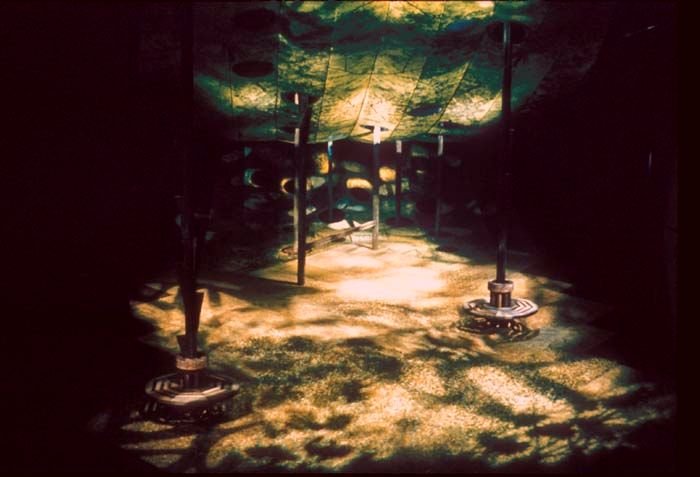
This can be seen in the 1973 Love’s Labour’s Lost where the major scenic element was a large printed silk canopy hung above the stage, and the ladies costumes were delicately printed with leaf motifs. The lighting added to the effect of a summery  outdoor glade in which the comedy played out. The photographs, particularly that showing the whole stage, demonstrates the sort of delicate effect which O’Brien and Firth were aiming at creating. You can also see the stage floor, suggestive of grassy turf, the wooden seats, and the simple lookout post used by Berowne when he is required by the text to hide in a tree to overhear his friends. The unadorned post ensured that Ian Richardson as Berowne was in full view of the audience. One of the poems read out during this scene perfectly describes the effect of O’Brien and Firth’s designs:
On a day – alack the day!-
Love, who’s month is ever May,
Spied a blossom passing fair
Playing in the wanton air.
Through the velvet leaves the wind,
All unseen can passage find;
That the lover, sick to death,
Wished himself the heaven’s breath. 

Here is a short sound clip of Roger Howells, Head of Stage at the time, talking about the design for this production and the work  of dying the fabrics which was carried out by the late Dorothy Marshall.

Share
Posted in Plays and Poems, Shakespeare on Stage | Tagged , , , , , , , | Comments Off on Into the Wild with Timothy O’Brien’s Love’s Labour’s Lost